Math for business
Although the workshop was first launched in 2020 at the Mathematical Center in Akademgorodok (under the aegis of Novosibirsk State University and the Sobolev Institute of Mathematics), it eventually extended throughout the country. According to the organizers, the mission of the project is to establish a nationwide network of mathematical centers and develop efficient communication between them.
The workshops have previously been held in Tomsk, Omsk, and Maykop (Adygea Republic) – and now in St. Petersburg. The event was hosted by ITMO University, one of the top IT universities in Russia. The university has recently opened the Institute of Applied Mathematics to amplify the mathematical training of students in the field of engineering and AI in particular, as well as in associated research and applied projects.
The event attracted 50 people from over 10 cities in Russia: Moscow, Krasnoyarsk, Perm, Saratov, Cherepovets, Khanty-Mansiysk, Ufa, Novosibirsk, Volgograd, and others. Among them were not only Bachelor’s, Master’s, and PhD students in mathematics and IT, but also teachers and even school students.
The project was supported by both educational institutions (Presidential Physics and Mathematics Lyceum No. 239 and Herzen University) and commercial companies that manufacture digital products, components, and devices for security and wireless communication systems, as well as those specialized in industrial non-destructive radiography (Sitronics KT, Terahertz Photonics, DKDPO, and Prodis.NDT.). The partners provided cases based on genuine research, methodological, and business tasks, as well as the necessary data and consultations for participants throughout the workshop.
“Businesses are increasingly embracing mathematics as they realize they cannot just enhance the capacities of their platforms; they need to reassess their approach to how processes are implemented. This is especially applicable for those working with AI and big data. It’s hard to find a solution without mathematical tools, and workshop participants are the ones who can provide unconventional ideas for our partners’ tasks. Furthermore, this is a way for companies to see that their requests can be met by means of mathematics,” stresses Svyatoslav Stumpf, an associate professor at ITMO’s Information Technologies and Programming Faculty.
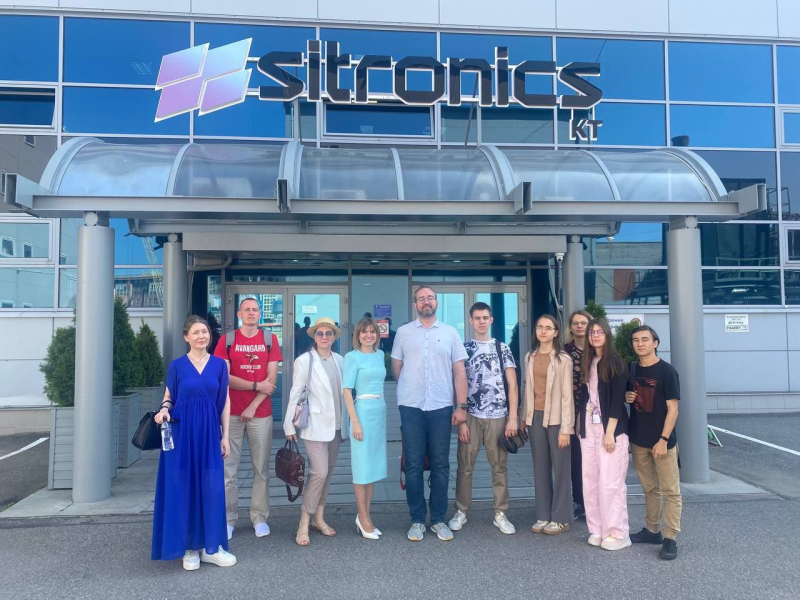
Participants of the Large Mathematical Workshop. Photo courtesy of the organizers
He adds that the workshop’s format benefits not only industry – but also the university, by allowing the latter to discover what competencies are in demand in today's market.
Real-world cases
The workshop was held as a two-week case championship – but without a competition and strict deadlines. Participants were divided into teams, each focused on a specific task and with access to any technology and tool. Moreover, they could seek assistance from curators, experts in mathematics, pedagogy, and IT, and their customers. At the end of the first and second weeks, teams defended their projects and received feedback from partner companies.
“Exposing our students to real-world business challenges is one of the major objectives of our workshop. For that purpose, participants were in constant communication with their customers: they requested data, shared interim results, and could clarify if they were on the right track. There were times when participants realized that their approach was not in line with the customer’s expected results and they had to synchronize and change their trajectory. This is a valuable lesson for students who are used to clear, step-by-step action plans in the classroom,” notes Anna Vozianova, an associate professor at ITMO’s Institute of Applied Mathematics.
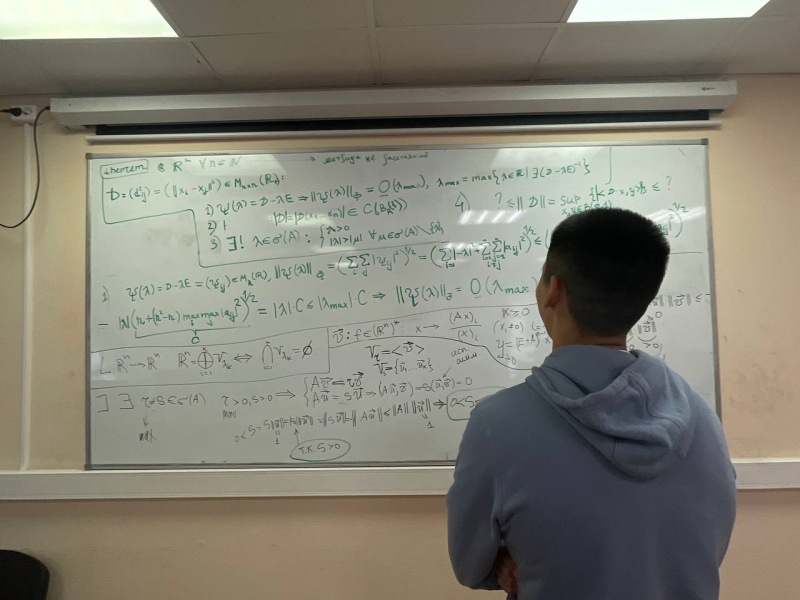
The Large Mathematical Workshop. Photo courtesy of the organizers
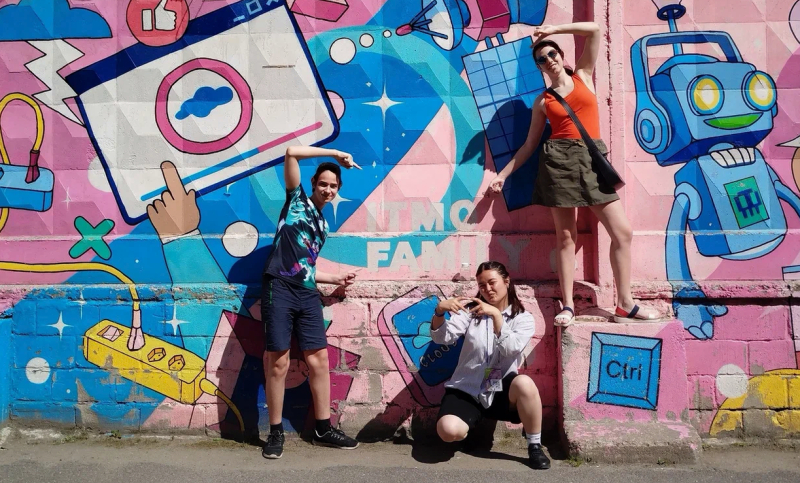
The teams also had the chance to visit the production sites and offices of the partner companies: Sitronics KT, ITMO’s Faculty of Physics, and the St. Petersburg branch of Steklov Institute of Mathematics. They took part in quizzes and business games, as well as joined ITMO’s annual summer festival – ITMO Family Day.
From a city ads analyzer to a geometry manual
During the workshop, participants got to work on nine projects across three tracks:
-
mathematics for life;
-
mathematics in ML and AI;
-
education and management.
The first team presented an algorithm that analyzes city images for compliance with the state requirements on advertising placement and design standards. The system scans photos from a variety of sources in real time, including surveillance cameras and video recorders on buses, and detects violations on signboards, posters, and advertising banners.
The participants of the second team created an LLM model to track company reputation rankings each week and anticipate future changes; additionally, the algorithm can distinguish between human and AI-generated reviews. An algorithm for automated design of neuromorphic computers was proposed by the third team. These computers are based on biological neural networks and are vital for creating processors that will make AI training faster and more efficient, as well as increase the performance of complex system modeling.
The fourth team suggested a model for simulating a quantum computer and building a system for searching for recipients in a 6G network. And the fifth one – a method for neural network training to detect defects in X-ray images of printed circuit boards during production. The project of the sixth team was a mathematical model that can determine how and to what extent big data can be compressed without loss.
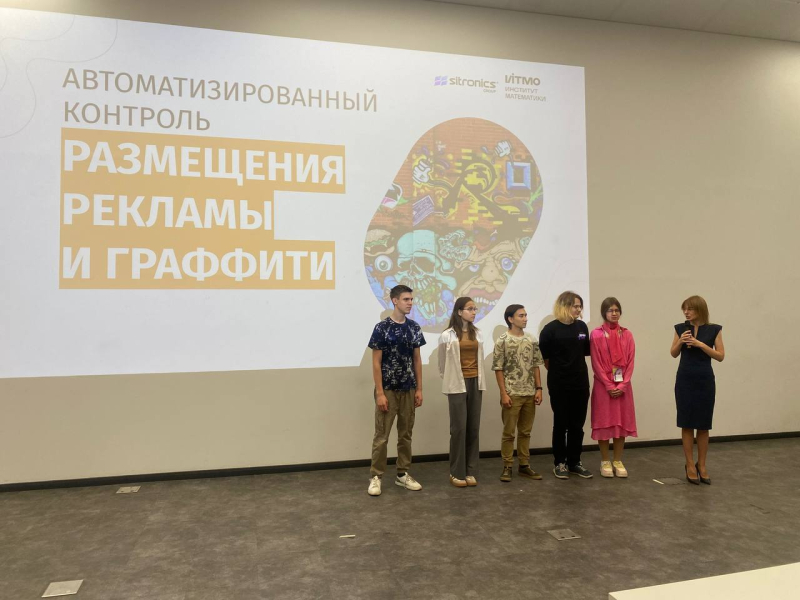
The Large Mathematical Workshop. Photo courtesy of the organizers
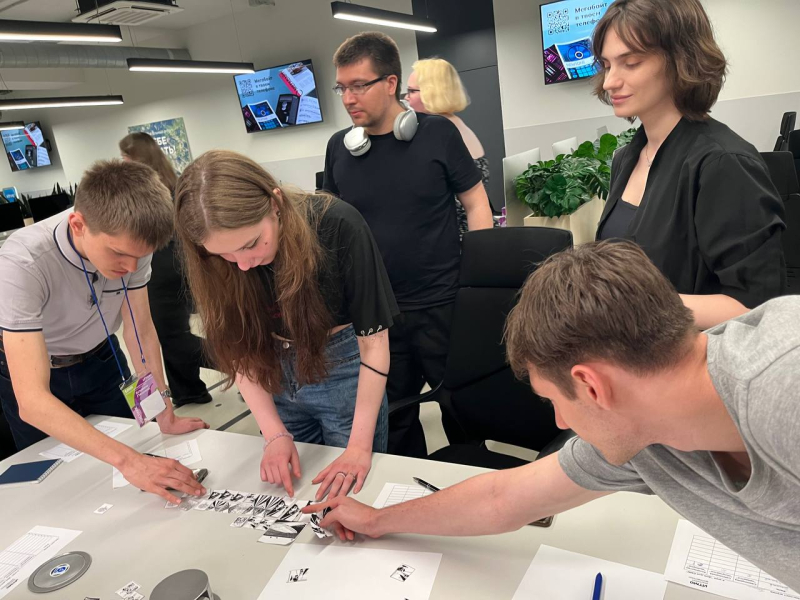
The Large Mathematical Workshop. Photo courtesy of the organizers
Other projects focused on the problem of mathematics training at schools. The seventh team presented a methodological manual on preparing school students for a geometry exam with practical tasks, flashcards, and a detailed study plan. The eighth team developed a professional development course for teachers called “Supporting Structures in Stereometry,” and the ninth – a manual on a new teaching method for schools based on non-Socratic dialogue; that is, a switch from passively receiving information to an active pursuit for answers.
Preparations for the workshop’s new season will start in the fall. From September to April, the organizers will be looking for partners and formulating a pool of cases for the participants of 2026. Applications will be accepted starting April.