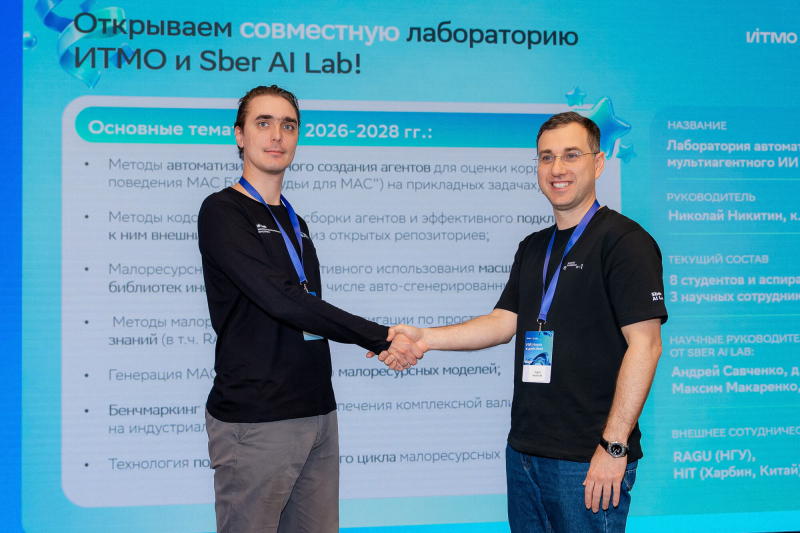
A regular AI assistant, like ChatGPT, is a single “employee” that conducts specific tasks. A multiagent system is a “team” of several agents that distribute tasks among them and work together. This team can solve more tasks than a single model; however, the more agents there are in a system, the more expensive its every launch is – and the more computational resources it requires, with the demand growing over time. This is the issue addressed at the new joint laboratory by ITMO and Sberbank’s Practical AI Center: the lab’s team aims to make multiagent systems quicker, cheaper, and more compact by relying on more energy-efficient models.
There are seven key research fields at the lab:
- Developing compact “judge” agents that assess the work of an entire team of AI agents;
- Developing methods that enable small models to select the appropriate tool from among thousands of available options;
- Code generation: models learn to write code used to build agents and integrate external tools from open-source repositories, without manual configuration;
- Training compact models to quickly locate relevant information in large databases and data graphs;
- Generating multi-agent systems using compact models;
- Creating open benchmarks and tools that companies can use to compare different AI systems and keep them up to date;
- Developing technologies that enable systems to operate under continuous, real-world deployment conditions.
“We publish benchmarks and code under open-source licenses, meaning they are available to all. The methods we develop are made for small language models with around 7 billion internal settings – that’s several times smaller than their large counterparts, which makes them less computationally demanding. This means our tools are accessible not only by corporations but by smaller companies, as well. We use the same principle when searching through our own database, the resource-efficient RAG; to make it even easier to use, we introduced our ideas into the already existing open-source interuniversity framework RAGU,” shares Nikolay Nikitin, the head of the new laboratory and a senior researcher at ITMO’s Institute for Artificial Intelligence.
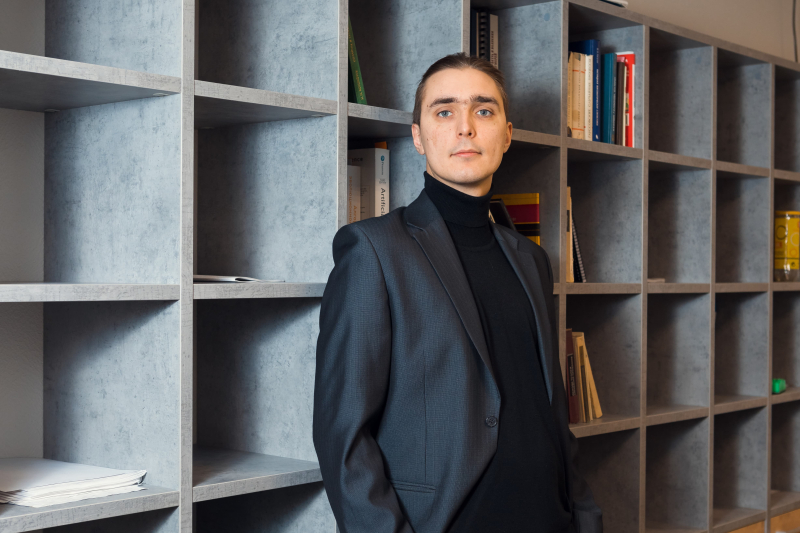
Nikolay Nikitin. Credit: Dmitry Grigoryev / ITMO NEWS
Such multiagent systems can be applied in various fields. For instance, in industry and engineering, they take on computations, technical data analysis, and project documentation verification; in finance and banking – data analysis, automatic decision making, and anomaly detection; in software engineering – writing, testing, and debugging code; in research – searching for information, literature analysis, and hypothesis formulation.
The Laboratory for Automated Multiagent AI was launched as a result of an open competition between young research teams of ITMO University that aimed to establish joint laboratories in contemporary AI. As per the competition’s rules, the lab’s team is now to prepare datasets and open benchmarks, develop methods for working with tools and databases, assemble prototype multiagent systems and bring them to real-world applications, as well as publish the results of their work.
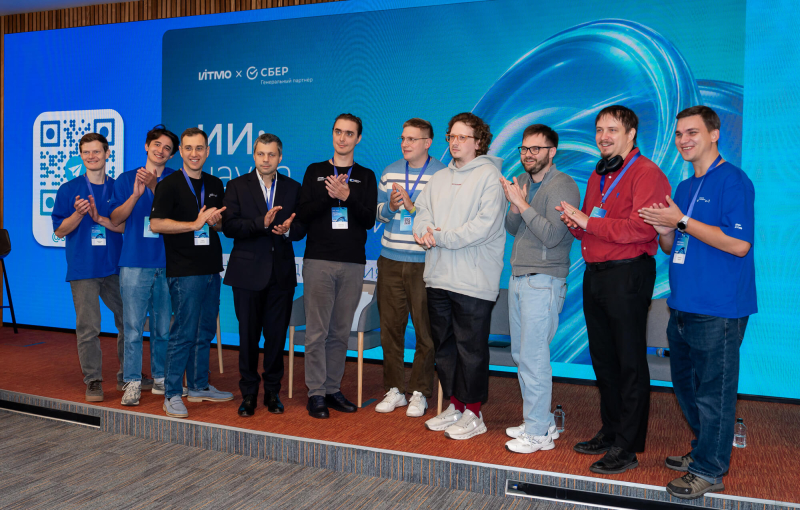
A part of these responsibilities will be taken on by the lab’s partner, Sberbank’s Practical AI Center, whose experts help select the research topics that hadn’t been pursued at ITMO and jointly develop them further. Additionally, the experts formulate and test research hypotheses, evaluate the developed solutions, contribute to publications for A* conferences, and provide access to their data and computational resources.
“Multiagent systems are a logical next step in business development. We are currently working on agent systems that don’t require expensive computational resources, while still achieving high accuracy in the domains relevant to the bank. This task requires serious research. Our center has always valued the synergy between science and business, and we hope that the new joint lab with ITMO will help us develop frontier technologies for multiagent systems,” says Nikolay Tiden, the senior managing director and director of Sberbank’s Practical AI Center.
From ITMO’s side, the core of the team is made up of three researchers and eight Master’s and PhD students. Representatives of other units of the Institute for Artificial Intelligence and students, for instance those from the AIST Lab, are also invited to join the project. The lab is looking for specialists with skills in developing and testing agents; interested candidates should email the head of the lab at nnikitin@itmo.ru with descriptions of their experience and projects.