Primary colors
Every language has its Roy G. Biv – a handy little mnemonic to help speakers keep track of all the primary colors. In the case of Russian, an acronym would be out of the question: have fun trying to say КОЖЗГСФ (“KOZhZGSF”) out loud! Instead, there is an amusing sentence that goes like: каждый охотник желает знать где сидит фазан (“every hunter wishes to know where the pheasant sits”), each word corresponding to a color starting with the same letter. These are:
- Красный (krasnyi – “red”);
- Оранжевый (oranzhevyi – “orange”);
- Желтый (zheltyi – “yellow”);
- Зеленый (zelenyi – “green”);
- Голубой (goluboi – “blue”);
- Синий (siniy – “indigo”);
- Фиолетовый (fioletovyi – “purple”);
Take special note of the pairing of голубой and синий. Even though they correspond to blue and indigo on the classic color scale, it is the latter that’s more often translated into “blue” between the two languages. But unlike indigo, a color that stands out as a less “mainstream” option on the English-language list, голубой is an “everyday” color, so to speak – so much so that there has been linguistic research on the subject, with scientists finding that Russian speakers are more apt at discerning between lighter and darker shades of blue.
Colorful words
The morphological nature of Russian, with its often-daunting number of prefixes and suffixes, also means that you can pretty easily make nouns out of colors! Some that you may or may not be familiar with include:
Краснуха (krasnukha) stands for measles – a nasty virus you never want to experience, especially when abroad. Hence, be sure to follow the vaccination guidelines for international students at ITMO!
Оранжерея (oranzhereya) is the word for an orangery, which is itself nothing more than a really fancy greenhouse. Read about the origins of this word in our curious Russian etymology article.
Alexander Makovsky's 1916 painting Easter Table. Just look at all those colors! Credit: Wikimedia Commons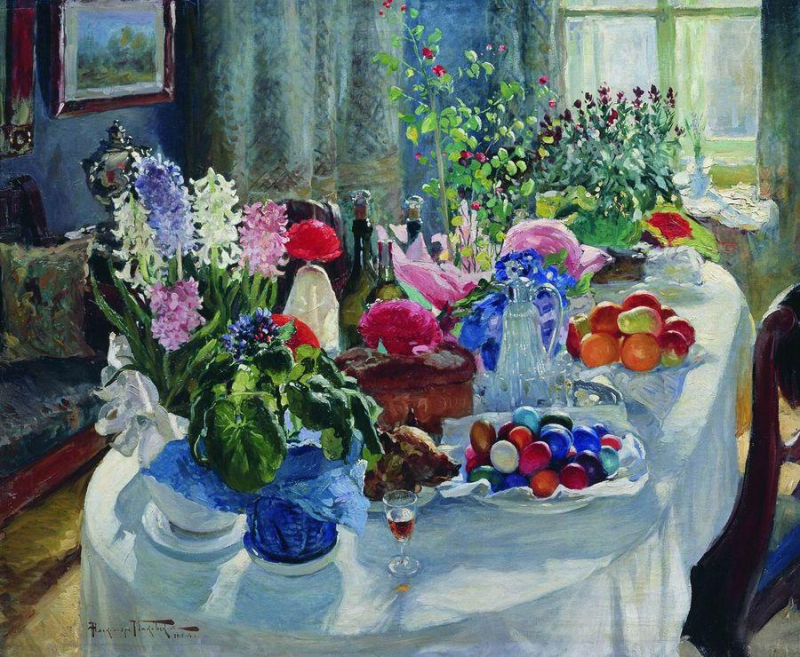
Желток (zheltok) is yolk, aka the best part of an egg – and, naturally, the yellowest. Just earlier this month, the nation went egg-crazy for Orthodox Easter, which ITMO NEWS celebrated with a guide to Easter in Russian art.
Зелёнка (zelyonka) is brilliant green, an aptly-named essential in any Russian first aid kit, which we’ve written about here. Bonus: note the appearance of the funky letter Ё.
Голубика (golubika) is bilberry, a tasty little fruit that’s often confused with the blueberry. In the north of Russia, both are in season around July, which is pretty soon – be sure to check out our summer fruit guide!
Синева (sineva) is, when translated literally, blueness. In colloquial speech, however, it usually refers to a clear blue sky – one you may associate with St. Petersburg’s iconic White Nights.
Ультрафиолет (ultrafiolet) is a single-word counterpart to ultraviolet light. Handy, isn’t it? Indeed it is, especially if you find yourself at ITMO’s Museum of Optics, where UV lights are used to a spectacular result at the dedicated “selfie room.”
To go on a color journey of the Northern Capital, check out our Rainbow of St. Petersburg feature. For even more handy materials for Russian learners, click on the Russian language tag.