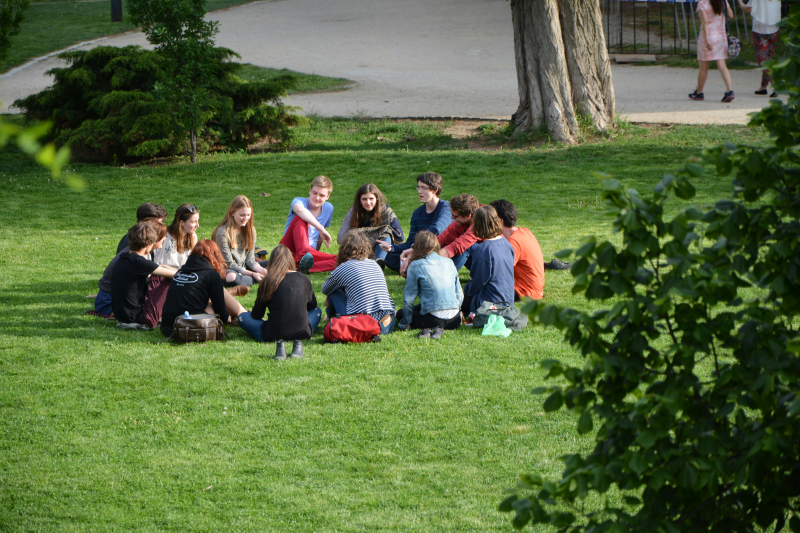
Some people seem completely confident in group settings but struggle to maintain a one-on-one conversation. Others are great public speakers but get anxious in new surroundings. So there’s always room to improve your social skills. And that’s exactly what we tried to do.
How it started
We met weekly for a month. First, we discussed what exactly our fears were and why we wanted to improve our social skills.
This is a very vulnerable topic for many people. It wasn’t an easy conversation to have with a group of strangers. But it was worth it. The shared conclusion we reached was that connecting with others helps you get out of your own head, broaden your horizons, and, overall, just be happier.
Challenges we had to face
Our self-improvement journey continued with daily challenges to complete on our own. The list ranged from socially acceptable to pretty eccentric, for example:
-
Complimenting strangers, or smiling while making eye contact with them
-
Asking someone in headphones what song they're listening to
-
Loudly citing poetry in a public place
-
Asking to retie someone else's shoes
We rated each task on a scale from one to ten based on how anxious it made us feel, then picked one to complete during the week.
At this point, many of us stalled by choosing tasks that sounded exciting but turned out to be too intimidating: around 6 or 7 out of 10.
If you'd like to try a similar experiment, I'd suggest starting with the easiest task for you and working your way up once you've gained some momentum.
The goal is to repeat these tasks regularly and build confidence in situations that make you slightly uncomfortable. My pick was asking strangers if I could pet their dog. It’s something I feel tempted to do on a regular basis anyway. But my very first attempt failed, and not because the owner said no, but because the dog almost bit me. Oh well. You have to respect their boundaries.
Other club members had more luck, and their stories inspired me more than my own. Someone complimented dozens of people. Others found the courage to ask for refills, dance in the street, high-five passers-by, and yes, even offer to tie a stranger's shoes for no reason at all (plot twist: they agreed).
Biggest insights and wins
The biggest lesson I learned from the experience is that strangers, as we say in Russian, "don't bite" (unlike dogs). Not everyone will want to have a conversation with you. Someone might even be rude. But it's usually not about you.
The more experience you gain, both positive and negative, the more your confidence grows. The key is to keep exercising your social muscles.
But it's one thing to know all this in theory. After years of social anxiety, stepping out of your comfort zone isn't that easy.
Encouraged by our community, I did the unthinkable: attended a big event all alone, introduced myself to someone I wanted to meet, complimented strangers (and got complimented myself, by the way), had multiple small talks, and overall felt much more comfortable than I usually do in these situations.
The verdict: understanding your fears, practicing regularly, and having the support of like-minded people really does help. Easier said than done, of course. But if we were able to conquer at least some of our fears, so can you.
How to practice yourself

Credit: ITMO.NEWS
Don't be afraid to face your fears one small step at a time to work on your social skills. Come up with a challenge, practice regularly, and feel free to take breaks and recharge. Progress will come sooner than you think.
If you'd rather not do it alone, ITMO is a great place to find people who'll cheer you on. Browse the university's student clubs and pick one that matches your interests. A speaking or debate club can be a great way to build confidence in social situations, but honestly, any community where you feel welcome is a good place to start.
Looking for ideas? Check out our Ultimate Guide to Finding Your Third Place (and Your People) in St. Petersburg for more ways to meet like-minded people.