Sword Kladenets
Used as: magic weapon
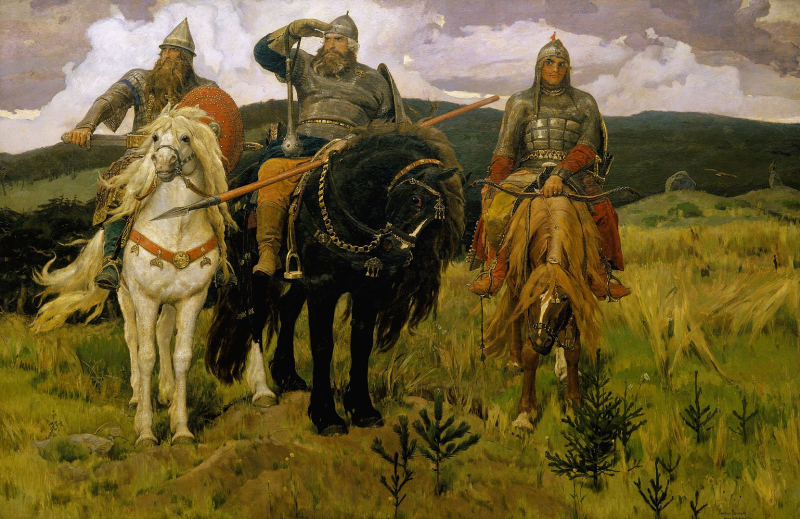
Bogatyrs, who are essentially the superhero knights of Russian folktales, have immense powers of their own, but also carried special weapons to enhance them. Two of the most well-known bogatyrs, Dobryna Nikititch and Ilya Muromets, were said to have possessed the sword at some point. Some tales also describe the weapon as capable of cutting through space and matter alike; curiously, just like many mythical swords around the world, Kladenets can only be carried by a worthy warrior. Another curiosity for etymology lovers: while some experts believe the name Kladenets is related to klad (a hidden treasure) – which would mean it was a coveted object only to be found by its discoverer – others connect it to ukladny (an old word for made of steel).
Self-replenishing tablecloth (скатерть-самобранка)
Used as: movable feast
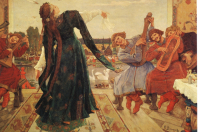
Who wouldn’t want a tablecloth that can set the table and then clean up all on its own? At Hogwarts, these tasks were accomplished by the untiring house elves, but in Russian fairy tales the tablecloth possesses a magic of unknown origin. Folklorists speculate that these powers had to be connected with the world of the dead, where food is always aplenty.
Silver saucer and juicy apple (серебряное блюдечко да наливное яблочко)
Used as: hidden camera
These days, we have technology at our fingertips that allows us to look into almost every corner of the world. Russian fairy tales offer a more ingenious solution: a ripe magic apple that, once rolled on a silver saucer, transforms into a screen of sorts, giving the user a glimpse of distant lands or someone in particular (the perfect spying gear!).
Needle, Koshchei’s death
Used as: good guy’s secret weapon
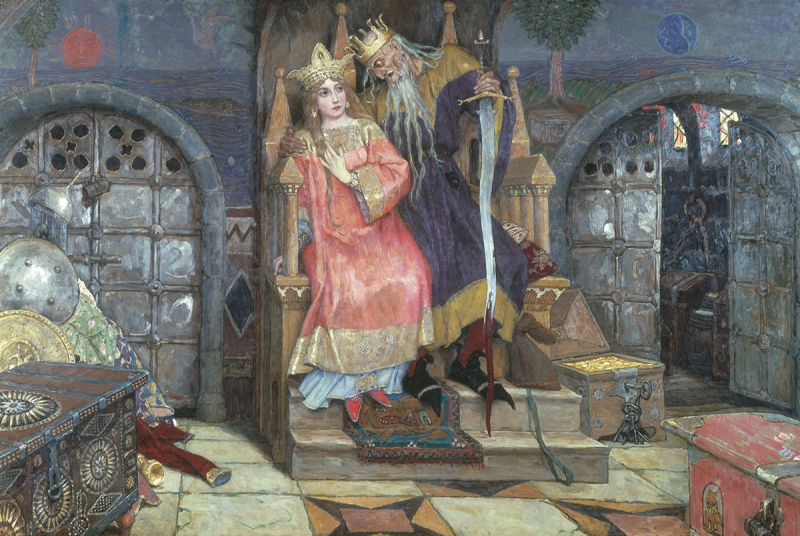
Kashchey the Immortal (Koschei the Deathless). Author: Viktor Vasnetsov. Credit: Wikimedia Commons (public domain image)
We’ve talked about the superheroes, but their archenemies, of course, also have magical objects to their aid – however, in this case, often used against them. Koschei the Deathless, the horrifying yet seemingly frail aged wizard, hid his death in a needle, the needle – in an egg, the egg – inside a duck, the duck – inside a hare, the hare in a chest, and the chest – typically in some faraway and dangerous location. Needless to say, this Matryoshka-like contraption still can’t protect him, but the hero’s pursuit of each successive layer is glorified in the tales.
Mortar
Used as: Baba Yaga’s flying machine
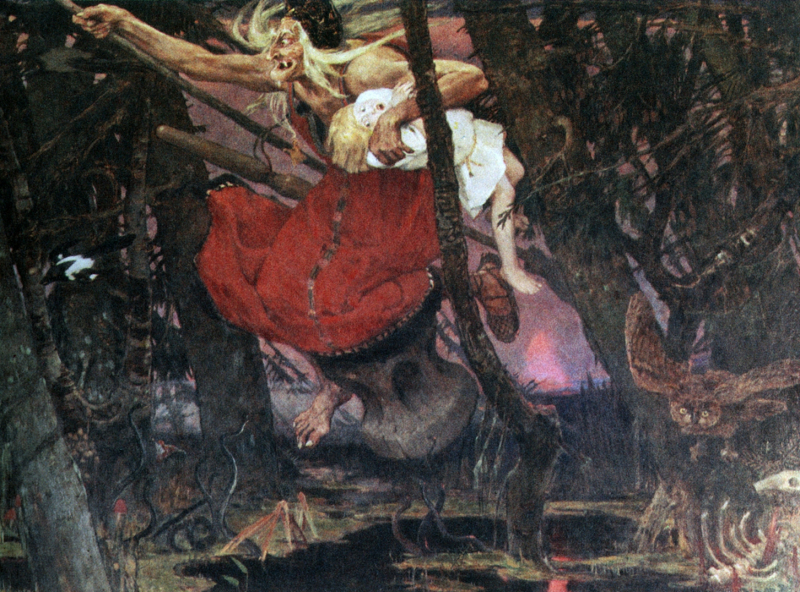
Baba Yaga. Author: Viktor Vasnetsov. Credit: Wikimedia Commons (public domain image)
Now to something more useful: Baba Yaga, Koschei’s female counterpart who is prone to capturing – and eating or, sometimes, helping (if she’s in the mood) – young children, has a rather unconventional means of transport. She flies a mortar that she controls with a pestle. However, she also has a broom – to erase her tracks so that no one can follow her to the chicken-legged hut deep in the dark-dark forest.
Self-moving stove
Used as: transportation for the lazy
Speaking of transportation, have you ever travelled on a stove? The lazy Emelya from At the Pike's Behest famously had: his stove was magicked into movement by a pike fish that the young man granted mercy. Why would he ask for such a weird means of transport? Well, you see, he didn’t want to get off the stove (comfortably warm in the winter), so – how else would he travel? Would you be surprised to learn he gets the girl and one-ups the king in the end? Sometimes, fairy tales don’t have the best of morals.