According to experts, 600 million tons of animal by-products are annually produced in Russia. Conventional composting takes 3-12 months and results in significant nutrient loss: half of the contained nitrogen is released into the atmosphere, while phosphorus is washed into soil and subsoil waters. Moreover, in Russia animal by-products are classified as type 3-4 waste, with enterprises taxed for their emission as they have a negative impact on the environment. However, internationally produced processing systems are expensive and are often unfit for Russian types of waste because of its more humid, heterogeneous, and fibrous structure. On the other hand, the devices developed in Russia rarely go into serial production, remaining at the stage of patents or prototypes.
“Organic waste is the most widespread and at the same time hardest for processing because of its heterogeneous contents. For instance, the same restaurant can produce different types of waste depending on the day: one day it’s acidic fruit, another – meat and fish with different properties. At the same time, any fermentation is done by microorganisms and our task is to create a comfortable environment for them in terms of oxygen, temperature, and humidity, so that they can efficiently handle waste regardless of contents,” explains Roman Uvarov, the developer of the biofermenter and an associate professor at ITMO’s Faculty of Biotechnologies.
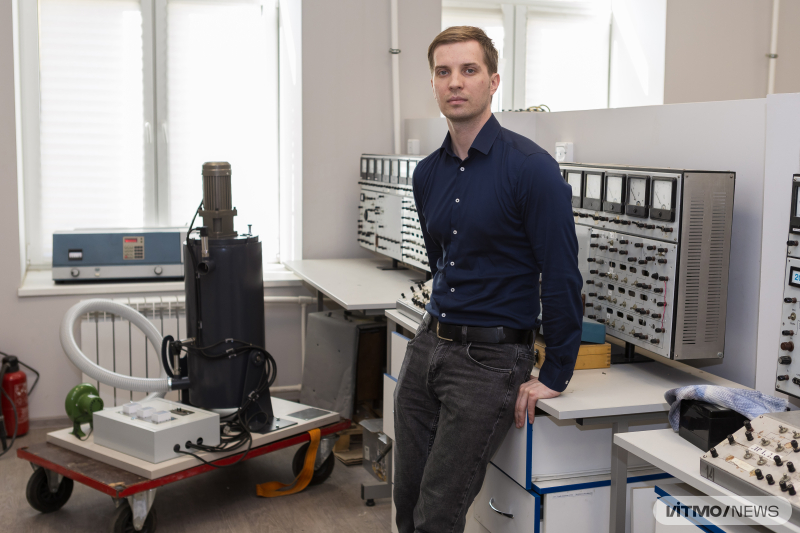
Roman Uvarov. Photo by Dmitry Grigoryev / ITMO NEWS
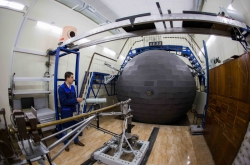
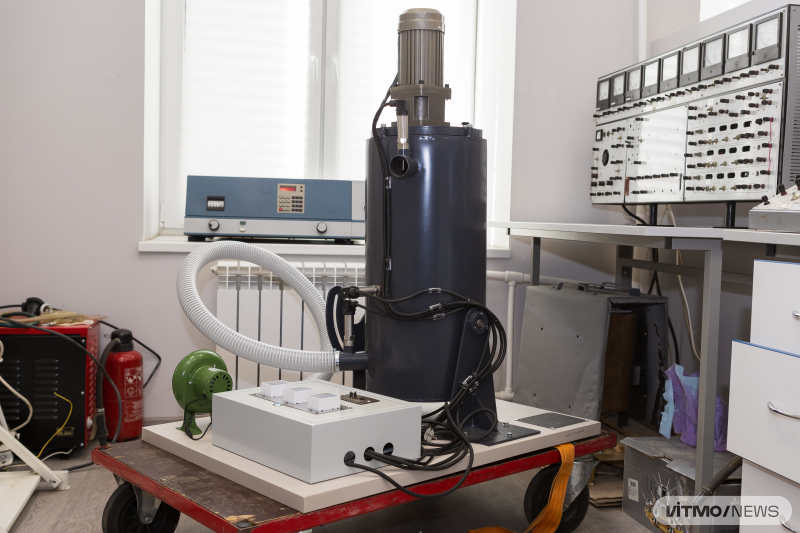
Together with collaborators from ITMO’s School of Life Sciences, Dr. Uvarov built an automated closed-type biofermenter based on a rotating drum that periodically stirs the waste. Unlike similar units, where the drum is rotated continuously, this system uses a cyclical mode. Rotation at 1-2 revolutions per minute is switched on every few hours to homogenize the mixture, oxygenate the mass, and ensure even warming so the fermentation proceeds faster. This mode was not used before because the system’s international analogs are designed for drier, more homogeneous feedstock that compacts when the drum stops. Russian waste, however, with its high moisture content and fibrousness, allows for pauses without losing aeration. The unit consumes no more than 6 kWh of energy to process a ton of biowaste, roughly 20 times less than comparable foreign systems.
The fermentation process itself is based on an aerobic thermophilic stage: the organic material self-heats to 55°C due to microbial activity and is maintained at that temperature for 24 to 72 hours. The thermophilic regime destroys pathogenic microflora, weed seeds, and parasite eggs, and the closed working chamber prevents hazardous ammonia, methane, and mercaptans from escaping. The final product has a state standard certification as an organic fertilizer thanks to minimal nutrient losses during fermentation: nitrogen content drops by only 4-8% and phosphorus by only 0-1.5% of the initial level. These results were achieved thanks to the cyclical rotation mode, adapted specifically for Russian types of organic waste.
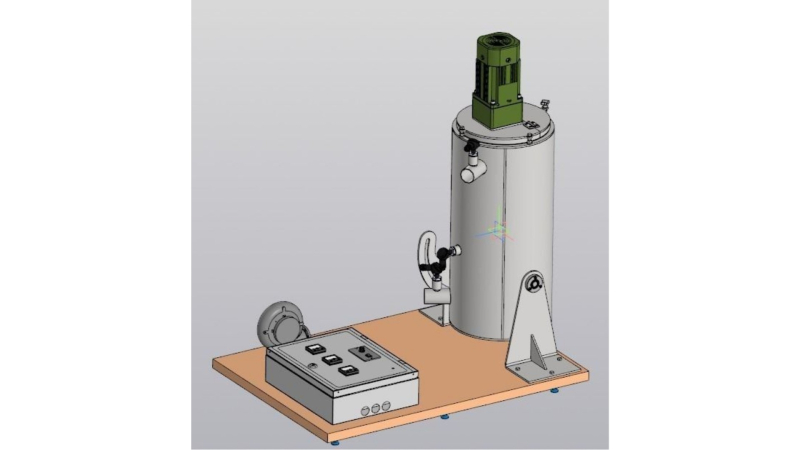
A 3D model of the fermenter. Image courtesy of Roman Uvarov
There are two available modes: cyclical (load-fermentation-offload) and continuous, when part of the processed product is collected and new raw materials are added in the process. In the second mode, the device proceeds to active fermentation in four hours instead of 12-18, as the warmth from the already processed biowaste is transferred to the newly loaded mass.
As the fermenter consists of several modules, it’s mobile and can function even at a standard utility room in remote territories, where waste transportation is expensive. The result of fermentation is a fertilizer that can remain on the soil without a negative impact on the environment.
The technology passed expert verification and was included in three Ministry of Industry and Trade of the Russian Federation lists of best available technologies – for poultry and hog farming, as well as municipal solid waste processing. Additionally, the project was presented at the St. Petersburg International Forum Ecology of Big City and in 2025, the team won a 1.5-million-ruble Russian Science Foundation grant (No. 25-28-00955).
“The industry is interested not in a standalone device but rather a complex solution. We are working on closing the cycle: from solid waste processing and liquid runoff purification to neutralizing gas emissions. Currently, within a practice-oriented R&D project we are working on a gas emission purification module: it’s a compact chamber with atomizers that absorb substance from vapor and a solid-circuit additional purification filter. The process is managed automatically, with exit and entry concentration control. This will make it possible to install fermenters directly on industrial premises without the need to worry about exceeding the maximum permissible concentration of malodorous substances,” adds Roman Uvarov.
Dr. Uvarov started developing the device while working at the Institute for Engineering and Environmental Problems in Agricultural Production with support from the Foundation for Assistance to Small Innovative Enterprises. At this stage, the engineer created the first prototype, founded an LLC, and started collaborating with engineering plants. In 2021, Dr. Uvarov started working at ITMO’s School of Life Sciences, where he put together a team of engineers, chemical engineers, and ML specialists; here, he also assembled a scientific fermenter. Dr. Uvarov’s industry partnership resulted in a series of industrial fermenters ranging from 3 to 40 cubic meters in volume. The largest one is used on a farm in the Priozersk district of Leningrad Oblast and can process up to 40 cubic meters of manure in a day; this means that the farm can fully process its waste without transporting it to landfill or fields. Smaller fermenters are located on the Kamchatka Peninsula, in the Chukotka Autonomous Okrug, in Yaroslavl Oblast, and at a food waste processing plant in St. Petersburg.
Next, the fermenter will be equipped with AI systems for online monitoring and automatic processing management. ITMO programmers are collaborating with the scientists to develop computer vision algorithms capable of determining the fermentation stage based on imagery, as well as predicting the optimal off-load moment. This will additionally decrease the time of one cycle by 15-20% and reduce energy consumption related to use of the drive and fans.