The Russian Robotics Olympiad is an annual national competition that has its participants solve engineering tasks based on the regional and industrial demands of the host region. This year, the contest was held in Orenburg and welcomed a total of 3,500 school students from 50 Russian regions. 325 teams proceeded to the finals. The competition was supported by Gazprom Neft, Yandex Education, StarLine (developer of smart car security complexes), DNS (consumer tech retailer – Ed.), and others.
This year’s topic was the development of robotic projects for the preservation and study of Russia’s natural reserves, parks, and other conservation areas. ITMO's youth robotics team competed in the senior creative category. There, teams had to come up with solutions that would help monitor the state of ecosystems and prevent environmental threats in conservation areas.
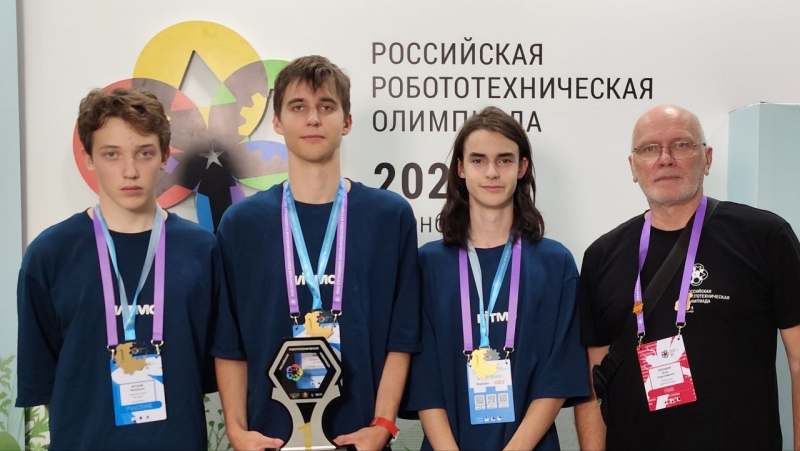
Since January, the team had been studying ecosystems, engineering their robot, writing algorithms, and assembling the system. The project team includes Alexey Kirsanov, Arseny Filimonov, and Evgeny Ivanov, and is supervised by Igor Lositsky, the head of ITMO’s Youth Robotics Lab.
The laboratory's projects are implemented at ITMO in partnership with the Presidenial Physics and Mathematics Lyceum No. 239
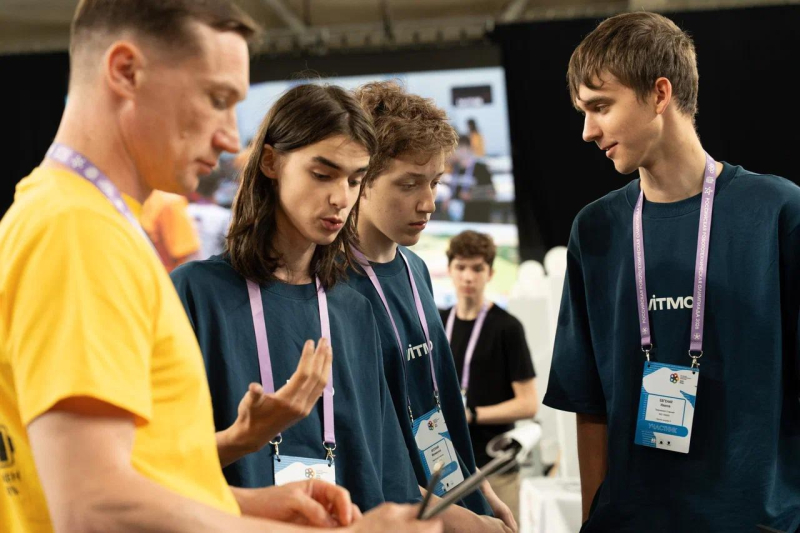
The team of the Youth Robotics Lab at the Russian Robotics Olympiad. Photo by Alexey Filimonov
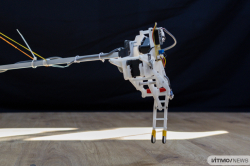
As a result, the trio produced an autonomous robot that can detect waste and collect it. The robot can traverse uneven terrain using a lidar, which can also detect trees and other obstacles, as well as build a map of the area. With the built-in AI camera, the robot can separate waste from natural objects like leaves, stones, and plants. Having detected waste, the robot approaches it, captures, and places it in a bin. Additionally, the robot can follow a specified route using GPS.
Projects were evaluated based on several criteria, including relevance, novelty, technical difficulty, presentation quality, and aesthetics. The team from ITMO scored highest in its category and took the first place. Winners received trophy cups, medals, and a partner prize – a robotic dog that can be programmed for various tasks.