The discussion “Robots + AI: What Should We Learn and Where to Create the Future?” was moderated by Daria Kozlova, the Director for Strategic Development at ITMO. It started with the idea that physical AI is a rapidly developing field that requires an interdisciplinary approach and a new structure for educational programs.
Sergey Kolyubin, the head of ITMO’s International Laboratory of Biomechatronics and Energy-Efficient Robotics, talked about the scientific challenges of physical AI. He specified that this concerns not only robots, but also a broader field where algorithms learn to understand the global context of natural laws. Such AI systems exist without embodiment, as well; for instance, in climate research or chemical calculations. When discussing machines interacting with their surroundings, the term “embodied AI” is more accurate.
As for frontier research in embodied AI, it primarily focuses on spatial intelligence – the capacity of AI to understand its surroundings and available tools. Two more complex aspects are decision-making and sensorimotor coordination.
One serious challenge for embodied AI researchers is the search for training data. Sensory experience and the understanding of various information types are crucial, but the amounts of data needed to train embodied AI are colossal – and they can’t be acquired from “ready-made” information. For this purpose, researchers either turn to video archives or generate videos. Physically accurate images are critically important for training robots and thus generating such resources is one of the foremost tasks.
Solutions to these challenges find their industrial applications today. Apart from delivery robots, which have become quite common, one actively developing area is of robotic manipulators.
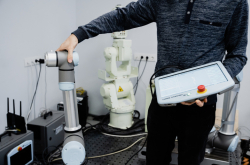
“At ITMO, we are focusing on contact manipulation: that is when robots have to not only pick up and move an object but perform some more complex actions with it – for example, fold clothes, lay a cable, or place test tubes in a lab in a particular order. There is a multitude of such scenarios and thus the benefit of embodied AI is its universal applicability. As soon as we find a solution that can be used in a great number of scenarios, we get a massive economic effect because we don’t need to develop a new system for every task. This universal robot configuration would be a paradigm shift,” says Sergey Kolyubin.
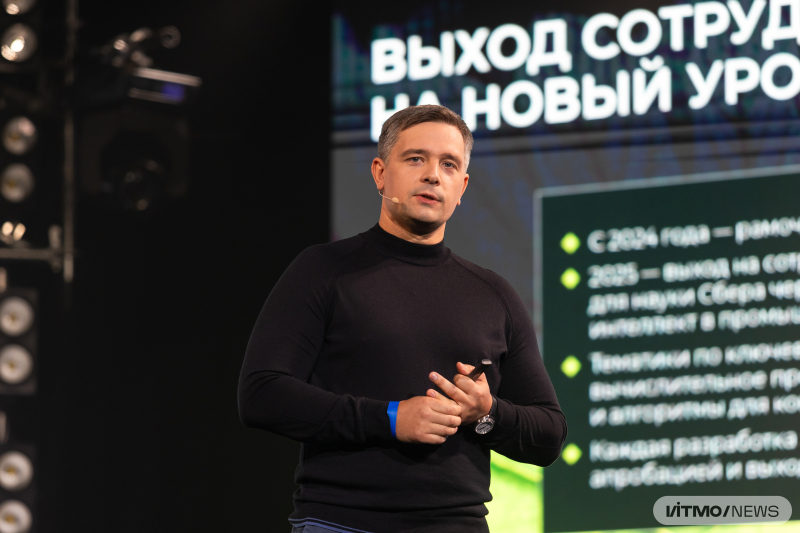
Sergey Kolyubin. Photo by Dmitry Grigoryev / ITMO NEWS
Developing humanoid robots, on the other hand, presents more technical difficulties than economic value. However, according to Dr. Kolyubin, working on such devices creates teams capable of taking on harder challenges.
“The community now developing physical AI has formed from classic AI and computer vision experts who saw a new research area. In their turn, robotics researchers realized the value of new methods and the reciprocity of this development – robotics and AI develop each other. Thanks to this synthesis, decision-making systems acquired a strategic level: they learn to understand the sequence of actions and make decisions. Now, fully automating processes using robots has become a reality,” adds Dr. Kolyubin.
Another challenge, this time for higher education, is training interdisciplinary specialists capable of developing physical AI. Alexey Shpilman, the director of artificial intelligence development at T-Technologies, believes that the advance of AI brought on a crisis in science and the classic educational model.
“Earlier, publications were believed to be the outcome of scientific research. Now, because of AI we have more papers – but these papers are read by AI, too. More and more we are coming to the conclusion that what we need is a result, that science should not turn into just a paper generator but should contribute value instead. We need to teach our students to be curious, learn to ask interesting questions, and look for answers. Whereas AI can help with generating ideas, only humans can deliver results that would also be economically profitable,” states Alexey Shpilman.
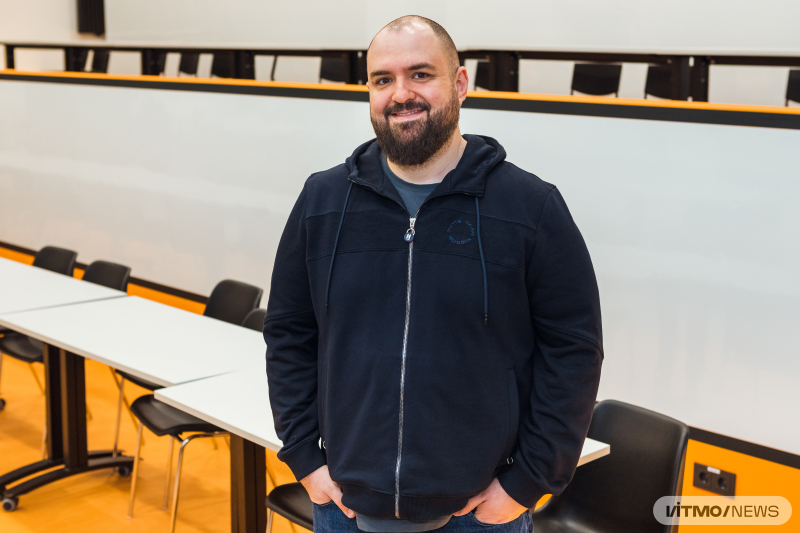
Alexey Shpilman. Photo by Dmitry Grigoryev / ITMO NEWS
The country’s leading universities have already understood the importance of teaching physics to IT students. It’s particularly crucial for future embodied AI experts to see where they’ll be able to use the skills at the intersection of these two sciences, according to Konstantin Kogos, the director of the Institute of Intelligent Cybernetic Systems at the National Research Nuclear University MEPhI. One educational program focusing on industry-based practical training in physical AI was launched by Yandex in 2025 in collaboration with ITMO, HSE University, Moscow Aviation Institute, National Research Nuclear University MEPhI, and MIPT.
At ITMO, this initiative is a special track of the Bachelor’s program Robotics and Artificial Intelligence. Among the track’s perks is the opportunity to work at a Yandex office and use the company’s resources for your engineering projects, as well as the option to create teams with students of other participating universities.