Many molecules exist as two mirror-symmetrical forms. They resemble each other like the left and right hands: they look almost identical, but cannot be superimposed. This property is called chirality. Despite having a fully identical chemical composition and structure, different forms of the same molecule can possess different properties: one can have a therapeutic effect, while the other can be less effective or even cause undesired side effects.
That’s why when developing medicines, it’s important to control the synthesized molecular form. For this purpose, chemists use chiral carbon nanoparticles that interact differently with “left” and “right” molecules and thus can act as sensors. However, the majority of such structures can act as sensors primarily in water solutions; in organic media, on the other hand, they don’t spread evenly and have a tendency to aggregate, leading them to lose their properties. At the same time, many chemical transformations, including those necessary for medicine synthesis, happen in organic solvents. That’s why scientists are developing materials that won’t lose their properties in such conditions.
Researchers from ITMO University have suggested a new approach to developing such materials. Typically, such nanoparticles are produced by attaching chiral molecules to the surface of a pre-existing carbon structure. However, this synthesis method is mainly used in aqueous media, and the surface modified in this way has relatively low stability.
In their study, the researchers used a fundamentally different approach: they introduced chiral fragments into the carbon matrix during synthesis. This made nanoparticles more stable and allowed them to keep their optical properties even in organic solvents.
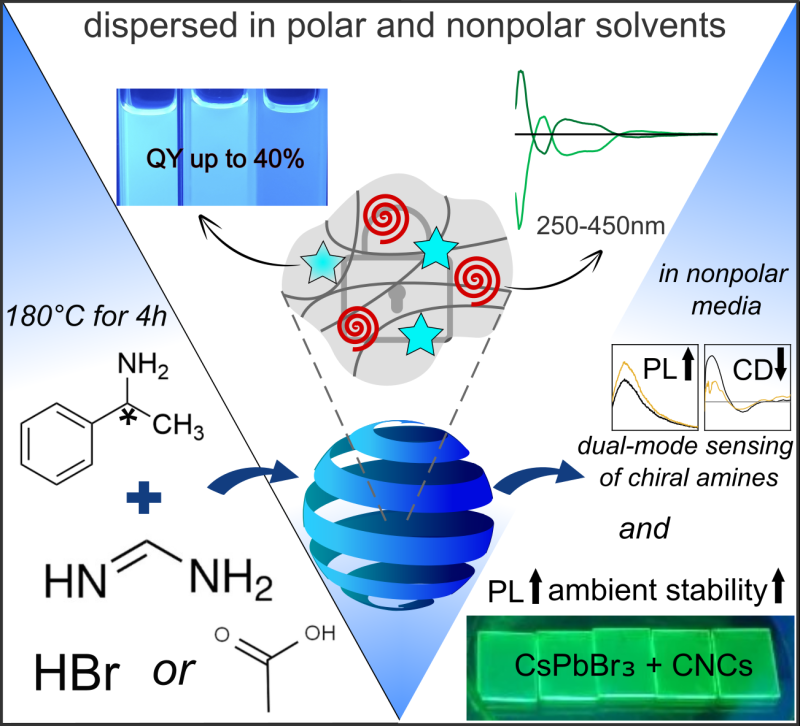
A schematic of chiral carbon nanoparticles and their application as optical sensors and components in fluorescent materials. Credit: Russian Science Foundation
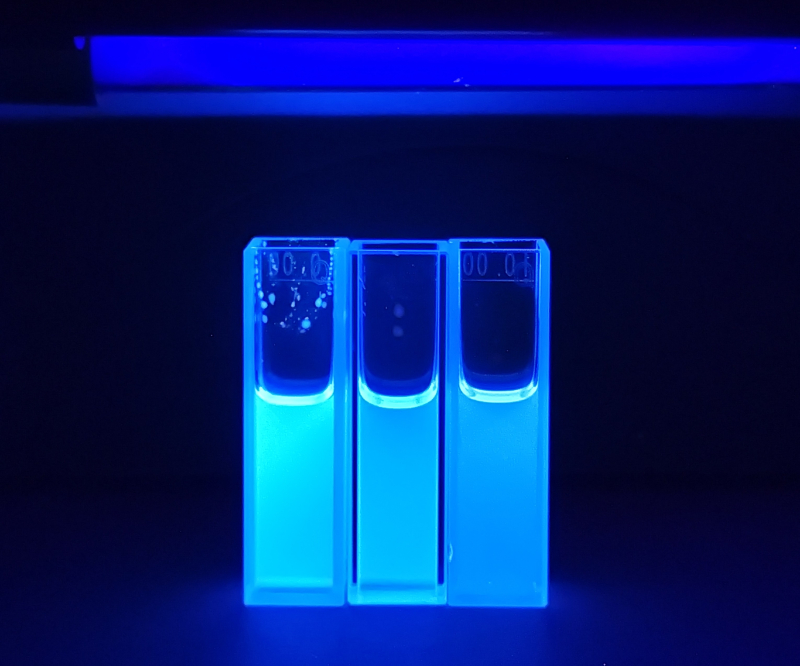
Subsequent analysis demonstrated that the acquired particles are about 5-10 nanometers in size – which is about 10,000 times thinner than a human hair. They also demonstrate two optical properties: they fluoresce brightly under ultraviolet light and absorb left- and right-circularly polarized light differently. This means that the nanoparticles interact differently with light whose direction of rotation is reversed. As a result, they make it possible to use two independent optical signals to identify chiral compounds: fluorescence and changes in absorption.
The research team has tested the material in toluole, one of the most widespread organic solvents. The nanoparticles changed their optical properties in the presence of “mirror” organic molecules, allowing the researchers to easily detect them. This confirms that the nanoparticles will be applicable in fields that work with predominantly organic solvents, such as optoelectronics and pharmaceutics.

Anna Vedernikova. Credit: Russian Science Foundation
“In the future, the developed materials can lay the foundation for sensors that will facilitate product analysis and improve quality control when developing new medicines. In the field of optoelectronics, chiral carbon nanocolloids can become the basis of new photonic devices, more efficient diodes, and solar cells. Next, we are planning to produce particles that can not only absorb circularly polarized light, but also emit it, and use them to create hybrid nanomaterials and spin-diodes,” says Anna Vedernikova, a member of the project and a junior researcher at ITMO’s International Research and Educational Center for Physics of Nanostructures.
The research team included specialists from St. Petersburg State University (St. Petersburg), Soochow University (China), Shenzhen MSU-BIT University (China), Jilin University (China), Beijing Institute of Technology (China), City University of Hong Kong (China), VSB - Technical University of Ostrava (Czech Republic), and Palacký University Olomouc (Czech Republic).
Text courtesy of the Russian Science Foundation press office