HAL 9000
2001: A Space Odyssey (1968)
It’s hard to overstate the impact of Stanley Kubrick’s sci-fi epic on not just its genre, but cinema in general. Among other things, the film arguably solidified the pop-culture image of a “rogue AI” in the form of HAL 9000, the deceptively polite computer system in charge of the spaceship Discovery One.
Depicted mostly as a camera lens (with a vaguely threatening red dot in the middle) and a disembodied voice, it sets the template for the well-intentioned evil robot of fiction; one that’s motivated by its desire to complete its mission at any cost.
***
OMM 0000
THX 1138 (1971)
Before George Lucas made history with Star Wars, he made a foray into more grounded sci-fi with THX 1138, a low-budget dystopian story about a man who rebels against the system in a world where emotions are forbidden.
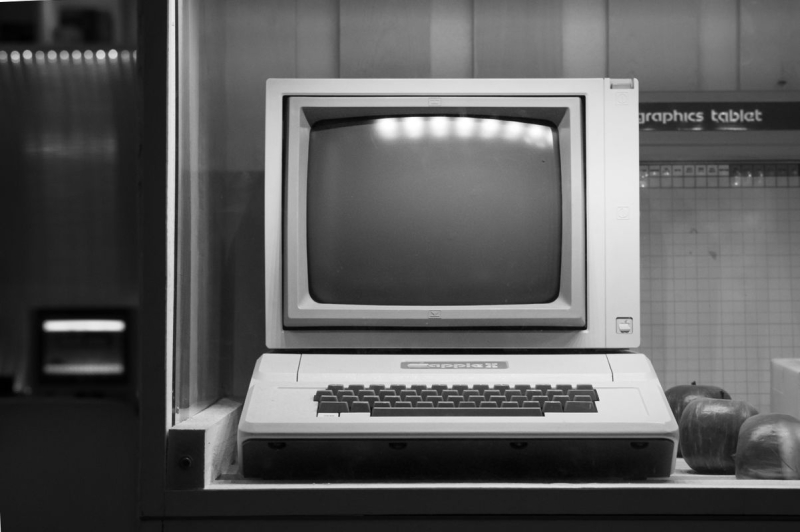
Even here, Lucas’ world-building skills are on full display, including through the appearance of OMM 0000, a computer “deity” that allows citizens to confess their worries in specialized booths. In a borderline iconoclastic manner, the machine is hidden behind a Renaissance painting of Christ while encouraging workers to comply and consume. A little too on-the-nose? Perhaps, but it’s an image that hits strongly within the film’s ultra-stylized vision of the future.
***
Credit: Keysi Estrada via Pexels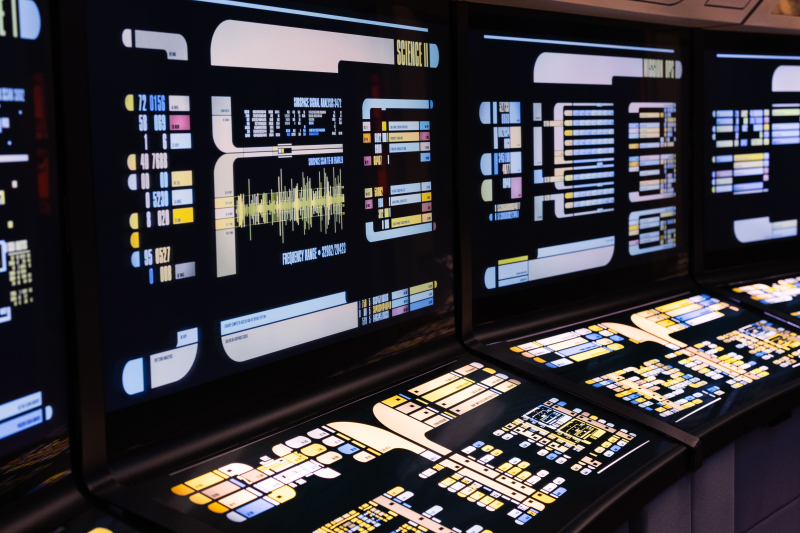
MU/TH/UR (a.k.a. “Mother”)
Alien (1979)
Just a decade later, HAL 9000’s influence is already made clear by another sci-fi staple, Ridley Scott’s Alien. Befitting its name, the Nostromo’s onboard computer is designed to take care of the astronauts – yet, its behavior seems to verge on authoritarian. “Mother” sets the plot in motion by waking the ship’s crew to warn them of a distress signal, but are its motivations all that pure?
Somewhat overshadowed by the franchise’s iconic xenomorph monsters, the different iterations of MU/TH/UR are nevertheless a big part of the overarching story – one about the dangers of corporate overreach and greed. By the way, did you know that the Alien films are said to fall under the subgenre of eco-horror? Read all about it in our guide to the genre.
***
Deep Thought
The Hitchhiker's Guide to the Galaxy (2005)
What is the answer to the Ultimate Question of Life, the Universe, and Everything? It only takes 7,500,000 years for Deep Thought to come up with a rather succinct response – “42.” In the 2005 film adaptation of Douglas Adams' book series of the same name, the supercomputer literally towers over its creators, a hyper-advanced species determined to solve the question of, well… everything.
Unlike many fictional computers, Deep Thought is not evil or compromised in any other way; if anything, it’s just a little too obsessed with watching TV. And isn’t that the most human thing?
***
Samantha
Her (2013)
“More relevant than ever” is a cliche that gets thrown around a lot in film talk, but it’s undeniably true in the case of Her, a story of romance between a human and his AI companion. Still, quite paradoxically, there is a tangible humanity to Samantha – a digital being who seems to possess a greater deal of agency than even the most advanced chatbots of today.
***
Honorable mentions:
- TARS and CASE (Interstellar, 2014)
- Icarus (Sunshine, 2007)
- Jarvis (Iron Man, 2008) and Friday (Avengers: Age of Ultron, 2015)
- WOPR (WarGames, 1983)
***
When we aren’t bringing you the top insights about Russian culture, we train future professionals in AI, IT, physics, engineering, infochemistry, and biotech.
Title image credit: Piotr Baranowski via Pexels