Building a career in the age of AI
AI opened a very interesting opportunity for us to pursue values: unlike the generations before, who had to be in constant competition with each other, we can look for meaning and value in our work.
“For me, in 1991, that was climate change. To many of my friends, to my boss, that was a foreign concept. How can you change climate, they asked. Not many people were aware of the issue, but I felt it was a fundamental problem and someone had to do something about it. Now, many of my friends have retired. They say life is boring, they have nothing to do – and I keep pursuing my value, I keep going, because I chose something different,” says Rae Kwon Chung.
The expert’s advice to young people is: if you want to build a future-proof career in the age of AI, you need to view your university years not just as a platform to acquire knowledge and hone your skills. University should give you an opportunity to decide what values motivate you personally, what you are ready to devote your life to, what you are ready to pursue in life. Then, you can use AI as a tool towards reaching this value. Not having a driving value or goal in life will, conversely, turn you into a kind of "tool" for AI.
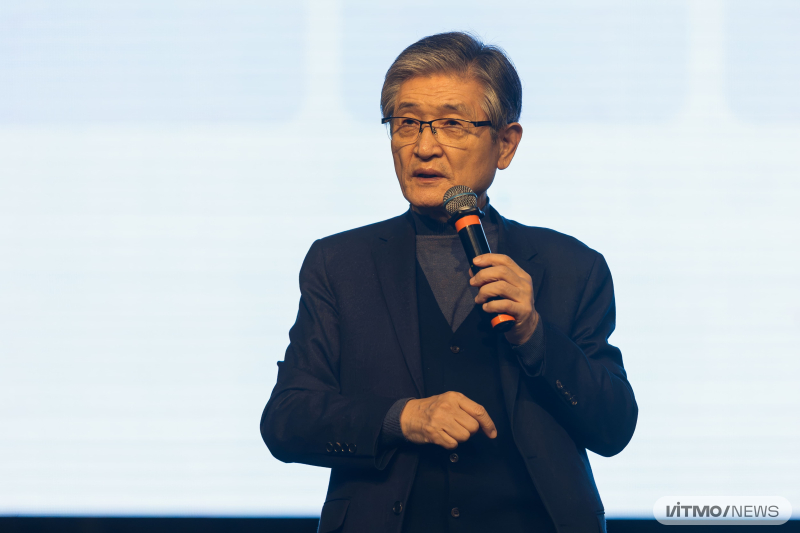
Rae Kwon Chung. Credit: Dmitry Grigoryev / ITMO NEWS
Though this may seem like an entirely philanthropic approach, Dr. Chung believes that it doesn’t have to be a sacrifice. In fact, focusing on bringing value to the community can make you a millionaire. Here are three examples of such projects as told by the expert:
-
Organic cashmere
One of my mentees, who worked at the chairman’s office at Hyundai Motor Company, resigned from this seemingly promising position and spent two years with the nomadic people of Mongolia. A key source of income for these nomadic people is cashmere. However, if we simply increase the volume of its production, it would mean breeding more goats, who would be eating more grass, and thus cause desertification.
He discovered that in spring, cashmere goats shed their fur naturally – and this shed cashmere results in a warmer, higher-quality fabric. So, he began to produce cashmere with this organic, naturally-shed cashmere, and sold it at a higher price due to its fine quality.
Initially, the business didn’t take off, but one day his product was mentioned on a TV shopping channel with its backstory of helping nomadic people stop desertification in Mongolia. And this story was very powerful – it led to a boom in sales, making my mentee millions. He later sold it to a major Korean fashion conglomerate, and shifted careers again, landing in one of the leading management positions at the HYBE agency.
-
Carbon-free cotton
This is my project, where I aim to prove that the green approach and business can go together. Over the years, I’ve visited Kazakhstan and Uzbekistan many times with lectures, and I learned that the Aral Sea in Central Asia has disappeared due to cotton cultivation, as it uses a lot of water. I started thinking: how can we solve this dilemma?
I came up with an idea: to grow cotton in a smart farm that’s run on 90% recycled water with no evaporation. But it’s very expensive, and that’s why nobody did it before. However, we can power the farm with a solar panel and thus acquire the carbon-free certification. The resulting product would rise 30 times in cost. The next step could be selling the product to high fashion brands, who wouldn’t mind a higher price because they know they have consumers who are willing to pay more for a carbon-neutral choice.
At the moment, the project has received a $200,000 feasibility grant, and our feasibility study will be complete by December. After that, depending on the scale, we could get a $10-30 million grant to start the project that can increase returns for farmers, while at the same time helping the ecology.
-
Star’s Tech
This is another project by a mentee of mine. Starfish is something of a pest: its overpopulation risks destabilizing the ocean food chain, while the animals themselves prey on coral reefs and shellfish that help maintain marine ecosystems and provide water filtration. In South Korea, when fishermen accidentally catch it, they take it back to shore and burn it.
My mentee decided to produce collagen from these starfish and use it as an additive in de-icing salt. Used every year during the winter, the salt actually has quite a destructive effect on roads and pavements. However, with the added collagen, it becomes less hazardous and biologically safe. Now, my mentee has turned it into a $30-million business in Korea and is looking to export to the US and Canada. This is a great example of combining a chemical engineering degree with a clear value.
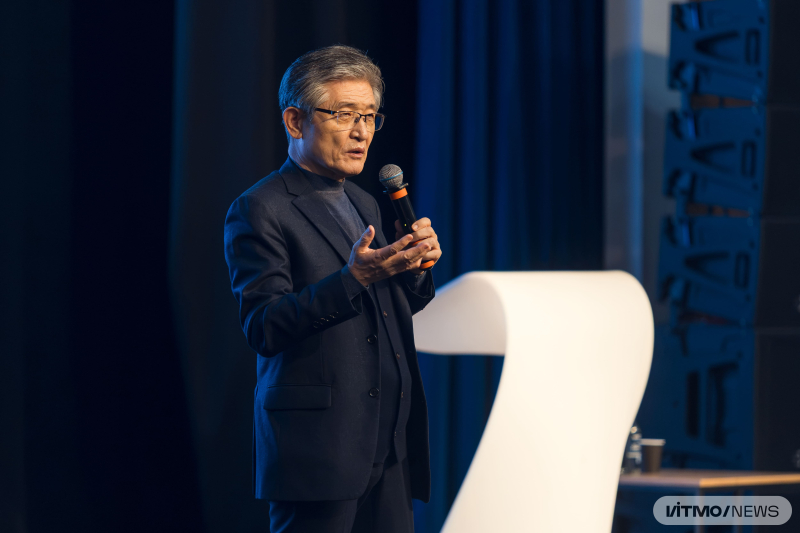
Rae Kwon Chung. Credit: Dmitry Grigoryev / ITMO NEWS
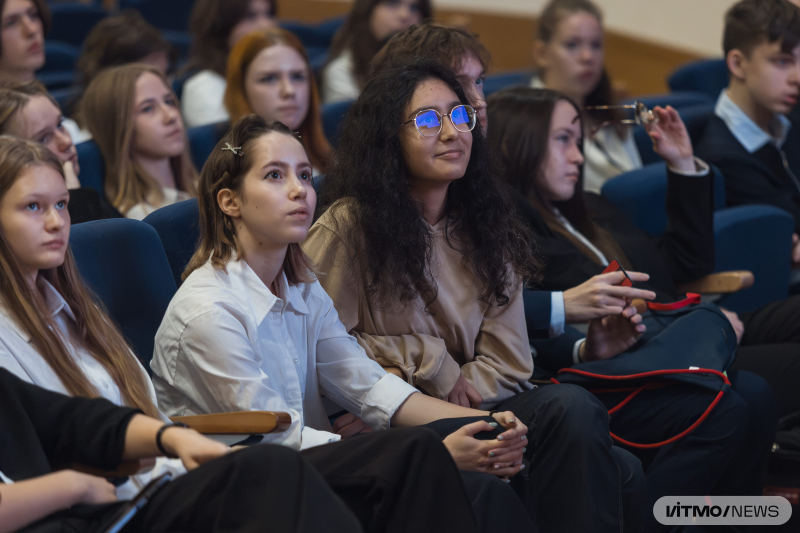
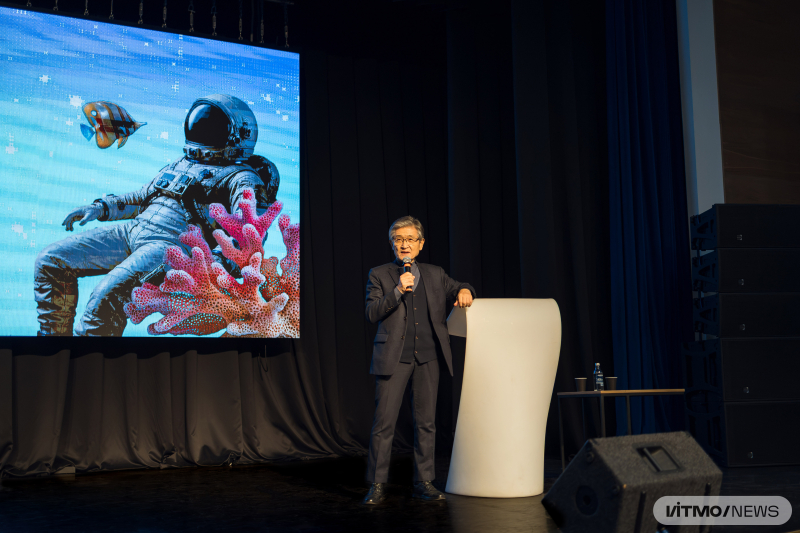
Rae Kwon Chung's lecture at ITMO. Credit: Dmitry Grigoryev / ITMO NEWS
How values can be the foundation of business
What do these cases have in common? They all started from a value, from the mindset of sharing and caring.
“I was surprised to find love on the list of ITMO University’s values. I interpret this word as the sharing-and-caring mindset: caring for ecology, society, our neighbors, and then sharing the benefits, not just monopolizing them. Many people believe that choosing between ecology and economy is a zero-sum trade-off. If we promote one, the other has to suffer. They differ in time-scale: while sustainability is long-term, market economics is about the short-term. I am convinced that win-win solutions are possible, even if they don’t happen automatically: we have to do something about it to make them happen,” adds Rae Kwon Chung.
By first establishing our personal values and then following values and applying them to business, he believes, we can move towards bringing social and economic benefit together with more and more win-win solutions.
The event was held with support from Gazprom-Neft Industrial Innovations.
Rae Kwon Chung is a Korean climate policy expert and laureate of the 2007 Nobel Peace Prize as part of the Intergovernmental Panel on Climate Change (IPCC) for “efforts to build up and disseminate greater knowledge about man-made climate change, and to lay the foundations for the measures that are needed to counteract such change.”