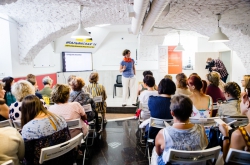
The laboratory operates as part of ITMO’s School of Physics and Engineering and is led by Yana Muzychenko, the school’s deputy head, and Andrew Kudlis, the head of the university’s core physics module and a researcher at the school.
At the heart of the laboratory are a project-based approach and teamwork: students work in teams, take on research and engineering tasks, and develop their own solutions. The university’s educational model follows the same approach.

Credit: Dmitry Grigoryev / ITMO NEWS
The projects are designed for different ages and skill levels – and their difficulty may gradually increase. Students start with a basic version of a device, learn how it works, and then add new functions. Most of the projects are interdisciplinary: they combine physics, mathematics, programming, electronics, and engineering.
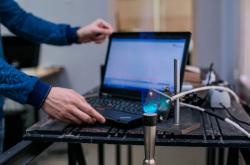
The lab’s classrooms and workshops are equipped with workbenches, tools, 3D printers, and a CNC machine – everything students need to turn their computer models into finished parts and test them in practice.
Another mission of the laboratory is to produce training engineering kits that let students use their developments not only in its workshops – but also in their own schools.

Credit: Dmitry Grigoryev / ITMO NEWS

Credit: Dmitry Grigoryev / ITMO NEWS

Credit: Dmitry Grigoryev / ITMO NEWS

Credit: Dmitry Grigoryev / ITMO NEWS

Credit: Dmitry Grigoryev / ITMO NEWS
When it comes to AI, the laboratory position is such: although AI is already used to code, build 3D models, and generate solutions, it can’t guarantee that the developed device will actually function in its physical form. For the lab’s students, working with their hands is a way of developing their engineering thinking.
The laboratory aims to provide a smooth transition from school to university by introducing the core principles pursued at ITMO. Currently, four groups study at the facility: these are students from the IT Lyceum, a project of ITMO University.