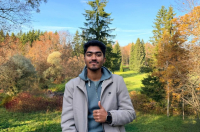
Hi, Tasmina! Could you introduce yourself to our readers?
Hi! My name is Tasmina Chowdhury, and I'm from Bangladesh. I'm currently a first-year PhD student at ITMO University's Faculty of Biotechnology. My research focuses on plant-based ingredients, such as bitter gourd, garlic, fenugreek, and turmeric, and their potential to help regulate blood sugar levels in the human body.
What inspired you to pursue a research career abroad?
I've always been interested in research. After completing my Master's, I started thinking about continuing my academic career. I wanted to gain new experiences and develop my skills as a researcher, so I decided to look for opportunities overseas.
And what made you choose ITMO?
When I started searching for universities, I was looking for strong academic programs in science and biotechnology. That's how I discovered ITMO. Another important factor was finding a suitable supervisor. I wanted to work with someone whose research interests aligned with mine, and I found a professor at ITMO whose expertise matched the direction I wanted to pursue. That played a major role in my decision.
You've recently started your PhD. How has your academic experience been so far?
It's been amazing. Before coming to Russia, I had already been in contact with professors about potential research opportunities. Now that I'm here, I get to work with experienced researchers and learn directly from them.
One thing I particularly appreciate is the feedback I receive. Whenever I prepare a research paper or a conference report, my professors take the time to read it and provide suggestions. I learn a lot from their experience, and that is incredibly valuable to me as a research student.

Photo courtesy of the subject

Photo courtesy of the subject
You also completed a Russian language course. How has learning the language helped you?
My PhD studies are in English, and I can communicate with my supervisor in English, which makes things easier academically. However, she also encourages me to improve my Russian because many conferences and other academic activities here are conducted in Russian.
Sometimes, when I'm speaking to someone, I even find myself mixing Russian and English together! I'm still learning, but I understand how important the language is for living and studying here.
Was moving to Russia a big change for you personally?
Definitely! This was actually my first time traveling abroad. Back in Bangladesh, I wasn't used to traveling alone, and I usually went places with my family. So, coming to another country was a completely new experience for me.
When I first arrived, some Bachelor's students helped me a lot. I wasn't comfortable traveling around on my own, and even simple things felt challenging. But over time, I've become more independent. It's only been about two months since I started feeling comfortable going places by myself. That's a big change for me, and I'm happy that things are becoming easier.
Have you had the chance to explore St. Petersburg or participate in any university activities?
Not much yet, unfortunately. But now that I'm more comfortable getting around, I'd like to start exploring. I'm particularly interested in visiting historical places and learning about different cultures.
How do you usually spend your time outside your studies?
Most of it goes towards research, learning Russian, and communicating with my professors. Research is a big part of my life, and chemistry is something I'm genuinely passionate about.
In my free time, I also enjoy cooking. I like preparing Bangladeshi food and trying different dishes. And, of course, I'd love to travel more and discover new places and cultures.

Photo courtesy of the subject
Moving abroad and starting a PhD can be challenging. What keeps you motivated?
My father is my biggest motivation. When I first arrived in Russia, I sometimes felt that everything was too difficult. But whenever I thought about my father, things became easier.
He has always wanted to see me build a career abroad, and that means a lot to me. Whenever I face challenges, I remember his hopes for me, and that gives me the strength to keep going. He's the person who motivates me the most in the whole world.
Finally, what advice would you give to other international students planning to study in Russia?
I would say that studying abroad isn't always easy, but it can be a very valuable experience. I'm still at the beginning of my PhD journey, and I have so much left to learn.
My first piece of advice is to learn Russian before coming here, or at least start learning the basics. Even if your studies are in English, Russian is very important for everyday life. Secondly, try to become more independent. Learn to do things by yourself, even when they seem difficult at first. I know from my own experience that it takes time to adjust, but gradually, everything becomes easier.
Studying abroad comes with challenges, but it also helps you grow as a person.