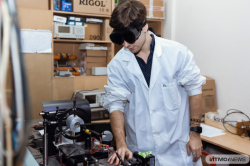
With levitating optomechanical systems, it’s possible to study individual nano- or microparticles isolated from external mechanical influences. In the method, the particles are literally levitating. Researchers use this method to precisely measure the force, torque, and acceleration, as well as to study the fundamental laws of physics, such as quantum states and nonlinear processes.
As this method excludes external noise and unwanted influences on an object, it increases the system’s sensitivity. In other words, a nano- or microparticle catches and reacts to the smallest external influences. A sensitivity this high is handy for all kinds of tests, for instance, for registering high-frequency gravitational waves or in meteorological studies. In recent years, levitating systems have been increasingly used in industry as compact, precise, and quick accelerometers.
Usually, researchers study tiny particles, such as atomic ions, since their dynamics are described by simple equations. When it comes to nano- and microparticles, nonlinear processes take the stage and make it so that the smallest external “disturbances” lead to a strong reaction in microparticle movement.
“The more energy is transferred to a microparticle, the more its velocity grows. However, with it grows the nonlinear force of friction that causes the microobject to lose its velocity. So this is a vicious circle, an unstable balance. If we add too much energy, we will cause a phase transition and the microparticle will start rushing around. Researchers tend to avoid the hard-to-describe nonlinear effects and that’s why they study the dynamics of larger particles in vacuum, where there is no energy loss. We considered the problem from a different angle: if there is a nonlinear process, this means that at some point the microparticle will become highly sensitive to external influences. Instead of avoiding difficulties, we decided to study them and potentially use them to create a more precise kind of sensor,” shares Dmitry Shcherbinin, the head of the study and a senior researcher at the Nonlinear Optics of Condensed Media Laboratory of the International Research and Educational Center for Physics of Nanostructures.

Dmitry Shcherbinin. Photo by Dmitry Grigoryev / ITMO NEWS
In their previous work, the scientists studied the nonlinear dynamics of a single microparticle levitating in a quadrupole trap and identified two modes of its movement: linear (low-amplitude oscillations) and nonlinear (movement along a rhombus-like trajectory).
In the new study, the team has for the first time considered the phase transition between linear and nonlinear movement and found the optimal state in which the microparticle becomes extremely sensitive to small external influences.
These different modes of movement can be compared to students who are writing a test and a lecturer who’s keeping an eye on them. While the lecturer is in the room, the students stay quiet. That’s the low-amplitude linear mode – the particle oscillates close to the center of the trap with a low amplitude. When the lecturer is distracted, the students peek into their notes. In the world of physics, the linear mode remains, but the amplitude changes slightly. If the lecturer leaves the room, the students begin talking loudly about their tasks. This is the nonlinear mode – the amplitude of the microparticle has increased by several orders and it has started moving along a rhombus-like orbit with a radius close to the size of the trap. The external influence (the lecturer being called away) that happened between the linear and nonlinear modes led to a gradual change from one mode to another – a phase transition.
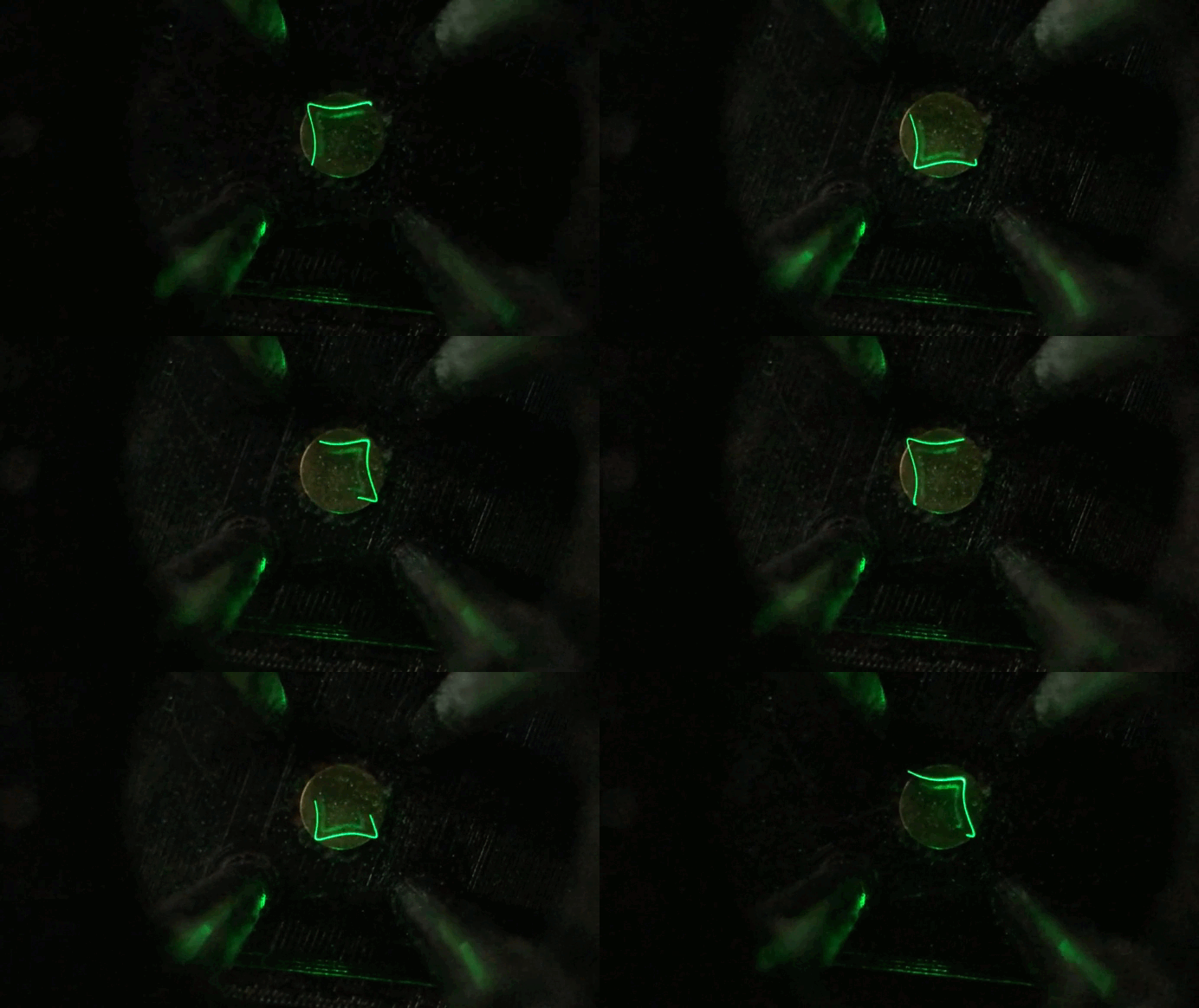
Nonlinear particle movement trajectory. Video courtesy of Vadim Rybin
“We studied the behavior of a levitating silicon dioxide microsphere at the border of phase transition. We have identified four characteristic modes of movement and discovered that a microobject is at its most sensitive closer to its phase transition, as its movement becomes unstable and resonant. New frequencies appear on the vibration spectrum, with their amplitudes rapidly increasing. Therefore, even the slightest external influence noticeably affects the amplitude of the movement and the frequency spectrum, making the microparticle very sensitive. We demonstrated that using laser radiation to create even a small impact on the system can push it into a nonlinear mode,” says Vadim Rybin, the paper’s first author and a junior researcher at the Nonlinear Optics of Condensed Media Laboratory of the International Research and Educational Center for Physics of Nanostructures.
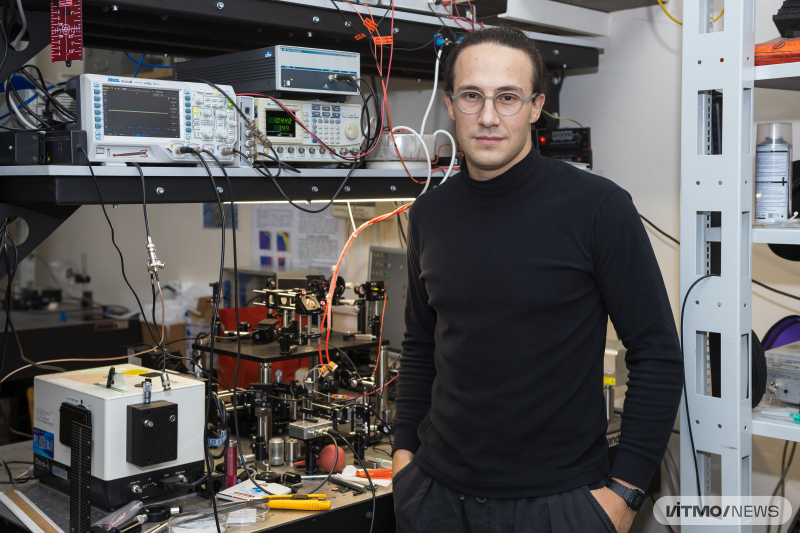
Photo by Dmitry Grigoryev / ITMO NEWS
According to ITMO scientists, for any spherical microparticle with its own charge, the right parameters can be calculated that will lead to its phase transition and imbue it with increased sensitivity. It’s also possible to measure any external influence regardless of its nature – be it an electric, magnetic, optical, or gravitational field. Based on this effect that was first considered by ITMO researchers, it’s possible to develop a universally applicable, highly sensitive sensor that could be used for precise geological exploration, identifying seismic activity, and locating ships in areas with low GPS coverage, such as the Arctic.
For now, the physicists have demonstrated the phase transition in a microparticle experimentally. In the future, they are planning to produce a mathematical model that will predict and describe the accompanying effects – and use it to create a general-purpose sensor for calibrating the sensitivity of measuring devices through various kinds of interactions.
This study was supported by a grant from the Theoretical Physics and Mathematics Advancement Foundation “BASIS.”