Quantum processors today accommodate dozens, if not hundreds, of qubits, and their number will continue to grow. Google plans to achieve 1,000 qubits in the near future, while IBM has already released Condor, a 1,121-qubit quantum processor. However, simply combining the numerous elements is not enough; the system must also be fine-tuned so as to, for instance, be able to transfer a quantum excitation (a photon or a spin state) from one end of the system to the other. If the transmission is too sluggish, an excitation may be lost along the way. For that reason, systems with a large number of qubits require higher speeds and transmission reliability.
There are two main approaches when it comes to transferring an excitation within a chain of qubits. The step-by-step method means that the system needs to activate the connection between adjacent qubits, wait for the state to flow from one qubit to another, and then turn on the next connection. This process is simple, yet slow. Alternatively, it’s possible to make connections non-time-dependent and with a desired magnitude. Then, the state will pass through the chain on its own; however, it is a time-consuming process, especially if there are many qubits. Both methods are far from perfect – but now there is a third, the fastest one, which was proposed by a team of researchers from ITMO University and the London Institute for Mathematical Sciences.
For their research, the scientists turned to quantum brachistochrone – an analog of the brachistochrone curve seen in classical physics, which illustrates the path of fastest descent for a ball between two points.
“Let’s say that there are many possible trajectories between points A and B; our task is to look through all of them until we find the one that offers the shortest path,” says Kseniia Chernova, an author of the paper and a Master’s student at ITMO University.
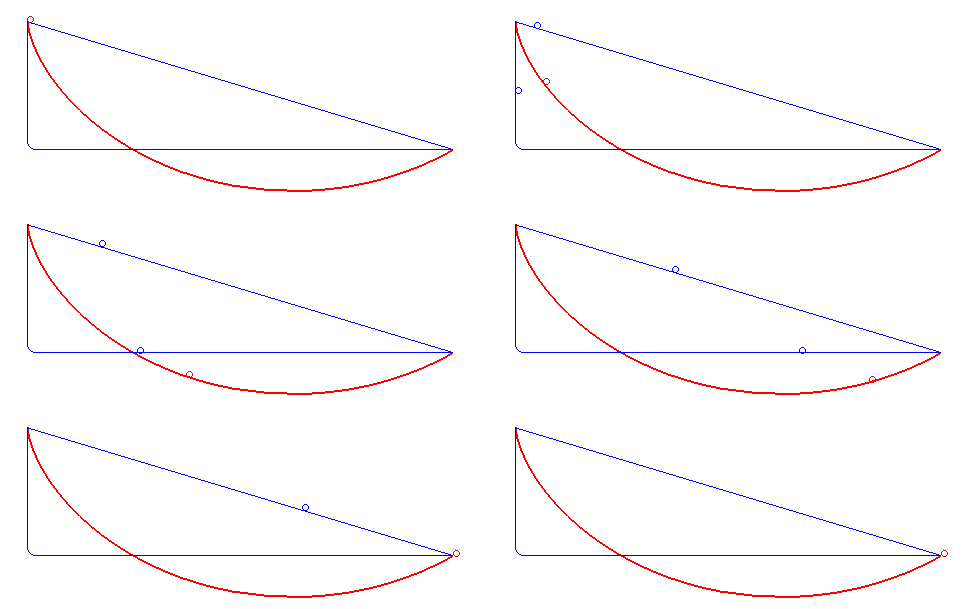
This classic physics problem concerns the movement of objects on three different trajectories. The red line is a brachistochrone – the curve that provides the fastest route for a ball between the points. Credit: Robert Ferreol / Wikimedia Commons
Instead of switching connections on and off, as it is done today, the team suggests changing their value smoothly across time. According to the researchers, the connection between the first two qubits is the highest at the beginning; then, as it gradually weakens, other, more distant connections gain strength. The method creates a wave packet that moves as quickly as possible within the constraints of quantum physics, allowing for the excitation to travel from the first qubit in the chain to the last, safe and sound.
“The method we propose for quantum state transfer relies on precise control of system parameters. Hence, if there’s noise, the accuracy of the transfer decreases. Nevertheless, other methods also display performance losses, but combined with lower speeds,” notes Andrei Stepanenko, the first author of the paper and a researcher at the London Institute for Mathematical Sciences.
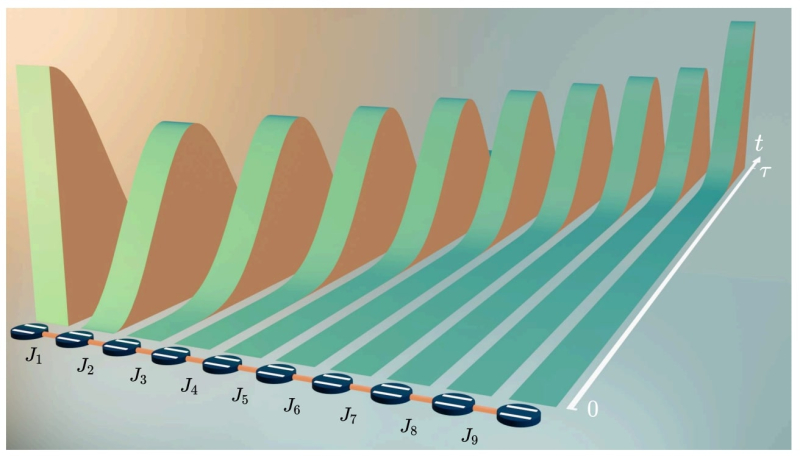
Schematic of quantum state transfer across a 10-qubit chain. Credit: Andrei Stepanenko, Kseniia Chernova, and Maxim Gorlach / Physical Review Letters
Additionally, the physicists suggested a general formula for figuring out the minimal transfer time for systems with any number of qubits. Their study features calculations for a chain of hundreds of elements – until now, these kinds of problems could only be handled for small systems with a few qubits.
“Our study is crucial not so much in solving a particular task, but rather in offering a novel method that works for large quantum systems. The new method will allow researchers to find more efficient algorithms and generate quantum states faster; altogether, it should open up new opportunities for next-gen quantum systems as a whole,” concludes Maxim Gorlach, the last author of the paper and a senior researcher at ITMO University.
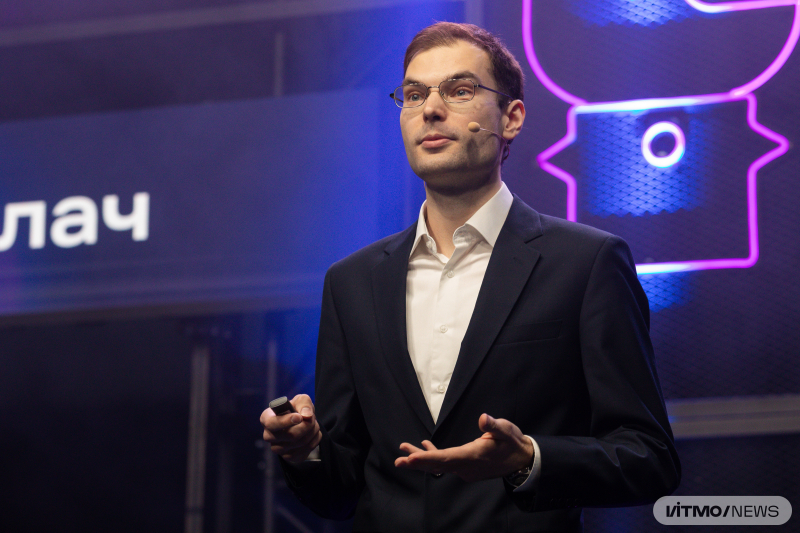
Maxim Gorlach. Photo by Dmitry Grigoryev / ITMO NEWS
According to the researchers, the method can already be implemented within several experimental platforms.
The study was supported by the national program Priority 2030 and the grant No. 24-72-10069 from the Russian Science Foundation.