ITMO University offers PhD programs in 50 specializations within 16 subject areas, including IT, telecommunication, computer sciences, physics, biotechnology, chemical engineering, and materials science. Nearly every specialization includes a choice of two tracks: industrial or scientific. The industrial track is for those who aim to tackle complex R&D challenges and work on real-economy business cases, while the scientific track will suit those planning to conduct cutting-edge research, publish papers in top-ranked journals, and work in an international team.
Apart from a great amount of research for papers and conferences, PhD students of both tracks can opt to take part in university-led, paid projects, regardless of their field of study. Various state programs in Russia offer funding for both fundamental and applied research – such as those by the Russian Science Foundation (RSF), the Foundation for Assistance To Small Innovative Enterprises (FASIE), and some others. Alternatively, companies across various sectors of the economy also commission and fund applied R&D projects. Among ITMO’s industrial partners are Gazprom Neft, SIBUR, Sberbank, Yandex, and other tech giants.
The starting salary for a researcher at ITMO can reach 100,000 rubles a month; however, on average, PhD students who are actively engaged in scientific projects can earn from 100,000 to 200,000 rubles per month, excluding scholarships.
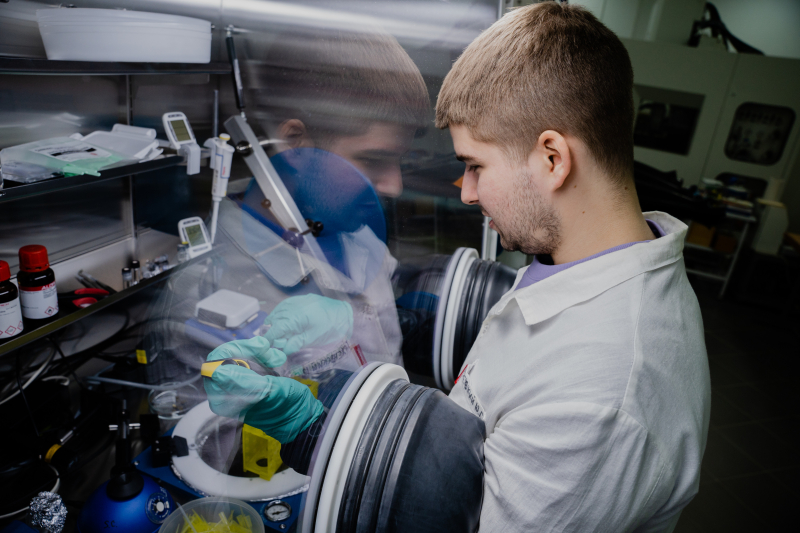
Research at an ITMO lab. Photo by ITMO NEWS
The total income for PhD students is made up of their salary for scientific projects and various enhanced stipends: the President's stipend (75,000 rubles/mo), named stipends like the Kamil Valiev scholarship (75,000 rubles/mo) or the Sergei Korolev scholarship (20,000 rubles/mo), as well as corporate stipends by industrial partners (e.g., Sberbank provides 100,000 rubles/mo). ITMO University consistently ranks among the top universities in Russia based on the number of recipients of the President’s and Government stipends.
Explore more about PhD admissions and opportunities on the university’s admissions website.
ITMO NEWS sat down with three ITMO students who pursue their PhDs in physics, chemistry, and IT. Read on to learn more about their ongoing projects and see their advice on how to launch a career in academia, apply for scholarships, and secure a high starting salary.
Yakov Kovach
A fourth-year PhD student at the Institute of Advanced Data Transfer Systems and a junior researcher at the Laboratory of Optoelectronic Support for Cyber-Physical Systems.
Develops fiber-optic sensors based on long-wavelength vertical-cavity surface-emitting lasers (VCSELs) for high-speed, long-distance data transmission.
Yakov Kovach. Photo by ITMO
Why do a PhD? It felt like a natural next step for me. I met some highly-driven peers as a Bachelor’s student and we started to work on an R&D project together; afterwards, I moved on to other projects in my Master’s and then PhD. PhD studies worked out great for me. I had the chance to try out different fields and work on various projects: I calculated and experimented, practiced 3D modelling, wrote papers, and applied for different projects. It kept me busy. Now, my team and I are developing optoelectronic parts and devices for our industrial partners.
Research projects. One of our developments is a prototype of a VCSEL-based optic-fiber sensor for telecommunication purposes; it can transmit data without significant signal attenuation over several dozens of kilometers, compared to lasers with shorter wavelengths and up-to-one-kilometer coverage. Our solution enables more energy-efficient, long-range, and high-speed data transmission – for instance, it operates at the speed of up to 20 Gbps. I was fortunate to present the results of our work at a major international conference in China. Later, we plan to adapt our transmitter for use at large-scale data centers, including those constructed for AI calculations.
Streams of income. I started to make money as a researcher way before my PhD; I worked on R&D during both my Bachelor’s and Master’s. Back then, I made around 60,000 rubles a month. My income increased as I started my PhD; I receive an enhanced stipend (13,100 rubles/mo) and the President’s stipend (75,000 rubles/mo), plus my salary from the laboratory, the RSF-supported grants, and R&D projects. All that in total makes me about 200,000 rubles per month.
For PhD students, my advice is to keep a list of publication metadata close at hand; it will help you save time and apply for stipends at a moment’s notice. At ITMO, you can use the library’s services for that: if you upload your data timely, you can export a full report of your publications in just one click. Requirements for all competitions are more or less the same: you should have “good” and "excellent" grades, publications in scientific journals, patents, participation in grants and conferences, and professional achievements (prizes and awards). In my view, the key opportunities are the President’s stipend and named scholarships available for various academic tracks.
Another thing a PhD student can do is pick a thesis topic that overlaps with the projects they are working on. If you do so, you’ll be able to dive deep into the topic of your research and earn some money while working on a side project and then integrate your findings and results into your university thesis.
Egor Ryabchenko
A fourth-year PhD student at the Advanced Engineering School and a junior researcher at the EnergyLab.
Develops high-efficiency, eco-friendly sorbents for removing heavy metals from wastewater.
Egor Ryabchenko, Photo courtesy of the subject
Why do a PhD? After completing my Master’s at ITMO, I wanted to further pursue my academic career and work on new solutions for fundamental and applied problems. Thanks to my PhD program, I was able to switch my focus from nanomaterials and photonics to sorbents for removing heavy metals from wastewater, learn to write grant applications, and expand my research opportunities. In the future, I’d like to get my PhD in chemistry, build my own team, and win a grant as a team lead or a responsible executor.
Research projects. Wastewater treatment analysis is an exciting and multifaceted field! It’s almost like House, M.D. Each sample needs to be studied thoroughly to find the right sorbent, so you can’t simply say: “I figured it all out, nothing can surprise me now.” I work on both non-selective (absorb the maximum amount of water pollution) and selective sorbents (target specific heavy metals like cobalt, lead, nickel, zinc, and mercury). As sorbents are typically purchased in bulk, they need to be eco-friendly and affordable.
As of now, I’m working on two projects: one is at the paper writing stage and another I have just recently defended at the university’s contest for practice-oriented student R&D projects. It involves the development of sorbents for selective removal of heavy metal ions from wastewater. It’s currently in the trial stage, but we are considering scaling it up for industrial implementation. It’s likely that Gazprom Neft will adopt our technology since the project was conducted with their support. Later, I’d also like to focus on creating selective sorbents for rare metals like strontium, which is used, for example, in the glass industry and metallurgy.
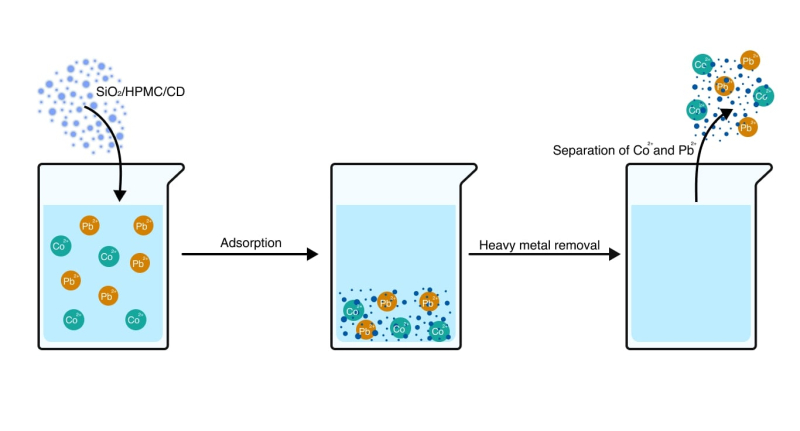
Sorbent operating mechanism: as it is immersed in stagnant polluted water, it adsorbs heavy metals onto its surface, and is then removed from the aqueous environment. Photo courtesy of the researcher
Streams of income. I have several streams of income: my academic stipend (9,300 rubles/mo), the President’s stipend (75,000 rubles/mo), my salary from the laboratory, financial aid for the R&D project, and corporate orders from industrial partners. The total monthly income can reach up to 170,000 rubles.
Having relatively modest earnings early in your Master’s or PhD is okay. In gaming terms, a “scientist” class might start with relatively low quest rewards but these are balanced out by their number and subsequent scaling. Though, the question is: What quests do you need to take to provide for yourself?
Here are a few tips for anyone thinking about doing a PhD:
- Find a supervisor with multiple research interests beforehand. If you consider ITMO for your PhD, you can select your future supervisor from the list of the university’s lecturers before you even enroll. You can send them your CV, discuss your future thesis, and ask for a letter of recommendation, which will give you 10 extra points for your admissions. This way, you'll kill two birds with one stone: as you start your studies, you won’t need to look for a “free” supervisor and will know in advance what grants, in-house contests, and commercial projects you can join;
- Follow the university’s websites and social media. You can find valuable information on the university’s admissions website (PhD programs), VK and Telegram pages for PhD applicants, and the website and Telegram channel of ITMO’s Center for Student Science, Conferences, and Exhibitions. Information about research findings and competitions for young scientists is also published on other specialized resources: for instance, the VK page of the Kurnakov Institute of General and Inorganic Chemistry of the Russian Academy of Sciences (IGIC RAS).
- Participate in local competitions. For instance, the Committee for Science and Higher Education of St. Petersburg supports promising research projects with grants, scholarships, and awards. If you have an idea for an energy startup, you can compete for a million rubles from the incubator of Energotechnohub St. Petersburg; you can also join their accelerator if you already have an MVP.
- Don’t hesitate to collaborate. Often, the skills you consider ordinary can seriously boost a grant application. For instance, if you can do rheometry or gas chromatography, which are rare in your lab, your colleagues may invite you to a joint project.
Gleb Solovyev
A third-year PhD student at the Artificial Intelligence Technologies Faculty and an engineer at the Research Center “Strong AI in Industry”
Gleb is developing an AI assistant that automates the full cycle of research and development, helping researchers solve tasks in computational chemistry and medicine faster.

Gleb Solovyev. Photo courtesy of the subject
Why do a PhD? For my Specialist’s degree, I studied aircraft engine design and completed many applied projects. I received fundamental engineering education and I found it appealing to learn something new using this knowledge. I was curious about machine learning and AI, so I started studying these fields alongside my university work. I programmed my first neural networks and solved simple ML tasks. After graduation, I was looking to combine my education and this new field, which is how I learned about the PhD programs at ITMO.
But, just like scientific discoveries are often a coincidence, I landed at ITMO by luck. I was preparing to apply to MIPT for a degree in ML, because I thought I lacked knowledge in the field. However, I then also learned about the generative design work conducted by the Natural Systems Modelling Lab (NSS.Lab) at ITMO and supervised by Nikolay Nikitin, the head of R&D at the Laboratory for Composite AI of the Artificial Intelligence Technologies Faculty. I realized that my engineering background could be of use there and my AI knowledge is enough to contribute to research with GEFEST – a toolbox for generative design of physical objects that are represented by geometrical structures and interact with continuous media. It optimizes physical objects, such as coastal protection structures, even before their construction. This is exactly where my skills as a design engineer came in handy: when creating objects with a neural network, you need to evaluate their real physical properties, such as strength.
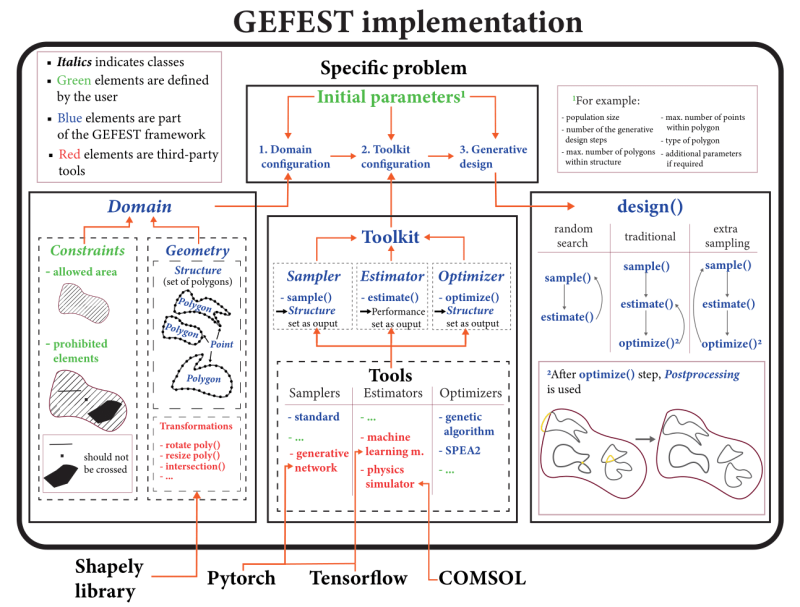
Architecture of the solution implemented within the GEFEST project. Credit: nccr.itmo.ru/gefest
Research projects. We’ve expanded the generative design research at the lab by linking it with LLMs. I now head a team that creates the architecture and code for the CoScientist project. It’s an AI assistant that automates research. Unlike its analogs, CoScientist can tackle complex, high-level tasks alongside researchers; it analyzes literature, generates hypotheses, extracts and prepares datasets, and trains generative and predictive models. At the moment, our solution is being tested on various cases in the fields of chemistry, nanomaterials, and clinical medicine; for example, it helps design new inhibitors for treatment of multiple sclerosis by taking into account the molecules’ activity toward the disease‑related target proteins, as reported in the scientific literature. As new LLMs are released, we are modifying CoScientist to enable it to work in other fields.
Streams of income. Over the course of my PhD studies, I’ve accumulated quite a few achievements – from research projects to publications at A* conferences.Thanks to that, I’ve built a portfolio that now helps me receive several stipends: the enhanced stipend (10,800 rubles/mo), the scholarship from the Chichkanov foundation for young scientists (30,000 rubles/mo), and the Sberbank scholarship (100,000 rubles/mo for 6 months).
However, you need to remember that scholarships only last a limited amount of time and to make a stable income you need to regularly participate in competitions, including those you’ve already won. If you combine your salary at ITMO with an additional stipend, you can expect to make over 120,000 rubles a month during certain periods.
Here are some of my tips for aspiring PhD students:
- Be active and productive. That’s the most important thing. Participate in research and academic activities because your achievements will make you competitive in various grant and scholarship competitions.
- Participate in scholarship programs by companies and foundations. Apart from Sberbank, such opportunities are offered by Gazprom Neft, the Vysota foundation, the Basis foundation, and others. It’s good to remember that some programs may include a joint project with the funding organization, such as Sberbank. It’s a great chance to get more experience and network, but you should also account for the time you’ll need to spend on that project.
- Apply to competitions at international conferences. For instance, our team participated in the Humies competition at the GECCO international conference. It evaluates who performs a task better – humans or evolutionary AI algorithms. We presented our solution and won $1,000.
- Consider programs that support startups. If you are a fledgling entrepreneur, you should apply for Umnik or Student Startup from FASIE, as well as acceleration programs at universities – for instance, ITMO Accelerator.