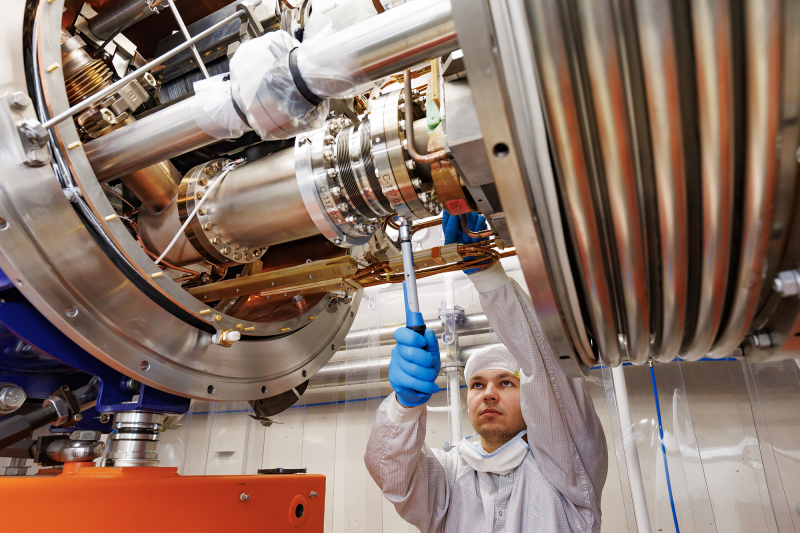
Megascience facilities are large-scale research complexes created to tackle fundamental problems of modern science. These include, for example, particle accelerators, deep-water neutrino telescopes, and ultra-high-power laser systems. They make it possible to address a wide range of tasks: generating X-ray radiation to study metals and new materials, advancing knowledge in nuclear physics, investigating processes in deep space, and developing optical detectors and lasers capable of operating in cold water. In addition, such facilities produce massive amounts of data, for the processing of which researchers now often turn to AI. However, in Russia there are relatively few experts in this field, and there are almost no comprehensive educational programs designed to train both experimentalists and theorists for work in megascience.
To close this gap, ITMO has now launched a new megascience-focused track within the Master’s program Advanced Quantum and Nanophotonic System. The track’s main partner is the Joint Institute for Nuclear Research. Students will be able to choose one of three fields depending on their interests: experimental-, programming-, or theory-oriented. Training will be offered in Russian and English.
“We are training theoretical physicists capable of modeling new phenomena, as well as experimental engineers who can implement these ideas on real-world equipment. At the core of the track are three principles: practical training with megascience-level equipment, focus on AI for data processing, and close integration with science. Students will be able to shape their learning trajectories based on their interests and choose specific courses,” shares Dmitry Karlovets, the head of the track, a senior researcher at ITMO’s Faculty of Physics.
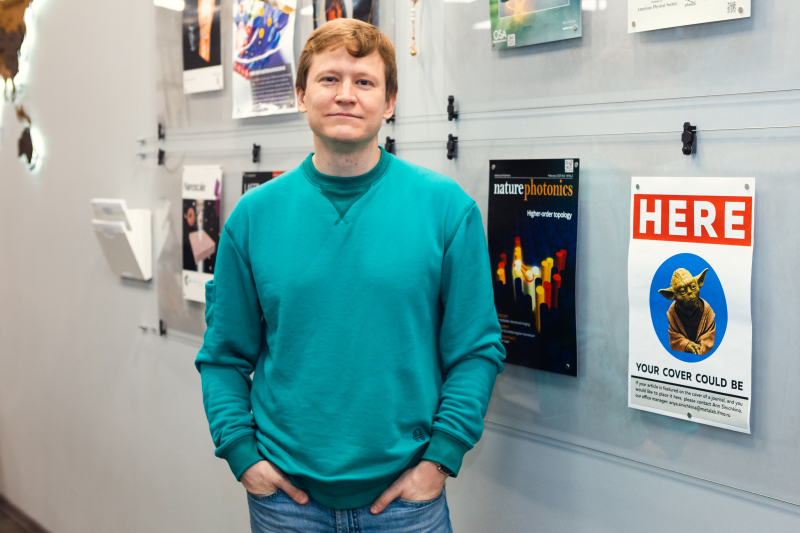
Dmitry Karlovets. Photo by Dmitry Grigoryev / ITMO NEWS
A significant part of the program will be dedicated to practical tasks. Master’s students will be able to intern at leading megascience facilities, including the deep-water neutrino telescope Baikal-GVD on Lake Baikal, the NICA collider in Dubna, and the HIAF accelerator in Huizhou. Additionally, students will master AI algorithms for the processing and analysis of data produced by experiments at these facilities.
The Center for Advanced Research that will be created by ITMO and the Joint Institute for Nuclear Research will become another facility available to students. There, they will be able to conduct research alongside their studies, with their graduation theses based on data from the center’s equipment.
Even more opportunities for students are made available thanks to Dr. Karlovets’ research group being part of the Baikal-GVD international cooperation. This project studies astrophysical neutrinos and neutrino astronomy. This will allow Master’s students to work with one of the world’s biggest deep-water neutrino telescopes located on Lake Baikal. With the telescope, scientists detect neutrinos, cosmic particles traveling at nearly the speed of light, and study processes occurring in different parts of the universe: the evolution of galaxies, the formation of supermassive black holes, particle acceleration mechanisms, and other fundamental phenomena. The leading roles in the collaboration are played by the Joint Institute for Nuclear Research and the Institute for Nuclear Research of the RAS, with the project featuring researchers from China, Czech Republic, Slovakia, Kazakhstan, and other countries.
Applicants with basic knowledge in quantum mechanics, classical electrodynamics, particle physics, programming, data processing, as well as engineering skills can apply for the new track.
Graduates of the track can work as researchers, physics engineers in accelerator operation, physical data processing specialists, sensor system developers, or experimental physicists in particle physics.