The International Federation of Automatic Control (IFAC) has been hosting ALCOS at universities across the world for over 40 years. In 2025, researchers and engineers from various countries gathered at the Autonomous Technological Institute of Mexico (ITAM) to showcase their latest advances and research in automatic control and learning systems. With such systems integrated, various devices can be operated and controlled without human involvement. These include, for example, autopilots in planes and cars, ventilation and air conditioning systems, or chemical reactors and energy networks. At the core of such technologies are nonlinear assessment or control algorithms, ML models, or neural networks.
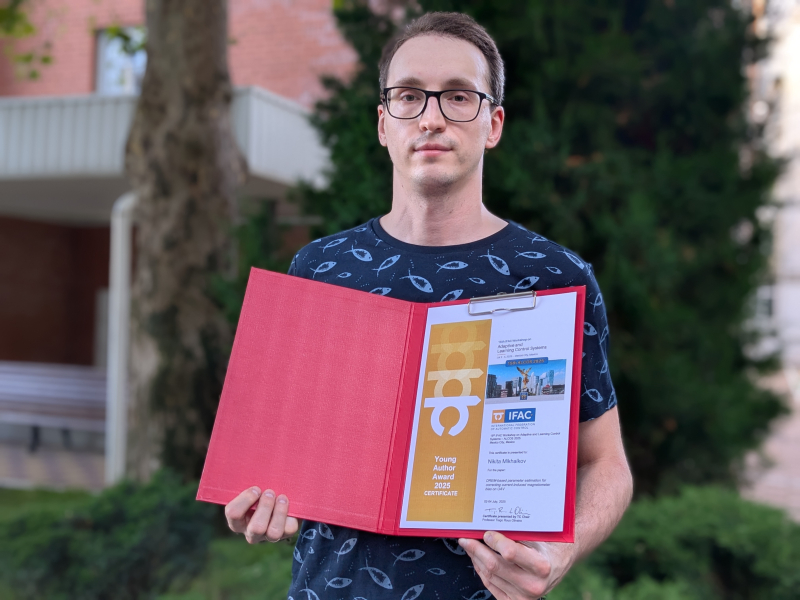
ITMO PhD student Nikita Mikhalkov received the award in the Best Young Researcher Paper category for his adaptive algorithm that processes onboard sensor data in small unmanned vehicles and helps solve navigation problems when satellite feeds are unavailable.
“In this case, drones use a magnetometer as a compass; that is, they rely on the Earth's magnetic field to determine their position in space. Yet here comes a problem: alternating currents in wires generate their own fields and hence can cause a distortion. My algorithm allows specialists to monitor these interferences, assess their influence, and automatically correct them – all in real-time. The algorithm combines mathematical models of the propeller group, electrodynamics of drives, and the dynamics of a device and thus turns the problem of determining the magnitude of an unknown disturbance to that of estimating unknown parameters. Using this assessment, I calculate interferences in the magnetometer’s readings and make the appropriate corrections. That is, I “restore the reputation” of the magnetometer as a reliable navigation device. No one would want a pizza robot to get lost when delivering their order because a satellite was disconnected, right?” explains Nikita Mikhalkov, a PhD student at ITMO’s Faculty of Control Systems and Robotics.
This year, ITMO researchers were among the organizers of themed sections at ALCOS 2025. The conference was co-chaired by Romeo Ortega, a co-head of ITMO’s Adaptive and Nonlinear Control Systems Lab, and Alexey Bobtsov, the head of ITMO’s School of Computer Technologies and Control. Alexey Bobtsov, Anton Pyrkin, the dean of ITMO’s Faculty of Control Systems and Robotics, Alexey Vedyakov, the deputy dean of the faculty, and Alexey Peregudin, an associate professor at the faculty, chaired four sections on adaptive control, robotics, and ML methods. At the event, the researchers discussed the ways of applying traditional methods of nonlinear control systems, as well as ML and deep learning methods, for building robotic systems. The conference was also attended by Vladimir Nikiforov, Vice Rector for Research at ITMO.
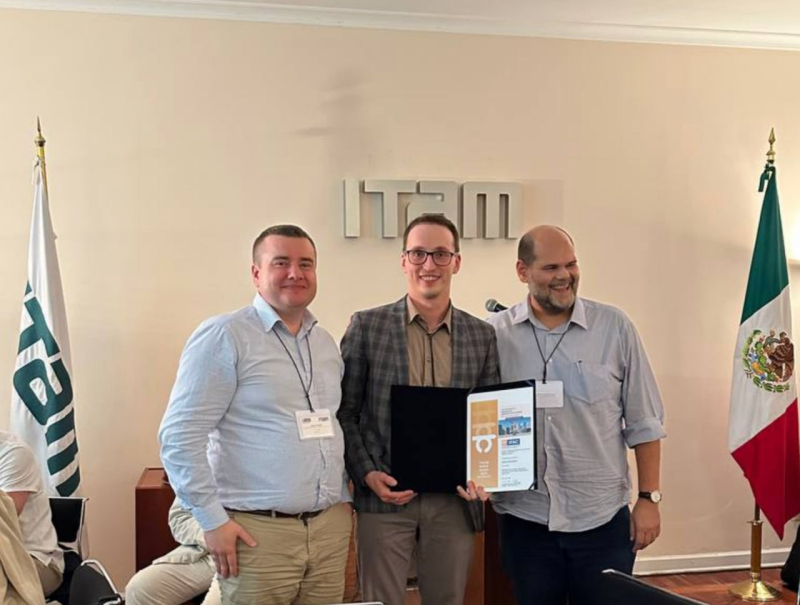
Anton Pyrkin and Nikita Mikhalkov at the awards ceremony. Photo courtesy of the organizers
“For young researchers, the conference is a chance to meet the world’s leaders in adaptive control in a working and informal setting. We therefore believe we should not only take an active part in the event’s organization but also attract fledgling researchers. This year, our center was noted by the conference’s organizers, which once again proves that our specialists are working on relevant and significant tasks. Their papers are published in the world’s leading journals, including Automatica, IEEE Transactions on Automatic Control, and the proceedings of A* conferences. We also actively cooperate with our industrial customers, including Diakont, HUAWEI, Gazprom Neft, and Severstal. Our center is home to all kinds of developers, from Bachelor’s students to professors, and we also welcome all inquisitive and active researchers,” explains Anton Pyrkin, the dean of ITMO’s Faculty of Control Systems and Robotics.