Equestrian statues
Where do you usually find a horse in a monument? First and foremost, under a rider. During the times of the monarchy, equestrian statues were popular among rulers, as horses symbolized strength, nobility, and leadership.
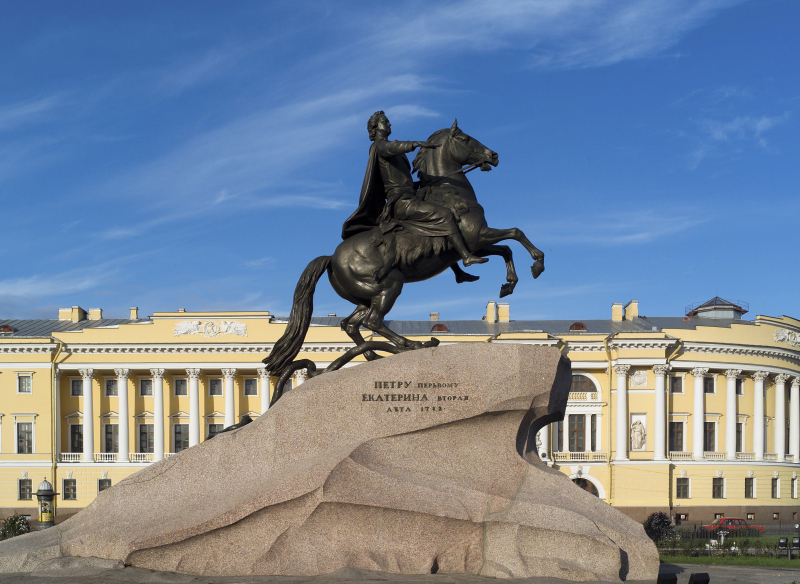
To our luck, St. Petersburg has no shortage of iconic examples. Start with the Bronze Horseman, the monument to Peter the Great. Here the horse tramples a serpent, seemingly a reference to the first Russian emperor’s fight against treachery and enemies. Wishing to capture the animal’s natural movement, sculptor Étienne Maurice Falconet reportedly had an officer pose on a rearing horse daily for three years while Falconet sketched it from life. Another equestrian monument to Peter the Great can be found at Mikhailovsky Castle.
Nearby, on St. Isaac’s Square, stands the monument to Nicholas I. The six-meter statue was considered a technical wonder at the time of its creation: it’s one of only a few bronze equestrian statues supported by just two points, the horse’s rear hooves. The horse was sculpted by Pyotr Klodt, a name we’ll encounter more than once in this article. Contemporaries also noticed that the monument to Nicholas I is aligned with the Bronze Horseman and stands at almost the same distance from St. Isaac’s Cathedral. This coincidence inspired a local joke about Nicholas trying to “catch up” with Peter, only to be stopped by St. Isaac’s Cathedral.
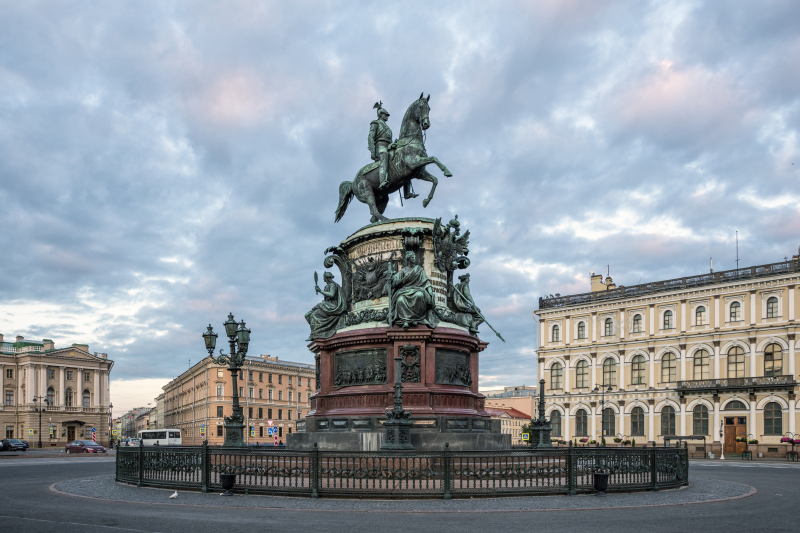
Credit: Andrew Shiva via Wikimedia Commons
Moving on to the Marble Palace, we find the equestrian statue of Alexander III. Today, it is tucked away in the courtyard, though it wasn’t always there. Originally, the monument stood on Vosstaniya Square (then called Znamenskaya Square) but was removed after the revolution. Because of its unusual appearance, the statue quickly became part of local folklore. Compared to other grand equestrian monuments, Alexander III looks bulky and squat, which made it a frequent target of jokes, especially because the horse appears to have no tail. In fact, this was not a mistake but a deliberate choice: the sculptor Pavel Trubetskoy depicted a horse breed that naturally lacks one.
Chariots
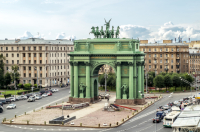
Another way horses appear in the cityscape is through chariots that celebrate military victories. The Narva Triumphal Arch, dedicated to Russia’s victory over Napoleon, is crowned by Nike, the goddess of victory, riding a triumphal chariot drawn by six horses. This sculptural group was created by the same master Pyotr Clodt whom we’ve mentioned before.
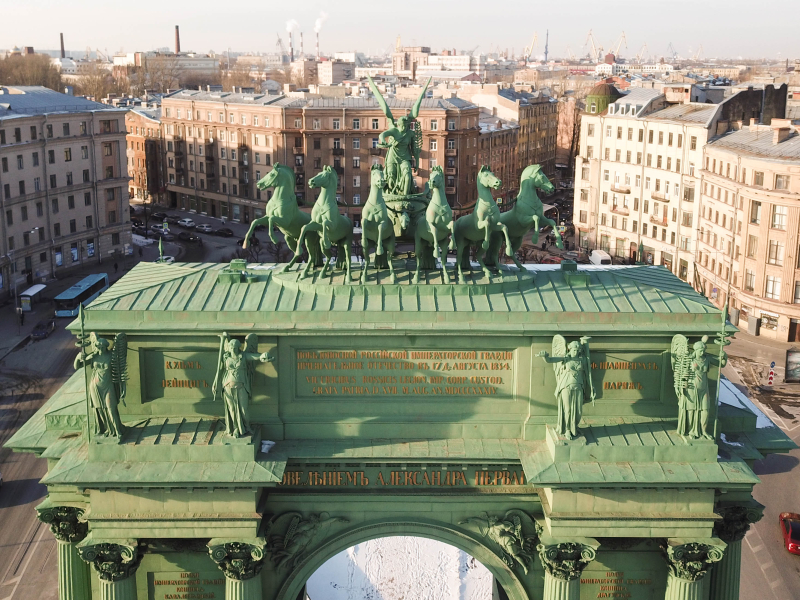
Credit: Nikolai Bulykin, CC BY-SA 4.0, via Wikimedia Commons
Another six-horse chariot tops the Triumphal Arch of the General Staff Building on Palace Square. The original design was supposed to have angels, but Emperor Nicholas I, who supervised the project after the death of Alexander I, insisted on the chariot commemorating Russia’s victory over Napoleonic France as well.
However, not all chariots carry a military message. The Alexandrinsky Theatre is adorned with a quadriga, a chariot drawn by four horses driven by Apollo. Here, the image symbolizes the triumph of art, light, and harmony.
Castor and Pollux
Castor and Pollux are figures from ancient Greek mythology, known as the Dioscuri. They were twin brothers, and are traditionally associated with horses, horsemanship, and protection of travelers and warriors.
Statues of these mythological twin brothers with horses adorn the entrance to the Manege. Today it houses exhibitions, but originally it served as an indoor riding arena. The marble duo are smaller-scale copies of the famous statues. of Castor and Pollux from the Fountain of the Dioscuri in Rome, commissioned directly from Italy by Giacomo Quarengi.
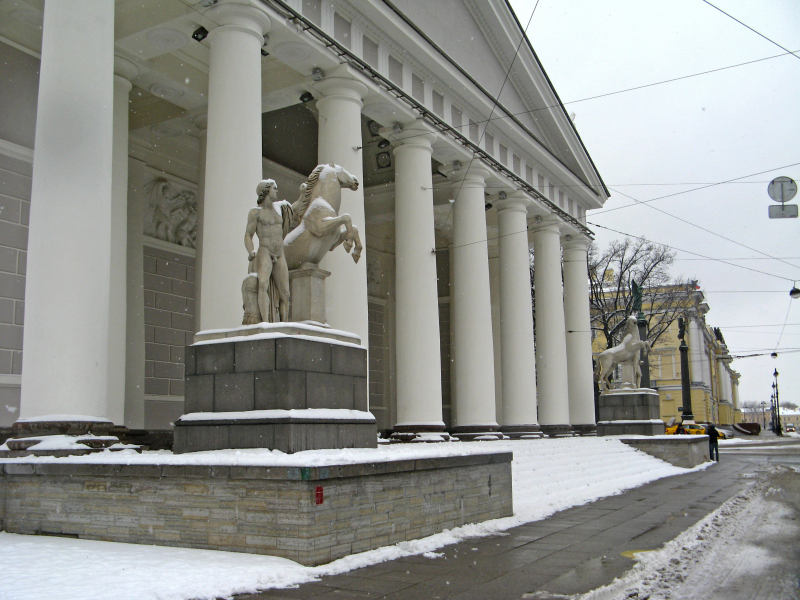
Credit: Ekaterina Borisova, CC BY-SA 4.0, via Wikimedia Commons
Another striking image of Castor and Pollux once crowned the nearby German Embassy building. However, in 1914 the statues were dismantled: according to popular rumors, they allegedly concealed German espionage equipment inside.
More horses to find
Some of the horses most beloved by both locals and tourists adorn the Anichkov Bridge. This is the famous sculptural group The Horse Tamers by Pyotr Klodt. The four statues symbolize humanity’s triumph over untamed nature.
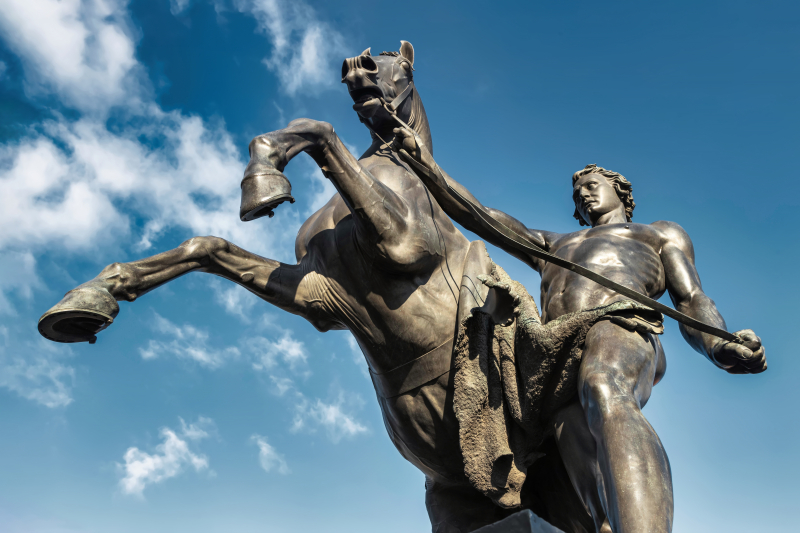
Credit: Elena Nechiporenko, CC BY-SA 4.0, via Wikimedia Commons
Credit: Ekaterina Borisova, CC BY-SA 4.0, via Wikimedia Commons
If you wander into the courtyards of Kolomenskaya Street 45, you’ll spot two striking cast-iron horse heads mounted on a facade. This building once housed a large stable, and today it serves as a veterinary station.
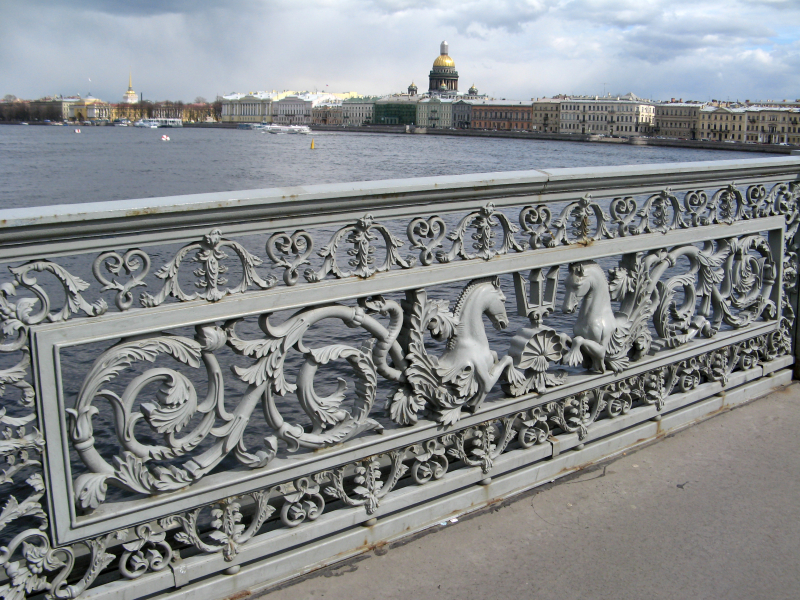
Horses also appear in more unexpected forms. On the railings of the Annunciation Bridge, each central section features symbols of the water element designed by architect Alexander Bryullov: Neptune’s trident, a shell, and two sea horses with arched necks and fin-like hooves.