You’ve been doing chemical research since your Bachelor’s studies – for more than 20 years now. Why did you choose this field?
My passion for synthetic organic chemistry came to me in high school. I used to picture the structures of molecules I wanted to create and how I’d synthesize them in a laboratory. As a student, I believed chemists and engineers were much alike: both have a blueprint (for a molecule or a house) and if they follow it, they will obtain the results they envisioned. Now, many years later, I realize that I wasn’t that wrong.
There was also another, more practical reason. In school, I loved studying life sciences, and I was especially good at zoology and botany. At that time, chemistry was a more promising field in India in terms of career opportunities as it’s closer tied to the industry – it'll be easier for you to find a job there if you, say, develop fuels, motor oils, textile, dyes, drugs, or polymers. I opted for chemistry and enrolled in the School of Chemistry at Madurai Kamaraj University. It’s a state university in my hometown; it has a good reputation, especially in organic chemistry.
If it’s that easy for chemists to find work in India, why did you choose to continue as a researcher?
My fascination with science started when I was a third-year Bachelor’s student. Not long before that, in 2000, Alan Heeger, Alan MacDiarmid, and Hideki Shirakawa received the Nobel Prize in Chemistry for the discovery and synthesis of conductive polymers. They demonstrated that these materials aren’t actually insulators and can conduct electricity as efficiently as metals after a special chemical treatment. Today, conductive polymers are used to create batteries, solar cells, flexible OLED displays for smartphones and TV, and anti-corrosion coatings for ships. At that time, I was deeply impressed by this discovery and thought to myself that it’d be amazing to see my own name in a journal; I could become a celebrated scientist and people from all over the world would know about my breakthroughs. Better still, there’s no boss in science; you get to develop and take full responsibility for your work and your results. It’s not like that in the industry – you have to follow algorithms. All that inspired me to build an academic career in science.
During my Master’s, I began treating research more seriously and even started preparing for my future PhD exams. In India, applicants have to take several entrance exams: CSIR-UGC NET (to secure a scholarship, work as an assistant professor, and pursue a PhD in natural sciences) and GATE (to get admitted into engineering and natural science programs). The exam is a tough nut to crack and is so difficult that, even though I prepared, I couldn’t pass them on the first try. But I didn’t waste my time between the attempts; I worked for seven months at a pharmaceutical company where I synthesized cephalosporin-based antimicrobial drugs. This experience gave me an additional advantage when I took the exam again.
After I passed, I started my PhD program at CSIR’s Central Leather Research Institute and in 2010, I earned my degree in organic chemistry. After that, for four years, I worked as a postdoc at Chimie ParisTech and then Aix-Marseille University. Working abroad helped me realize what field I would like to pursue myself – I wanted to study the optoelectrochemical and other functional properties of organic semiconductors for emerging organic photovoltaic technologies (the conversion of sunlight into electricity).
I came back to India in 2015 and until 2024 I ran my own research team at the Central Electro Chemical Research Institute. It is a part of the Council of Scientific & Industrial Research (CSIR) in India, which is a major community of the country’s top-tier research centers that work on various industrial and societal projects of national and international importance – from electrochemical science to sustainable energy. After winning the Commonwealth Fellowship program and a FAPESP grant, I went to the University of Strathclyde (Scotland) and the University of Sao Paulo (Brazil), respectively, between 2024 and 2026 for collaborative research. In my independent research, I specialize in chemical engineering, synthetic organic chemistry, and organic solar cells – and it was the latter that led me to start working with ITMO.
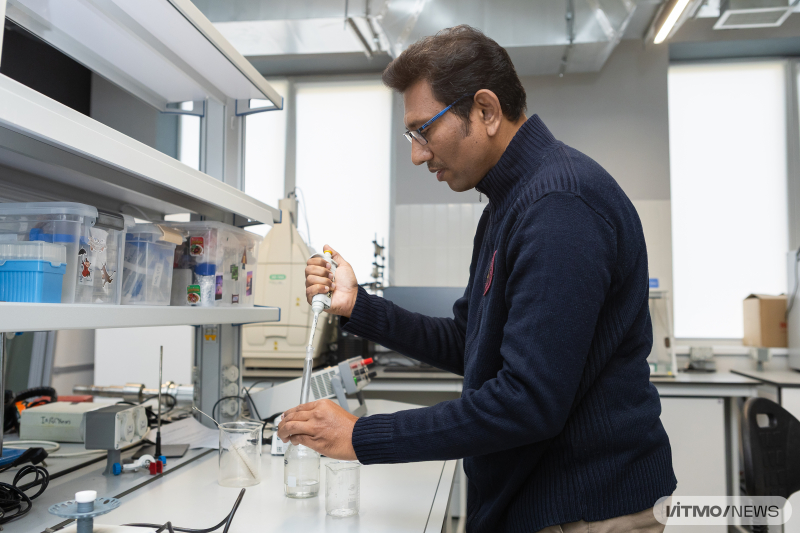
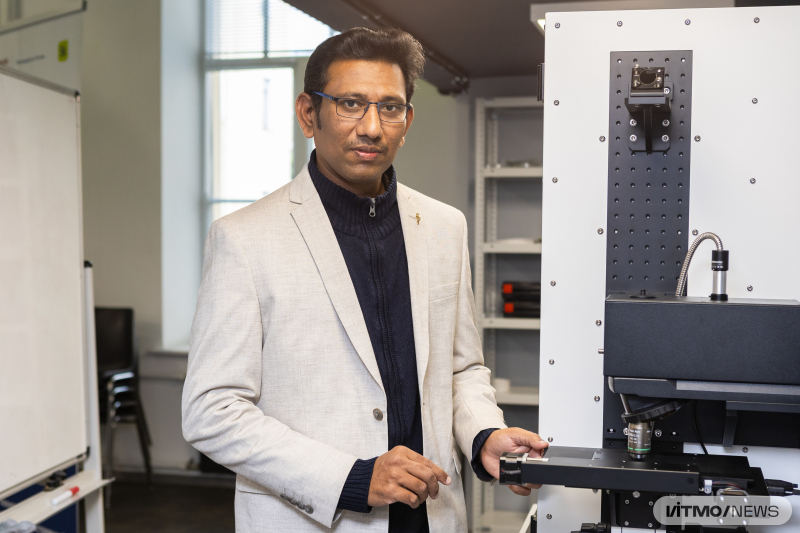
Praveen Chandrasekar. Photo by Dmitry Grigoryev / ITMO NEWS
Please tell us more about the project that brought you to Russia. From what I know, it has something to do with the development of photoelectric technologies for next-gen organic solar cells.
As you know, India is a sunny country, and I’m from its southernmost state, Tamil Nadu. Sunlight, especially when there's a lot of it, is an excellent source of renewable energy that can be converted into electricity. It’s done using solar cells, typically silicon ones. Though the material is affordable, its ultrapurification remains highly expensive, and if silicon materials contain any impurities, they simply won't convert energy into electricity efficiently. And there’s one more hurdle: silicon-based solar cells are still produced in plate form, which makes them thick and bulky.
As an alternative to silicon cells, researchers are working on next-gen organic photovoltaic materials. To ensure that the new material is lightweight, flexible, and stretchable, they use carbon, hydrogen, nitrogen, and oxygen – combined into a single material, these substances can easily coat even a flower vase. What’s more, organic solar cells can be printed, like a sheet of paper, while silicon ones have to be factory-made.
I’m working in an emerging field that holds much promise – these are π-twisted semiconductors for organic solar cells. Usually, semiconductors have to be linear and flat; this is the only way negatively charged electrons and “holes” – positively charged particles – can move from one part of a semiconductor to another and pass energy along. If twisted, electrons and “holes” can hardly move.
You may ask yourself: “Why would anyone study π-twisted semiconductors if they complicate the energy transfer process?” But the thing is, the method has its advantages that we are specifically interested in. For example, twisted semiconductors absorb light at very low concentrations, efficiently separate charges under light exposure, and also dissolve in most organic solvents. The latter is one of the critical factors for solution-based production of thin and flexible organic solar cells. For one, these technologies can be utilized to produce and collect converted energy. Although the field may seem not fully developed yet, I believe prospects will outweigh limitations regarding structure geometry and charge carrier mobility – and this thought makes me want to move forward.
Praveen Chandrasekar. Photo by Dmitry Grigoryev / ITMO NEWS
You’ve recently joined ITMO via the Fellowship program. What made you choose ITMO?
I learned about ITMO four or five years ago; back then, I became a sort of a fan of Prof. Ekaterina Skorb, the director of ITMO’s School of Life Sciences and the head of ITMO’s Infochemistry Scientific Center, who has also built a name in machine learning, AI, and digital chemistry. So, I wanted to find out more about how mathematics, AI, physics, chemistry, and materials can come together in just one field.
In 2021, I had the chance to talk to her online. At that time, I couldn’t apply for the Fellowship program because I was on a visit to RWTH Aachen University (Germany) and the University of Wrocław (Poland). Everything changed last year; I contacted Prof. Skorb again and she accepted my collaboration offer.
The idea was to drastically reduce the laboratory workload for the project. As an experimental chemist, I look for candidate compounds for the synthesis of organic semiconductors, conduct chemical reactions, purify, and analyze the functional properties of polymers (e.g., crystallinity, absorption, redox behavior, fluorescence, and solubility). In practice, teams need at least five months to build five molecules from scratch, but even these kinds of efforts don’t guarantee success. We’re trying to incorporate generative ML and computational models into our research to predict the physical and chemical properties of substances based on their structures. These technologies will help us design and screen libraries of new compounds before the synthesis stage. As planned, the approach will help cut the time down to just one month.
ITMO invites scientists, lecturers, and laboratory heads from all over the globe to launch their projects in St. Petersburg. Participants are able to visit ITMO for two weeks or longer in order to implement their research ideas, work with strong teams, and deliver courses for students. Learn more about the program here.
It’s your first time in St. Petersburg. What do you think of the university and the city so far?
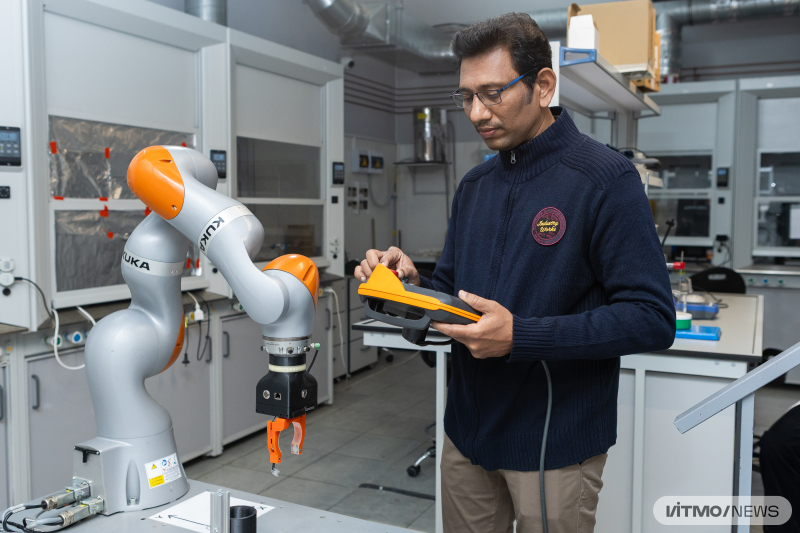
I’d recommend my students to come on an academic exchange to ITMO. First of all, there are many laboratories and varied facilities here, some of which I had never seen before – for example, a robotic arm that can automate some experimental procedures. Secondly, ITMO is indeed an unconventional university. I believe the researchers here don’t pursue pure chemistry and material sciences; instead, they develop new areas for research at the intersection of these fields. For that, they have a high bar for training in mathematics, AI, machine learning, robotics, and other fields. And finally, there’s always some lecture or seminar happening, so students never get bored. In fact, I delivered three lectures at the university, and I know for a fact this is a great experience that allowed me to interact with highly qualified specialists and students.
As for St. Petersburg, it’s a nice city. One of ITMO’s campuses – the one where I work – is located right downtown. So, here I’m not just a scientist but a tourist, too. I’m taking every opportunity to explore the city, whether it means going to the Kazan Cathedral and the Church of the Savior on Spilled Blood or walking along Nevsky Prospect. And one more thing I can say for sure: Russia might be cold, but the people here aren’t.

ITMO’s Lomonosova campus. Photo by Dmitry Grigoryev / ITMO NEWS
How do you plan to continue working with ITMO?
I’ll go back to India to join as a research faculty at SRM Institute of Science & Technology, a new environment to test the compounds we discovered via machine learning at my laboratory.
Together with Prof. Skorb and another colleague from China, we’re also working on a joint application for a BRICS project in which we will study how machine learning can be used to design and develop new organic functional materials for battery applications. Currently, we’re discussing what kind of expertise each of us can bring to the table and where our findings can be applied most efficiently. If successful, we’ll receive funding for our project (as researchers from the BRICS countries), and I’ll be able to visit ITMO more often.
You were ranked among the world's most influential researchers in organic chemistry twice, in 2022 and 2023. So, one can say your dream of making a name for yourself has come true. How did you manage to get onto the list twice and what would you recommend to future scientists?
I work at the intersection of synthetic organic chemistry, solar cell development, and sustainable chemical technologies, so my publications come across many different researchers, which increases my chances of getting noticed. Currently, I have a fairly good citation rate and h-index. I don’t think I’d reach this level if I chose to focus merely on organic chemistry exclusively. I also strive to find practical applications for my findings. They should help solve some important social problems at home, and I also want them to be easy to implement in industries. Research that never leaves the lab won’t ever be noticed or valued by your colleagues or business partners.
The second factor is publication activity. My first paper was published in 2008, 18 years ago, and all this time later I am still doing experiments with passion. You should also pay attention to the flagship journals you want to get published in – they should be peer-reviewed and Q1 or Q2. For chemistry, these are publications from the American Chemical Society, The Royal Society of Chemistry, and Wiley Online Library. It won’t be easy to get in – but in the end, you’ll definitely get noticed.