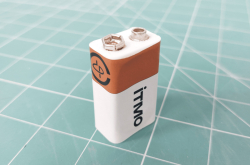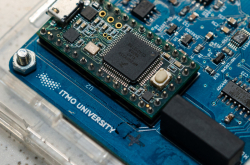
Although many devices can be charged wirelessly, such as phones, watches, and earphones, a significant number of appliances still run on AA batteries: computer mice, remotes, microphones, and even string lights. At the same time, connecting a wireless charging receiver to them via USB is impossible because they do not have such a port. Researchers from ITMO University have found a way to overcome this limitation: they came up with a power cell that looks like a regular battery and can be charged wirelessly without being taken out of the appliance where it’s being used.
The device's operating principle is based on the same effect as conventional wireless chargers. Inside any Qi-standard charging station there is a transmitting coil that creates an alternating magnetic field at a frequency of 100-200 kHz, that is, 100-200 thousand oscillations per second. To capture this field, the researchers placed a receiving coil inside their battery.
“We couldn’t fit a flat coil inside an AA battery – it was either too big or its curves were too small and could barely sense the transmitter. We had to curve the coil along the battery’s cylinder so that it would capture a larger share of the magnetic field. Next, the alternate current focused by the magnetic field is rectified, brought to the required voltage, and used to charge the built‑in lithium‑ion battery. After that, another converter brings the voltage down from the typical 3.7-4.2V of such batteries to the standard 1.5V at the output for an AA cell. Thanks to this, the powered device recognizes our battery as a regular AA cell and operates correctly,” shares Nikita Olekho, the head of the project and a senior researcher at ITMO.
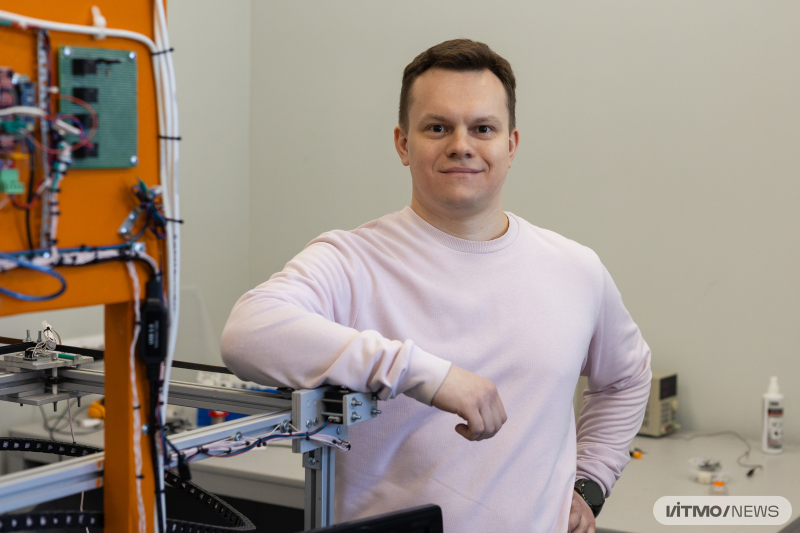
Nikita Olekhno. Photo by Dmitry Grigoryev / ITMO NEWS
“Many rechargeable batteries that mimic AA ones have a common trait: they show full charge until the very last moment and then shut down unexpectedly. This is due to the nature of voltage converters in the batteries, which maintain a 1.5V output at all times, even when the battery is almost empty,” adds Aleksey Dmitriev, the lead developer of the device and a researcher at ITMO.
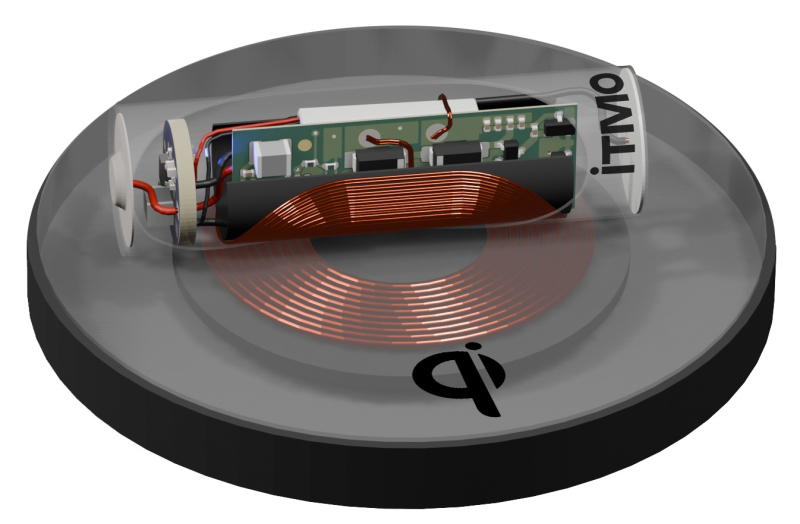
A 3D model of the battery prototype. Image courtesy of the researchers
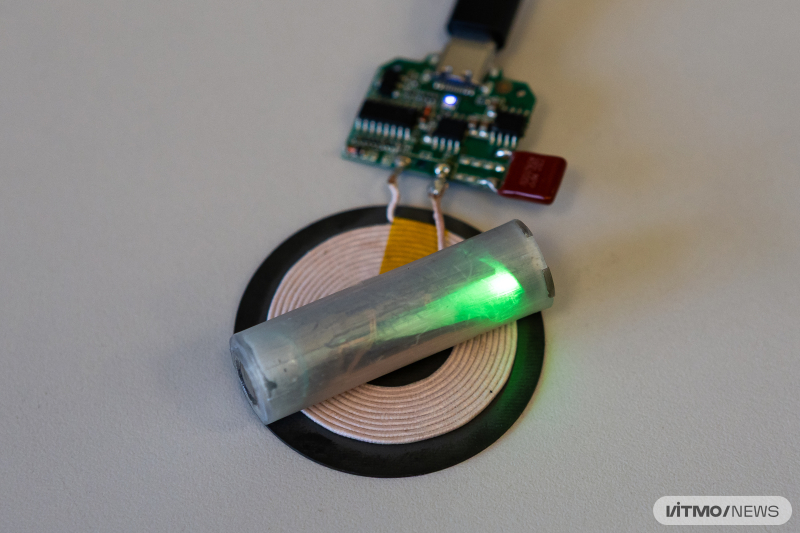
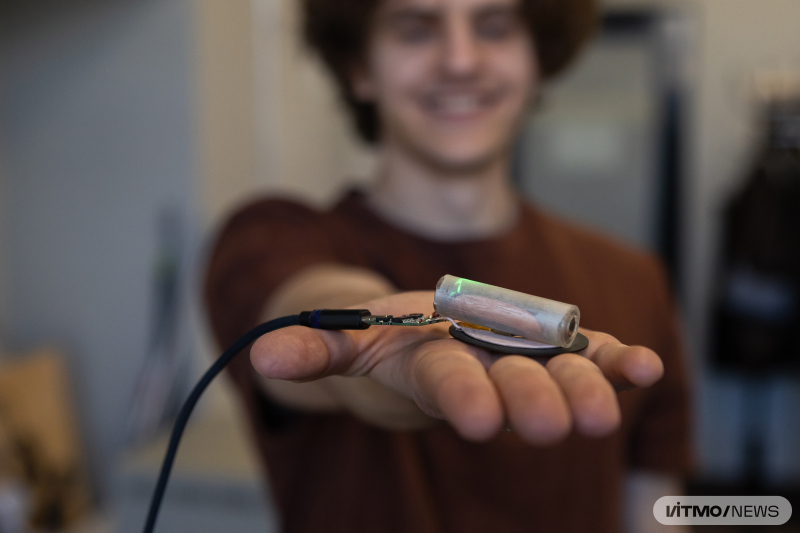
The AA battery charged by a Qi station. Photo by Dmitry Grigoryev / ITMO NEWS
That’s why the team decided to take another route and assemble a converter that gradually lowers the exit voltage as the battery discharges. The device using the battery detects this drop and has time to send a signal, for example by blinking an indicator or showing that the charge is running low. Usually, such solutions require a microchip, but the ITMO team didn’t use one and has already patented their solution.
The current prototype is assembled in a transparent cylindrical casing, 3D‑printed from photopolymer resin, which is non‑conductive and does not interfere with the coil’s operation. Inside, there is a 65 mAh battery that fully charges in about an hour. Thermal imager tests showed that even after an hour of continuous charging, the case temperature does not rise above 40°C, which is a safe level both for the battery itself and for the device it is inserted into.
The project grew out of an assignment for students of the Bachelor’s program Wireless Technologies. The main condition was to create a working device – first, the students chose a simple nine-volt battery and later the project was expanded to include the more complex and more widely used AA battery. As they looked through the patents and research on the matter, the team discovered that there are many ideas but not a single full prototype either in Russia or internationally.
In 2024, the project became a part of a state assignment for the development of wireless energy transfer technologies for use in the Arctic.
“In a severe cold, it’s not convenient to remove the battery from the device and fuss with wires and connectors, as everything quickly becomes covered with ice, and the plastic turns brittle in the cold and can be easily broken. With wireless charging you don’t need to touch the battery compartment at all: it is enough to place the device on the charging station, and it will start recharging by itself. That’s why by the end of 2026, we are planning to make a version with a low-temperature battery,” says Nikita Olekhno.

The project team. Photo by Dmitry Grigoryev / ITMO NEWS
Now, researchers are in the miniaturization stage. Next-gen circuit boards are smaller so there is extra space inside the casing to fit a more powerful battery. The team aims to reach the same ratio as in rechargeable batteries shaped as AA cells with a built-in USB port: so that 20-30% of space is taken by electronics, with the battery occupying the rest. This will provide enough capacity to support daily use in computer mice, remotes, and toys.