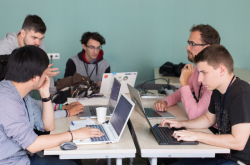
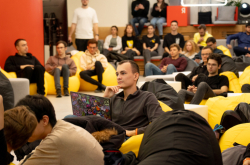
Yandex Education’s two-week intensive course lets students of different universities study, live, and work on projects together. Thanks to this format, participants get to know frontier technologies, solutions, and research via the expertise of Yandex and top universities. This is also an opportunity to explore a specific field and choose an IT career.
For the program, Yandex Education invites the country’s leading universities to host the activities. On October 17-30, ITMO and St. Petersburg State University served as such hosts, curating respectively the tracks Algorithms and Mathematics. This final course of the year was available only to students who had completed one of the past seasons of the program.
Students were encouraged to understand which algorithms and data structures serve as the basis for various tools. Through this competency, future professionals will be able to evaluate solutions suggested by others and create their own. During lectures, students learned how algorithms are used in payment system design, graph systems, planners, deduplication, retry policies, and data storage synchronization.
“We taught our students to apply algorithmic thinking: to not simply select the tools like hashing or a pyramid, but to consider a problem as a whole, see its nuances, and choose an efficient implementation at each step, taking into account the time, space, and other constraints. That’s what distinguishes a developer from a coder: the latter solves the task at hand, while the former thinks through to the next step – where a solution can break, what needs to be compromised, and which approach will lead to the most robust result,” says Anton Permyakov, a lecturer in the Algorithm track and an associate professor at ITMO’s Information Technologies and Programming Faculty.

Anton Permyakov. Credit: Dmitry Grigoryev / ITMO NEWS
In parallel to the main program, participants worked on industrial cases suggested by Yandex and ITMO, including projects on robotics, machine learning, datasets, and computer vision. Each project team was made up of students from different cities and universities. Over the course of two weeks, they had to take on a problem and suggest a solution.
“This course’s idea was also to encourage student mobility: to offer them an opportunity to experience different universities, work with various experts, and not only deepen their knowledge but also broaden their horizons. This aspect is also very important for ITMO’s team of educators: we get to see the level of training of students from other universities, what they know, and how they learned it. It’s like a conference, but here we get to see what’s going on in the world not via a presentation on a narrow topic but through a product and students who came to us,” shares Alexander Mayatin, the executive director of and an associate professor at ITMO’s Information Technologies and Programming Faculty.

Alexander Mayatin. Credit: Dmitry Grigoryev / ITMO NEWS
Each team had its mentors, who helped participants define their problems, reviewed their work, considered risks, and supported students until their defence.
At the end of the course, participants had to defend their projects in front of experts. The cases encompassed several fields: computer vision and machine learning, data search and processing, algorithm optimization, and distributed systems management. Students developed tools to detect objects in images, compare and verify datasets, and accelerate calculations, as well as solutions for robot coordination, cross-device data exchange, and sensor monitoring.
One of the projects that involved an ITMO student focused on automatic search and identification of makers’ marks on ceramical archeological finds. The team developed a computer vision system that finds a maker’s mark on a photo of an object and then compares it to the catalog of over 3,000 reference images. The algorithm accounts for potential image artifacts, such as distortion, low resolution, or lighting, and suggests the most likely matches. This technology can facilitate the work of archeologists and ceramics specialists who have to manually search for and match such makers’ marks.
“For our project, the lecture on caching turned out to be really helpful. We had a computer vision task: we needed to train a model that transforms an image of a maker’s mark into a numerical vector and then compares it to others. Having first understood the principles of working with data in caching, we were able to better understand the technologies that we subsequently used in our project,” says Ekaterina Gubareva, a second-year student of computer technologies at ITMO.

Ekaterina Gubareva. Credit: Dmitry Grigoryev / ITMO NEWS
The final projects may still continue. In previous seasons, some student teams grew their solutions into startups. A course completion certificate may also offer benefits when applying to ITMO Master’s programs.
“We work in partnership: universities offer the foundational curriculum, while Yandex shows how to apply this knowledge in practice. We introduce students to the office and the industry atmosphere to let them see how a product team works. Our task is to give students an opportunity to not only gain knowledge but also apply it and see how it works in real-world tasks,” adds Alena Rymshina, the head of intensive learning formats at Yandex Education.