These days, it’s hard to find a field, especially a digital one, that doesn’t use AI, and product design isn’t an exception. Which tasks can a designer delegate to AI and which should remain solely a human responsibility? How will it benefit the product and the professional behind it?
I think that it’s easy to overestimate the role of AI, especially in product design. Many fledgling specialists just delegate every stage of their work to AI, including the idea and concept, interface development, and the choice of visuals. However, as they don’t have extensive experience, it can be hard for them to assess the result. At first glance, the generated mockup may seem okay, but the mistakes, as always, are in the details: the prototype has non-optimal interface patterns and extra elements, it’s overloaded, or the model has hallucinated. Experienced designers can spot generated elements at a glance. It’s like noticing the extra details that AI-generated images were so infamous for earlier: at first, everything seems okay, but look a little longer – and you will see that something isn’t quite right. It’s the same with an interface. You can always spot traces of AI: unnecessary functions, elements out of nowhere, and filters that can’t properly work.
That’s why it’s much better to delegate smaller, precise tasks to an AI tool. For instance, it can generate a demo text used to temporarily fill out a page, or make temporary images so that the mockup doesn’t look too empty (generated images can’t stay on permanently because they’ll likely not fit the product’s style). An AI can also be used to quickly find all the buttons on the mockup and change their roundness, say, from 30 to 20, while keeping their tokens and functionality. I would say that you shouldn’t delegate anything else to AI.
In 2026, Nielsen Norman Group introduced the term “AI UX debt”: teams generate interfaces faster than they can test them, thus creating issues for users. Is this a widespread problem? Who should be responsible for the elimination of such debt within a team?
Some developers may be told “We’ve bought you 20 tokens, let’s make two new features using AI.” I haven’t yet heard about such things from designers in the Russian market and I don’t think anyone wants to make 20 new features in a month, so we don’t have such debt. Testing has to be integrated into the process, not relegated to someone else: if a task is done with an AI, it has to be validated by an experienced designer or product manager; using AI should be a weighted decision.
Have your personal practices changed with the advance of AI tools? What do you use and rely on and what will you definitely never use?
Actually, my work has barely changed. The process stays the same: it always starts with discovery, where we study the problem and product demand, and then we develop solutions. I turn to AI at separate stages: when I’m generating ideas, it can quickly collect references and offer styling tips, but manually you can find more references that would be more diverse. I see AI as a junior-level assistant who can take on routine tasks, but you still have to check their work.
Neural networks are also useful in design systems. A design system is a set of components and patterns used across the entire company: they are created once in Figma and in development, then reused by everyone. Specialized teams of designers and developers create and develop the design system, and among their tasks are plugins that speed up component updates. The components themselves, especially the code, can also be generated by a neural network, although the code still needs to be refined afterward. At the same time, idea generation and key decisions should remain with people, because without experience and an understanding of context, the result is weak.
Speaking of current trends, many believe that conventional tile-like interfaces are becoming obsolete and the future is with dialogue systems. Do you agree with this opinion? What will happen with virtual design if users stop using buttons and start chatting with their apps?
I think the need for dialogue systems depends on the target audience and the context. Users always behave differently: some scroll through the features without knowing what they want, others go to a specific category, and still others know exactly what they want and type in a query. The dialogue format works like a search engine, but not everyone knows what they want a service to do – and that’s the main problem. The usual buttons help us see what a product can do, while a person faced with an empty input field doesn’t know what to do. A user without a specific goal will see the “What can you do?” button and click on it. So, buttons don’t go anywhere, they just move inside the dialogue. That’s why assistants are handy in services that people use for specific tasks: for instance, Gosuslugi (the Russian state services website – Ed.) has long ago introduced their text assistant, and it’s a logical solution there, because people usually turn to it with a specific query.
It’s different for marketplaces and delivery services. Many open the app without knowing what they want; it’s also inconvenient for users to describe it in a chat. I can hardly imagine that many users would need to solve their task with such an assistant. That’s why for such services it’s more about keeping up with the trends than responding to actual user demand.

Ilona Sarkisova. Credit: Ksenia Plesovskikh
If you were a student who is only thinking about product design, what single skill, apart from Figma, would you focus on to become a sought-after professional in three years?
Around 10 years ago, when I started my career, there was no such thing as a product designer, only UX/UI designers. Back then, I could develop as an interdisciplinary specialist: I did interviews and studies, created prototypes, and generally took any job there was. I started in B2B, where the main task was building a logical interface that would be convenient, easy to use, and transparent; the visuals were less of a priority because there weren’t many products with strong visuals.
Today, everything has changed, so the key skill I’d focus on is being able to make interfaces that are logical and visually strong. Now that outsourcing has gone down, there’s significantly less B2B in Russia, so the majority of designers are transferring to B2C, where the market is taken up by major companies with mature products: Yandex, Avito, Cian, VK, and others. Their products are in a highly competitive environment, so they require solid composition, typographics, colors, and layouts. Such skills are usually studied at art schools and courses, and I myself am still polishing those.
Education is also rapidly changing. Some skeptics say that what was taught at universities five years ago is no longer relevant. Do you agree? As an ITMO graduate, what skills or knowledge gained at university did you get to use in your professional life?
University opens our worldview and teaches us to study on our own, which is a skill many lack these days because of AI: you ask it, you get an answer, and that’s it. At university, you learn to look for information, identify the key facts, and apply them in practice. It’s an important skill in life, and especially in design and IT. Educational curricula grow outdated in a couple of years anyway, because the technologies, approaches, and demands change. That’s why universities offer competencies and knowledge, not specific skills. You can spot good graduates based on their worldview and the abilities to self-study, manage their time, and take on responsibility. This is more about soft skills than hard professional competencies.
I have benefited from my education in my career. I completed my Bachelor’s in computer technologies and thanks to that, was able to find a part-time job as a developer and gain foundational programming skills. In the Master’s program Multimedia Technologies and User Interface Design, I learned data analysis methods, including mathematical and statistical analysis, which is unknown to most designers. That’s why I can speak the language of developers, researchers, and designers.
How should we train professionals to make sure they are in demand after graduation?
University graduates are well-read, but not ready-made employees. It’s rarely the case for people to land a serious job straight out of university. It’s especially noticeable now: it’s become expensive to grow specialists internally, so companies bet on independent, mature professionals. In such conditions, universities should offer students a broad worldview, as well as self-learning and self-management skills. It’s also important to work with applicants to help them understand why they study. Many believe that a diploma will guarantee them a job, but it doesn’t always work that way: you should come to a university for skills that will become your starting point.
This year, you took part in WUD@ITMO, a conference that’s been held at ITMO for the 12th time. Why did you decide to join it? And what role do such conferences play for the professional community?
After I graduated, I stayed on at the university for four years to teach Master’s students, and I noticed how students change year after year. That’s why I am always curious to attend university events and present at them. Such conferences offer the most help to young professionals and students who are only learning about a career – for them it’s a chance to meet the right people or even land a job. I got my first job at a big company thanks to the ProfsoUX conference that I attended as a student. I was approached by an expert from the company who asked for my portfolio and gave me a recommendation. So, students can come to such events with no expectations and leave with an offer.
By the way, at WUD@ITMO I was approached by a young woman who wants to work at VK, and I took the time to review her portfolio. This kind of networking is especially important nowadays, when landing a job just by responding to a posting has become quite difficult.
About WUD@ITMO

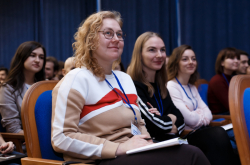
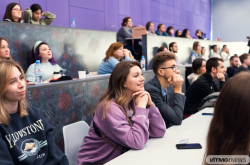
WUD@ITMO. Credit: Ksenia Plesovskikh

WUD@ITMO. Credit: Ksenia Plesovskikh

WUD@ITMO. Credit: Ksenia Plesovskikh
WUD@ITMO is a conference on UX, design, research, and interfaces that’s annually held at ITMO to mark World Usability Day. The event is organized by the Faculty of Software Engineering and Computer Systems and the Center for Usability and Mixed Reality. The conference is open to anyone interested in UX/UI: designers, researchers, product managers, developers, and students; any industry or academic expert can give a talk. At the conference, speakers discuss UX solutions and practices at Russian companies, while students learn about current market demands.