Bare minimum: AI edition
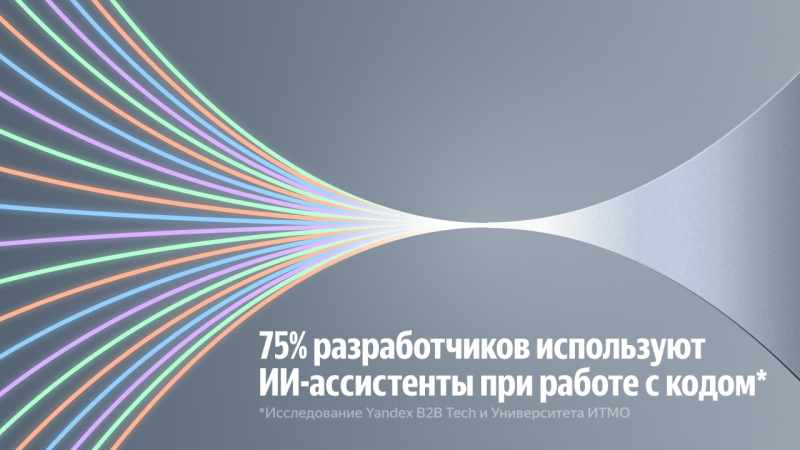
According to the participants, whether to use AI or not for job tasks is no longer a question. The recent statistics confirms the trend of the mass use of AI coding assistants: 75% of surveyed IT specialists admit to using AI to code, with more than one in four using the technology for other tasks such as generalization and analysis of documentation (57%), technical text analysis (18%), and information search (15%).
Popular IT hubs
Most IT experts (75%) opt for one of the three global platforms: GitHub, Atlassian Bitbucket, or GitLab. However, there’s a growing interest towards domestic solutions: 49% of respondents show a positive attitude towards Russian platforms due to their geopolitical and information security, as well as Russian language support. Meanwhile, IT specialists turn to coding assistants in their jobs, but fully delegating the work to AI agents, nevertheless, isn’t that common yet.
AI in the workplace
As AI becomes more ubiquitous, IT specialists have to rapidly adapt to changes. The majority of tasks of testers (62%), data analysts (46%), and developers (41%) can be automated by AI, say the respondents. 79% of those surveyed believe that beginners will experience most changes as they are now expected to have at least basic AI skills. To stay marketable, they need to keep up with the technologies, know how to apply them efficiently, and work on their cross-functional expertise. The respondents note: “What used to be expected from a mid-level specialist is now expected from a junior. There’s no such thing as a low entry threshold anymore.”
“Today, we see AI as a tool that can help us develop, employ, and maintain software products faster. At Yandex, our goal is to speed up coding and debugging tasks by 30% and those related to information search twofold. We’ve run some tests and already see results in other aspects – SRE and QA – too. Our clients have access to SourceCraft with a built-in AI assistant that simplifies teamwork, reduces development costs, and speeds up the time-to-market,” notes Dmitry Ivanov, the head of SourceCraft Development Platform at Yandex.
AI in education
AI skills should be taught at universities; 88% universities with software development degrees use platforms such as GitHub, GitLab, or JetBrains Space in the classroom. More than a half of respondents and 79% students train their coding skills and learn to check generated code by using AI assistants: GitHub Copilot, Gemini Code Assist, Cursor AI, and some others.
“Studying how AI assistants and platforms are being applied in different fields is vital for us to see the best practices, as well as existing limitations and future prospects. We purposefully chose to analyze the experiences of both industry programmers and science and education workers. The reason is, universities and research centers are already actively adopting AI technologies in their curricula so that students can acquire hands-on experience in cutting-edge tools and faster integrate into ongoing projects, corporate or open-source. The results of such studies can also benefit AI users, developers, and researchers,” says Nikolay Nikitin, the leader of the ITMO Open Source community and the head of the Laboratory of Automated Machine Learning at ITMO’s Institute of Artificial Intelligence.
You can find the complete survey by B2B Tech and ITMO via this link (in Russian).