Many future scientists discover their passion for science in childhood. Was it the same for you?
Yes, I grew up in a family where everyone had a university degree. My grandfather Sergey Dmitriev was a professor, a DSc in engineering, and an aerospace and internal combustion engine engineer. I grew up watching him teach, write papers, issue patents, visit different countries for conferences and trials, and work with aircraft built at the Tupolev and Antonov design bureaus. He was very active.
I was so fascinated by his work that I decided to follow in his footsteps and become a scientist. I didn’t care much for mathematics and some other subjects, but natural sciences was a different story for me. I started to look into other fields and also tried all kinds of activities: I went to music and art schools and studied foreign languages. My family never restricted me; instead, they were very supportive and never forced me to keep going if I lost interest in something. The only principle they followed was that if one gets bored, they need to find something else to do, not just sit idle. And that’s how I found myself in chemistry.
Creativity is an integral part of chemistry: you get to generate ideas and work with your hands – and each time, you will get a new result. Say, you want to recreate synthesis from some paper; if you don’t follow the procedure down to the detail, the result won’t be the same. Surprises happen all the time, but I like that. Moreover, I believe a negative result is still a result. For me, it’s a chance to relax, start enjoying the process, and figure out a new approach.
As far as I know, you first studied in St. Petersburg, but then – in France and Italy. How did that happen?
Once I finished school, I was determined to get a degree in chemistry and win a scholarship for my studies. As a result, I was accepted into the program in chemical engineering of medicines at the St. Petersburg State Chemical and Pharmaceutical University. But when I graduated, I realized that I don’t have enough expertise in the synthesis and characterization of novel materials – so I applied for a Master’s degree abroad.
At first, I didn’t get a full scholarship, so I started working and took a job as a technologist at BIOCAD. For a year, I worked with documentation and closely communicated with engineers at the departments specializing in scaling and production of active pharmaceutical ingredients. This was my first serious job in the field, and it was excellent practice; what I lacked, however, was R&D. Because of that, I continued applying to universities abroad – my colleagues at BIOCAD supported me in every possible way and helped translate my documents. In the end, I secured a full scholarship for a double-degree program and went on to study physical chemistry at Université Paris-Saclay (France) and materials science at the University of Genoa (Italy).
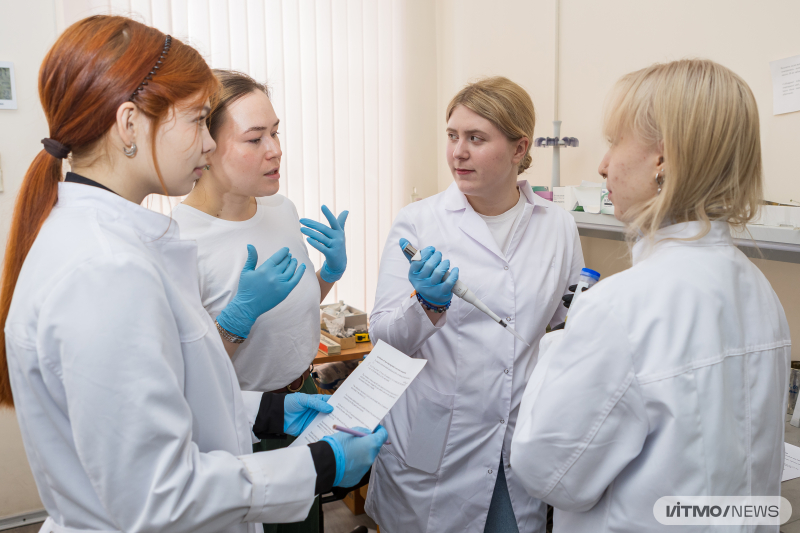
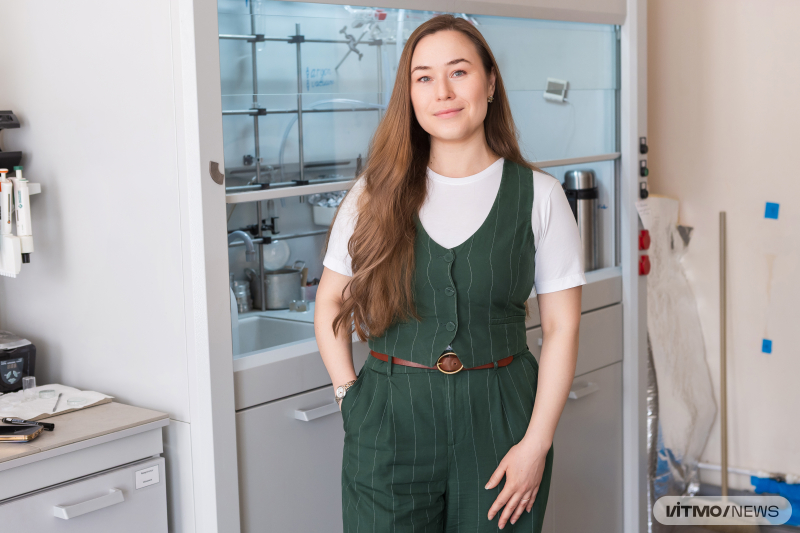
Katerina Kukushkina at the ITMO laboratory. Photo by Dmitry Grigoryev / ITMO NEWS
How were the studies organized? And what did that experience give you?
Usually when I tell people about my studies abroad, they immediately picture me strolling by the Eiffel Tower and having the time of my life at other beautiful landmarks. The reality was different. Because of some document issues, I missed a month of my studies and so when I finally came to France, I had to take midterms in just two weeks. It was even more stressful because it was my first time studying in English outside an English-speaking country. To catch up, I spent days at my dorm or a library cramming books and notes with my peers. This went on for about five months. As the second semester kicked off, I had to start my training at the University of Genoa, as well.
Later on, I got my PhD degree in chemical and molecular sciences from the University of Bari Aldo Moro, Italy. That program was part of the Marie Skłodowska-Curie Actions – I heard there were around 100 applicants per spot. For this project, I developed nanohybrids with antimicrobial properties and actively studied novel methods for the synthesis and characterization of materials. For several months, I also worked at the Meat Industry Association of Asturias (ASINCAR) and the Institute of Dairy Products of Asturias (IPLA-CSIC). There, I learned to conduct antimicrobial tests on meat and cheese samples and even participated in the experiments myself. I’ll never forget that specific lab aroma!
In general, my experience was indeed stressful and intense – yet highly rewarding. What’s most important is that I was able to figure out what kind of research I want to do. All thanks to the lectures by Prof. Sandrine Lacombe where she talked about using hybrid metallic nanoparticles to enhance radiotherapy in cancer treatment. This topic really inspired me then and it still does. I like the concept, and I believe we can make radiotherapy more efficient and safer for patients.
Please tell us more about the project and your role in it.
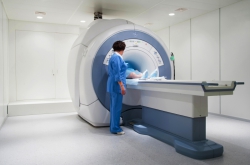
X-ray therapy is one of the most common and globally accessible types of radiation therapy; the treatment, however, has its drawbacks. To begin with, cancer cells with radiation-damaged DNAs can repair themselves and develop resistance to the treatment. Worse still, X-ray therapy is often available only in large cities. And last but not least, when passing through the human body, radiation affects not only the tumor but also healthy cells – and even with the best targeting techniques, healthy cells can still be damaged, especially if the tumor is located deep in the body.
Globally, the idea is to create a multimodal cancer treatment system that will use hybrid nanoparticles to penetrate and accumulate locally in the tumor and be activated by an external source of exposure, be that X-rays, ultrasound, or light.
This would make the treatment more effective, accessible, and safe.
At the core of our technology is a hybrid gold nanoparticle with a biopolymer shell. Why this particular combination? Due to their physical properties, nanoparticles of gold and other metals with a high atomic number absorb more energy and enhance the DNA damage of cancer cells. This is especially relevant for the human body since the density of healthy and tumor cells is the same. We can “attract” more energy and target the cancer if we direct nanoparticles to the tumor. Moreover, irradiated nanoparticles cause extensive DNA damage to cancer cells, making it harder for the tumor to recover and develop resistance to the therapy.
The biopolymer shell makes nanoparticles more stable – and personalized for patients thanks to targeted ligands. Generally speaking, ligands are ions or molecules that can selectively bind specific atoms, molecules, or cellular structures. Given this, they can be used as sort of “address tags” to deliver substances to specific areas. Nanoparticle surfaces can be “embellished” with targeted ligands, making them recognize specific cell types.
For example, many cells actively consume folates – a group of water-soluble compounds, including Vitamin B9 that is essential for DNA synthesis and rapid cell division. In order to meet their folate demand, tumor cells can increase the number of folate receptors, and covering nanoparticles with ligands and folic acid will help them interact with tumor cells more efficiently. This way, targeted ligands can deliver nanoparticles directly to the tumor and keep them inside the cancer tissue, reducing the harm on the healthy cells.
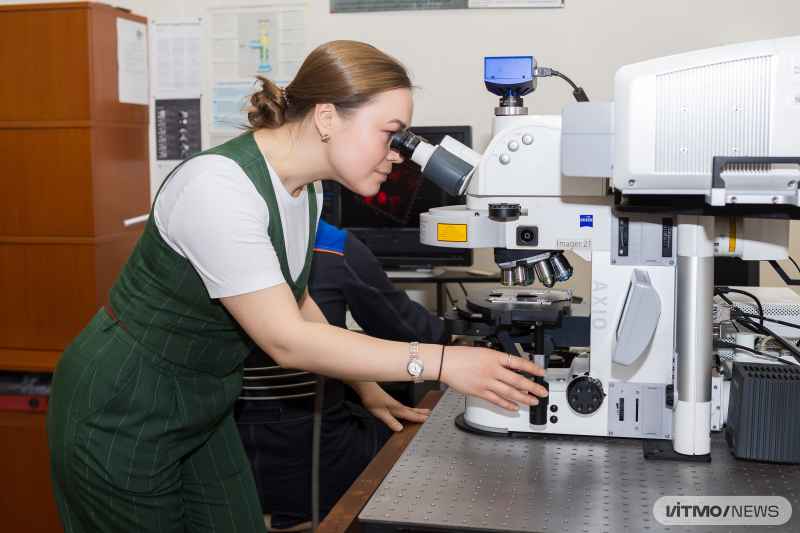
Katerina Kukushkina at ITMO. Photo by Dmitry Grigoryev / ITMO NEWS
The next step is adding photosensitizers, which are already used in photodynamic therapy, to the shell. When exposed to the light of a specific wavelength, these activating agents trigger processes that damage and destroy cancer cells. By adding photosensitizer to the nanoparticles, we can train them to react to X-rays, ultrasound, or other external triggers.
Earlier, we demonstrated that a photosensitizer built into a hybrid nanoparticle can be activated by X-rays without light, which makes it possible to enhance the local production of cytotoxic singlet oxygen not only on the surface but also deep within the body due to the penetration of X-rays. The technology was tested on glioblastoma (aggressive brain cancer) cells resistant to X-ray radiation. Nanoparticles improved the cytotoxic effect, proving a 2.5-fold increase in the efficacy of cell elimination at the same radiation dose of 6 Gy. By merging photodynamic and radiation therapies using nanoparticles into the so-called X-ray-induced photodynamic therapy (XPDT), we will obtain three cancer-killing mechanisms in a single treatment: the production of singlet oxygen via a photosensitizer, the generation of reactive oxygen species, and direct DNA damage to tumor cells as the primary mechanisms of radiosensitization. The method will reduce the number of sessions needed from ten to five and allow for lower power exposure and therefore less harm on the human body.
You’ve recently visited St. Petersburg as part of the ITMO Fellowship program to deliver seminars and take part in some joint studies. Why did you decide to partner up with ITMO and what did you do exactly?
As I left Russia more than 10 years ago, I wanted to see how things have changed over this time and also gain some experience working with Russian universities. So, I started looking up research teams, mainly in Moscow and St. Petersburg, that worked on similar studies on alternative cancer treatment. That’s how I found Anna Orlova’s team; she is a professor at ITMO’s International Research and Educational Center for Physics of Nanostructures and the head of the International Laboratory “Hybrid Nanostructures for Biomedicine.” We talked a bit, realized we have shared interests, and she invited me to visit the university through the program.
ITMO welcomes scientists, lecturers, and laboratory heads from all over the globe to launch their projects in St. Petersburg. Participants are invited to visit ITMO for a stay starting from two weeks to implement their research ideas, work with strong teams, and deliver courses for students. Learn more about the program here.
What’s more, at ITMO, I found the technologies and specialists I needed for my personal mini-project. I’m working on a hybrid of a metallic nanoparticle that will be coated by an artificial protein corona. There are natural protein coronas – they typically form on their own when a nanoparticle enters the human bloodstream. Such a corona can completely alter the properties of a nanoparticle – most often, in an uncontrollable and unexpected way by deactivating it. An artificial corona, on the other hand, can equip nanoparticles with useful functional properties tailored to each case, which will allow it to preserve its therapeutic potential. That’s what my project is about.
However, my research fell short of direct evidence that protein molecules were indeed fixed on the nanoparticle surface, improved its stability, and could deliver a nanoobject to the tumor. It turned out that Anna Orlova’s team has a circular dichroism (CD) spectrometer that can be used for my experiments. Moreover, there are students at ITMO who specialize in this kind of equipment. We partnered up and obtained some intriguing results.
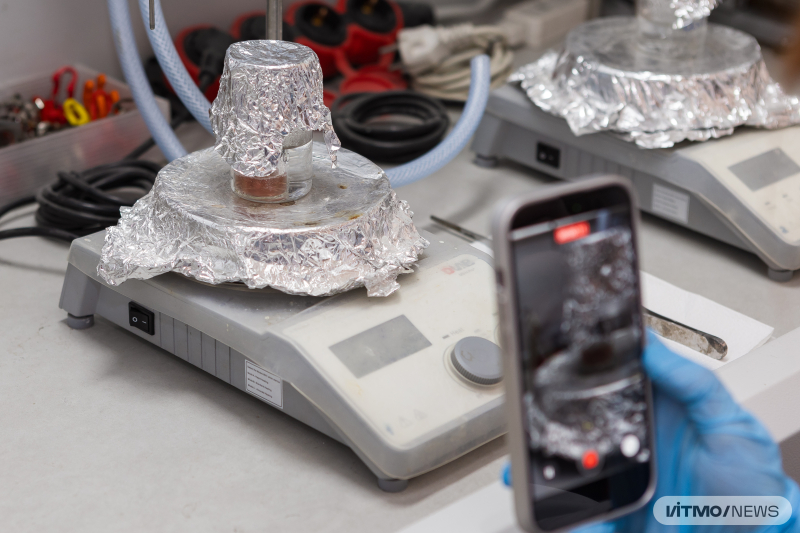
Katerina Kukushkina’s project with students. Photo by Dmitry Grigoryev / ITMO NEWS
How do you envision your future cooperation with ITMO?
I’d love to teach. I want to share my experience with students and perhaps learn something new myself, too. If all goes well, I might come back to Russia as a postdoc, for instance.
From the outside, a research career may seem as a series of exciting experiments and breakthroughs, but in reality, it’s a painstaking effort and often, sadly, hundreds of failed experiments and unconfirmed hypotheses. How do you personally handle this and how do you stay motivated? And what advice would you give to young researchers?
Major “wow” discoveries have already been made and these days it’s hard to discover a new planet or create an innovative molecule. It’s a bitter pill to swallow, especially if you’re thinking of a Nobel Prize or global recognition. That’s why I often see many talented scientists leaving academia after they earn their PhD. It’s also hard if you can’t achieve the results you planned for your grant projects because you simply didn’t have enough time or set an overly ambitious goal for yourself.
My personal motto is “Expect the worst, hope for the best.” I try to approach tasks as methodically as possible: I plan out my experiments and study other papers to see which synthesis worked best to recreate it and make it even better. If something doesn’t work out, I keep trying until it finally does.
The way I see it, a person’s character plays a major role here, too – whether you can come back the next morning to the lab in a good mood to repeat your experiment again and again. Throughout my career, I learned to see what can go wrong in synthesis and how to avoid it – I developed a sort of scientific intuition.
It’s also important to be able to switch to other things that bring you joy outside the laboratory. I’m a very social person; I recharge my battery when I’m with my friends and family, and we often try something new together: activities, including sports, food, and places. It’s okay to take a break when you need one – be you a beginner or a seasoned scientist.
My piece of advice is to choose your future career with a clear mind. At some point, young researchers start to develop their own work plans and propose projects – and this requires a spark in your eyes and belief in your concept. There’ll be days when equipment breaks, glassware doesn't come clean, and synthesis doesn’t bring the desired result. You need to surround yourself with people who will understand, support, and give you advice. Sooner or later, everything will work out and all setbacks will lead to success, even if the path differs from the one you built before. If you feel it's your job, your calling, then every day in the lab will start with a smile and interest.