The Russian Science Foundation (RSF) selects and funds promising research, supports young researchers, and promotes science. In 2025, the foundation distributed 38.2 billion rubles, supporting over 8,800 projects – that’s 55,300 scientists from over 800 organizations.
In 2025, St. Petersburg scientists submitted 2,300 applications, with 464 receiving funding. ITMO was among the top ten universities in the country by the number of submitted applications – they amount to 1.2% out of the total. Additionally, the foundation ranked St. Petersburg universities by the number of supported applications: St. Petersburg State University came first (127), ITMO took second place (49), and Peter the Great Polytechnic University landed in third place (25). Nationwide, ITMO took the sixth place in this ranking.
In total, St. Petersburg universities received over 1.62 billion rubles in funding. Importantly, around 70% of grant executives are young researchers under 39 years old.
One of the supported projects from ITMO (grant No. 24-62-00022) made it to the list of top 10 achievements of RSF in 2025. At a press conference, the project was presented by Alexandra Furasova, a senior researcher at the Laboratory of Hybrid Nanophotonics and Optoelectronics of ITMO’s Faculty of Physics. Her team, in collaboration with researchers from MISiS, have developed a perovskite nanomemristor, a miniature electronic component that memorizes a signal’s history and processes information akin to the brain’s neurons.
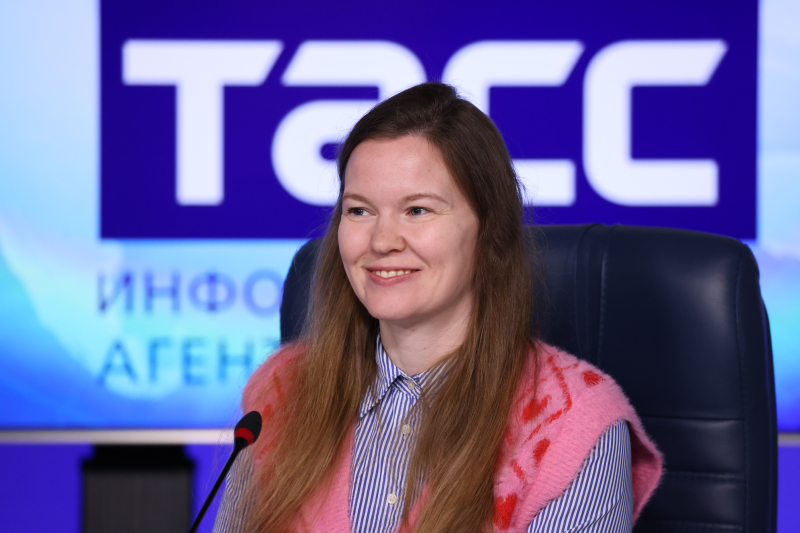
Alexandra Furasova at the press conference. Photo by the Russian Science Foundation
The solution can be the foundation for fast, ultra-compact processors for neuromorphic computing. A memristor could also become the basis for solar modules – lightweight, low-cost, and space-resistant power sources for CubeSat micro-satellites. Traditional silicon cells quickly fail in space, whereas perovskite-based alternatives combine low-cost, simple manufacturing with high efficiency and low weight.
Among other funded ITMO initiatives is a megagrant for an acoustic laboratory at the Faculty of Physics. The researchers will receive 250 million rubles for research in acoustics. The laboratory will produce acoustic metastructures – artificial materials that eliminate noise and transform acoustic energy into electricity for autonomous sensors.
At the press conference, Vladimir Bespalov, the general director of RSF, stated that the foundation will keep supporting young researchers and focus on practically-oriented projects.