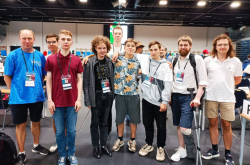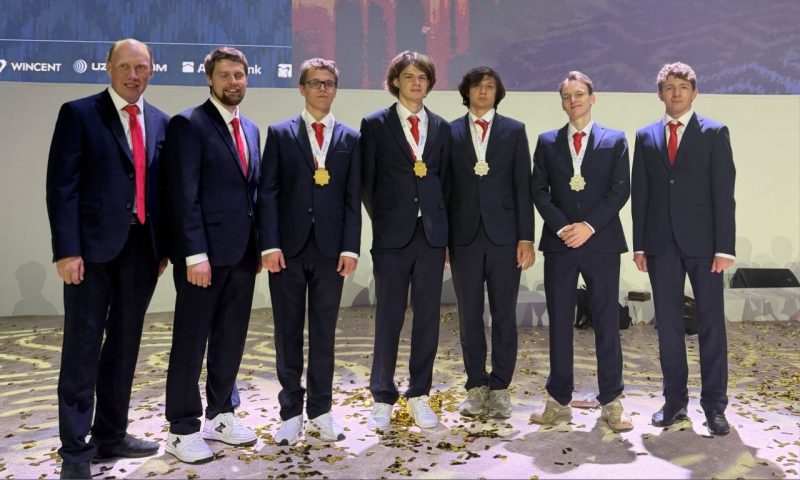
After two rounds of the competition, the Russian team received a total of four medals. Among the medalists were three high school students from Moscow: Vladislav Zhiganov (gold and the second place in the general ranking), Maksim Kravchenko (gold), and Sergei Mukhanov (silver). Another silver medal was earned by Vladimir Zvezdin from St. Petersburg. Among the team’s coaches were lecturers from Moscow Institute of Physics and Technology (MIPT), ITMO University, and HSE University. The head coach was Andrey Stankevich, the dean of ITMO’s Information Technologies and Programming Faculty; Ildar Gainullin, a two-time IOI gold medalist and a fourth-year student at ITMO’s Information Technologies and Programming Faculty, was also on the coaching team.
The 38th IOI brought together 386 contestants from 97 countries, including the US, China, Japan, South Korea, Brazil, Canada, and Australia. The competition featured two rounds during which participants solved algorithmic problems and coded in C++ under strict isolation conditions – with no access to the internet, phones, or any other external media.
“The tasks were exceptionally hard and creative this year. Usually, every task at the contest involves two core steps: finding a solution and writing it in code. This year, however, the focus was more on the first step: coding wasn’t that hard, the real challenge was figuring out the solution. In this light, I’d like to give a special shoutout to Vladislav Zhiganov from Kolmogorov Boarding School; he placed second behind only one student from China – that’s truly incredible,” shared the team’s coach Andrey Stankevich, the dean of ITMO’s Information Technologies and Programming Faculty.
The International Olympiad in Informatics (IOI) is a flagship computer science competition for high school students that has been held annually since 1989. This year, the contest took place in Tashkent, Uzbekistan, on August 9-16. Over the past three years, Russian teams have secured 12 IOI medals, eight of them gold.