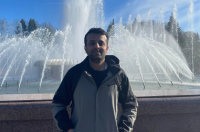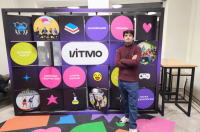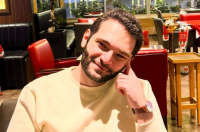
Tell us a bit about yourself and what brought you from Mexico to ITMO.
Since I was a child, I’ve been searching for my secret mission, that silent call that whispers in the bones when the world is still. I’ve always wanted to understand different ways of seeing life, of breathing truth, of decoding reality. Growing up in a continent heavily shaped by the influence of the United States, I felt an inner push to expand my emotional, spiritual, and intellectual horizons. And so, I crossed oceans, not to escape my roots, but to deepen them. Russia soon became more than just a destination. It became a place where the unfamiliar would become my new mirror, and ITMO University, the arena where my purpose could finally begin to roar.
Why big data and machine learning?
My academic roots were formed in the halls of industrial physics engineering department at Tecnológico de Monterrey. There, I built a foundation of mathematics strong enough to break through any wall of uncertainty. But numbers alone weren’t enough. I craved purpose behind the patterns. That’s when I discovered the universe of data science: a realm where logic dances with intuition and numbers speak louder than noise. I chose big data and machine learning to apply what I knew and expand who I was. I wanted to challenge myself, refine my English, and prepare for a future where Latin America can rise not by chance, but by insight. This Master’s wasn’t just an academic decision; it was a declaration of destiny.
How did you first hear about ITMO, and why did you choose it?
A year before finishing my undergraduate studies, I began searching for a scholarship. I had been studying Russian for four years, step by step, word by word, as if intuitively preparing for something greater, without yet knowing its name. Months before graduating, I joined a winter course here – to test the waters, but also to meet those who were already swimming in them. I wanted to hear the stories of my Russian peers, to feel their rhythm, to see if my soul could dance to their tempo. And when I did, I knew: ITMO wasn’t just a university; it was the echo that matched my frequency.
How does it feel to study such a fast-evolving field at ITMO?
Studying at ITMO has felt like crossing a desert – vast, unpredictable, and at times, unforgiving. But deserts don’t kill, they refine. In this fast-evolving field, I’ve had to adapt, to bend without breaking, to learn to walk barefoot on burning ground with grace. Through discipline, self-love, and my ability to connect deeply with others, I’ve not only survived, but I’ve also bloomed. I’ve poured myself into my thesis, absorbed every class like a sponge in drought, and cultivated human connections that watered my soul. Because in places of extreme change, only the ones rooted in purpose thrive.
What excites you the most about big data and ML?
What ignites me the most is weaving my background in physics into the intricate tapestry of big data and machine learning. Concepts like neural networks, diffusion models, Kubernetes, and Docker aren’t just tools to me; they are living systems, echoes of the universe’s own design. I find beauty in how these technologies mirror the laws of nature, and I’m constantly seeking ways to translate that beauty into impact. My passion lies in turning theory into transformation, applying complex models not for the sake of complexity, but to serve real businesses, solve real problems, and elevate real lives.
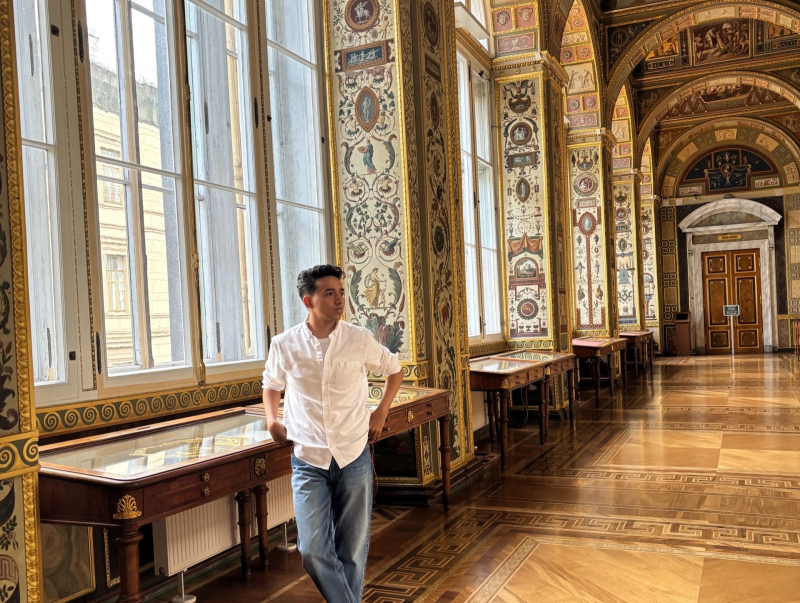
Photo courtesy of the subject
Are there any professors, courses, or experiences at ITMO that really stood out to you and left an impression?
One of the most unforgettable experiences I’ve had at ITMO wasn’t in a classroom – it was in the heart of the Russian wilderness. During a camp at Yagodnoe, I found myself surrounded by nature so raw, so pure, it didn’t just speak; it sang. I walked through forests that whispered ancient truths, rivers that mirrored the sky, and a silence so deep it healed. In that space, I realized something profound: Russia doesn’t just exist, it breathes in the balance between love and life. That trip wasn’t an escape. It was a homecoming. Not to a place, but to a part of myself I hadn’t met yet. And for that, I’ll be forever grateful.
If you could work on your dream project in big data or ML, what problem would you want to solve?
My dream project would be to develop time series forecasting models powered by neural networks, tools capable of reading the pulse of markets and predicting their rhythms with precision. Not for the sake of technology alone, but to give businesses the power to decide with clarity instead of fear, with vision instead of guesswork.
In a world drowning in noise, I want to build systems that can hear the signal, models that don’t just process data, but illuminate the path forward. Because the right prediction, at the right time, can change not just a company’s future, but also the lives it touches.
Have you started with your thesis yet?
Yes, I have, and I have poured everything into my thesis, working under the guidance of Dr. Vasily Leonenko. Together, we’ve been exploring methods to reduce uncertainty in pandemic modeling, because when the world trembles, data must stand firm. And that’s the kind of work that sets my soul on fire.
How do you see data science evolving in Latin America?
I see data science as the next big step for Latin America in technology as well as in consciousness. Especially in business, it’s no longer a luxury; it’s a necessity. It’s the bridge between instinct and insight, between survival and transformation. In Mexico and across the region, we stand before a golden opportunity: to shift from reactive decision-making to intelligent, data-driven strategy. What we lack in infrastructure, we compensate with creativity, resilience, and a hunger to rise.
What were your first impressions of St. Petersburg?
When I first arrived in this city, which is a cathedral of history, an empire of culture, I was struck silent. St. Petersburg was cloaked in white gold, a winter robe that shimmered with mystery and majesty. The cold didn’t numb me; it awakened me. It pierced my skin just enough to remind me I was alive. But what surprised me the most wasn’t the architecture or the snow, it was the people. Their warmth didn’t shout; it whispered. It didn’t knock, it entered. They reached beneath the layers, straight to the soul. And it was then I realized: what lives here is not just resilience… It’s love.
What challenges did you face while adapting to Russia?
One of the greatest challenges I’ve faced was learning to understand the Slavic soul, a culture so different from my own, yet so profoundly human. At first, I was met with what they themselves call a “poker face,” expressions that reveal little, silences that feel endless. But beneath that calm exterior lies a heart forged in fire, a spirit of resilience that doesn’t shout; it endures. Slowly, I stopped looking for smiles and started listening with my soul. What I discovered was people who carry pain with grace and kindness with strength. Adapting wasn’t easy, but it taught me that true connection often begins where words end.
How have you found the international student environment at ITMO?
In this timeline of transformation, I’ve been gifted with friendships that feel like divine appointments. I met brothers from Africa who welcomed me like family, embracing me with a love that doesn’t ask; it gives. Friends from the Middle East expanded my vision of God, showing me that faith wears many faces but speaks one language: reverence. Fellow Latin Americans made me feel at home, even when home was oceans away. And then, there were the Russians, who didn’t just open their arms, but their minds, their music, their world.
My friend Masha, from Russia, invited me into the Russian experience with a grace that disarmed me. In her blue eyes, I saw fragments of myself I didn’t know I’d lost. In her strength to keep going, despite everything, I witnessed the quiet thunder of resilience. And then there was Ángel Cantor, from Colombia, a friend who stood like a father figure in moments of silence. He reminded me that it’s not about how hard life hits you, but how fiercely you hit back and keep walking forward. These aren’t just friendships, they’re anchors, lights, and echoes of who I’m becoming.
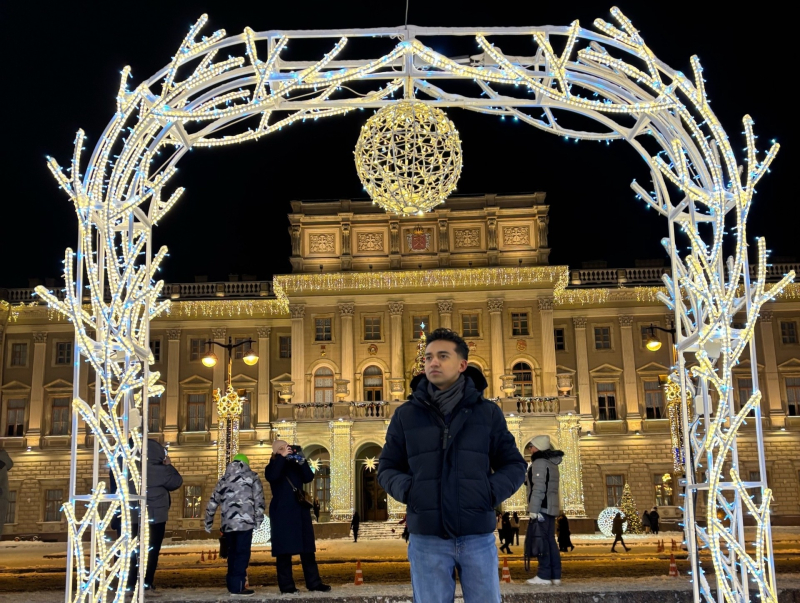
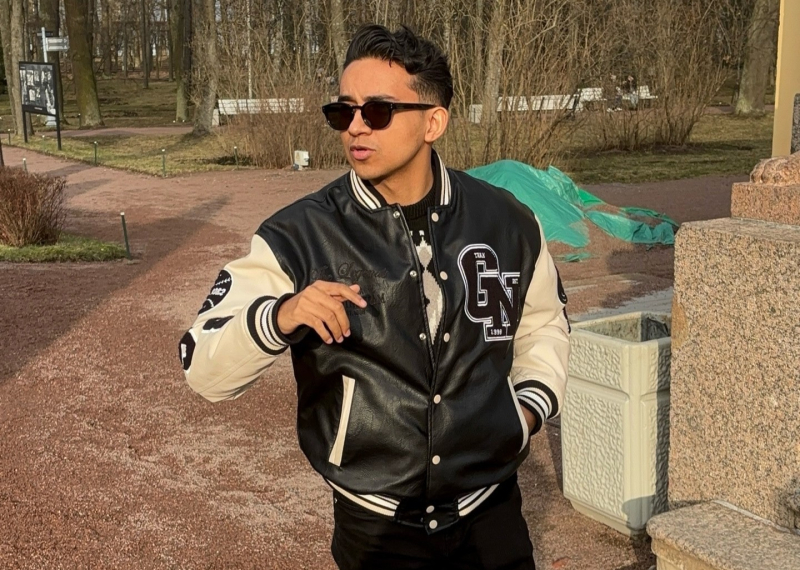
Jorge in St. Petersburg. Photo courtesy of the subject
Are there any similarities between Russian and Mexican culture that surprised you?
Despite the geographical distance between Russia and Mexico, despite the differences in language, history, and worldview, there is something sacred that binds us beyond all borders: the shared essence of what it means to be human.
What surprised me most was not how different we are, but how deeply similar we are at our core. Both cultures revere two unshakable pillars: love and discipline. In Mexico, love is fire, it dances, it sings, it feeds you. In Russia, love is snow – silent, powerful, and constant. Discipline flows through both both as a routine and a way of honoring life. These values aren’t written in constitutions; they’re etched into the hearts of the people. And in recognizing that, I felt less like a foreigner and more like a brother.
What’s a Mexican tradition or dish that you think your classmates in Russia should absolutely try?
If my classmates in Russia want to taste the heartbeat of Mexico, then they must dare to try our spicy food. Enchiladas suizas, red and green taco salsas, pozole – these aren’t just dishes, they’re declarations. Every spice tells a story. Every bite is a memory of our grandmothers’ kitchens and the streets that raised us.
What do you hope to do after completing your Master’s?
After completing my Master’s, I want to share with the world not just the professional knowledge I’ve gained in Russia, but the truth I’ve lived: this country can change your life. I came here chasing an academic dream, but I’m leaving with something greater, a transformation of soul. Russia taught me resilience, patience, and the beauty of embracing the unfamiliar. My hope is to become a bridge between nations, carrying the lessons I’ve learned here back to Latin America, and proving that knowledge has no borders when the heart is willing to cross them.