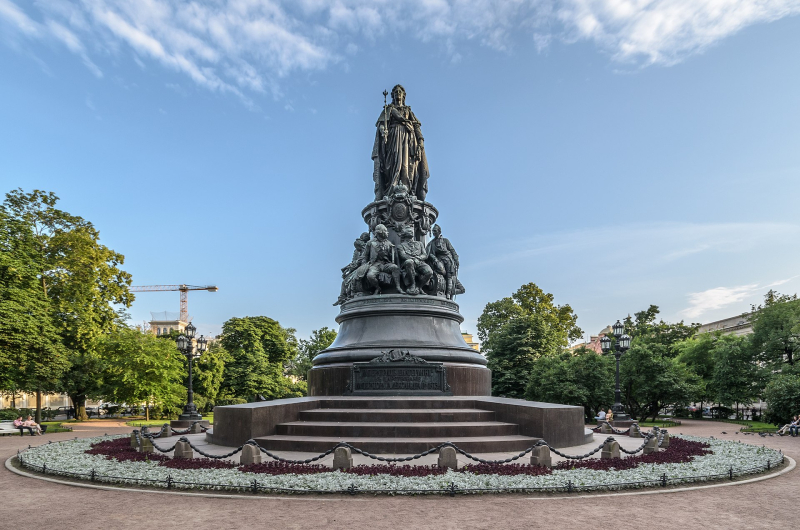
Catherine the Great, 18th century
A foreign princess, Catherine the Great married the Russian emperor Peter III, launched a coup against him, and continued to rule Russia for over 30 years, from 1762 to 1796. Though not devoid of controversies (and rebellions), her reign saw the country expand and grow into one of the great powers of Europe. The empress’ fascination with Peter the Great and the Enlightenment also meant that the country acquired new cities, theaters, and universities, as well as Europe’s first state-funded higher education institution for women, the Smolny Institute of Noble Maidens.
As she reigned from St. Petersburg, Catherine the Great shaped the city’s architecture as well, favoring classical-style buildings. Among those commissioned or reconstructed by the empress were the Small Hermitage, the Catherine Palace in Tsarskoye Selo (her summer residence), and Gostiny Dvor. The famous Bronze Horseman was also commissioned by the empress as homage to her inspiration, Peter the Great.
Zinaida Yusupova, 19th century
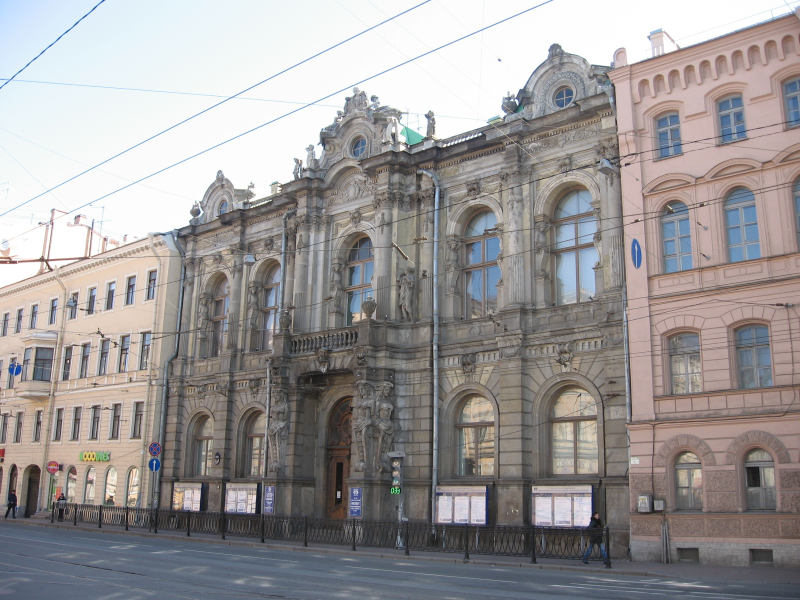
Princess Yusupova’s Mansion on Liteynyi Pr. Photo by Dr.bykov / Wikimedia Commons / CC BY-SA 3.0
A 19th-century aristocrat and socialite, Princess Yusupova’s life could easily have been the inspiration for many a period piece. A lady-in-waiting to Empress Alexandra Fedorovna, wife of Nicholas I, Zinaida Yusupova (née Naryshkina) was favored at the court. Having married into one of Russia’s richest families, she continued their tradition of charity, also adding to their famed collection of paintings by Russian and European masters. Her influence stretches to the city’s architecture as well: having redecorated the Moika Palace of the Yusupov family, she commissioned her own mansion on Liteyny Prospect, following Baroque Revival style.
Prince Yusupov, her first husband, passed away in 1849, and in 1861 she was married in the chapel of her new palace to Louis Charles Honoré Chauveau, a French officer 20 years her junior. St. Petersburg’s society was appalled by this marriage – so, to make it more appropriate, Zinaida procured the titles Count of Chauveau and Marquis de Serre for her husband. When they moved to France, she bought another palace, Château de Keriolet, which went to her husband’s mistress after his sudden death (imagine the audacity!). Countess de Chauveau, however, bought the palace back for 1.5 million francs.
Discover residences of other influential women of St. Petersburg:
Anna Pavlova, 19th-20th century
A program of Anna Pavlova’s performance in New Zealand. Credit: New Zealand Archives / flickr / CC BY 2.0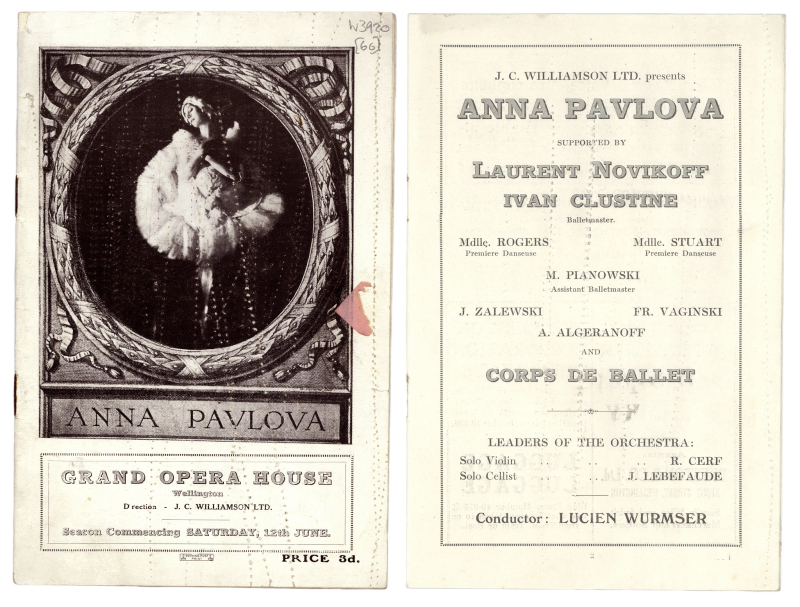
Anna Pavlova was a ballet dancer whose arched feet and long limbs were ridiculed by her fellow dancers in childhood, but who rose to fame and became the first prima to tour the world. First inspired to practice ballet at a performance of The Sleeping Beauty, she trained under many famed ballet masters, including Marius Petipa. In her dancing, she often tended to break convention, sometimes performing on bent knees or not completing her elements perfectly, which made her stand out.
She is most known for her role as The Dying Swan, a solo dance choreographed specifically for her, like many pieces had been at the time. Having briefly performed with the Ballets Russes, she formed her own solo dancing company and successfully toured the world for 20 years, visiting the US nearly annually and influencing a generation of dancers.
Though Anna Pavlova’s Room isn’t a classic apartment museum in that the dancer didn’t reside there, she did live in the same building in 1909-1910. On display are posters, postcards, rare photos, and videos from that time.
Agrippina Vaganova, 20th century
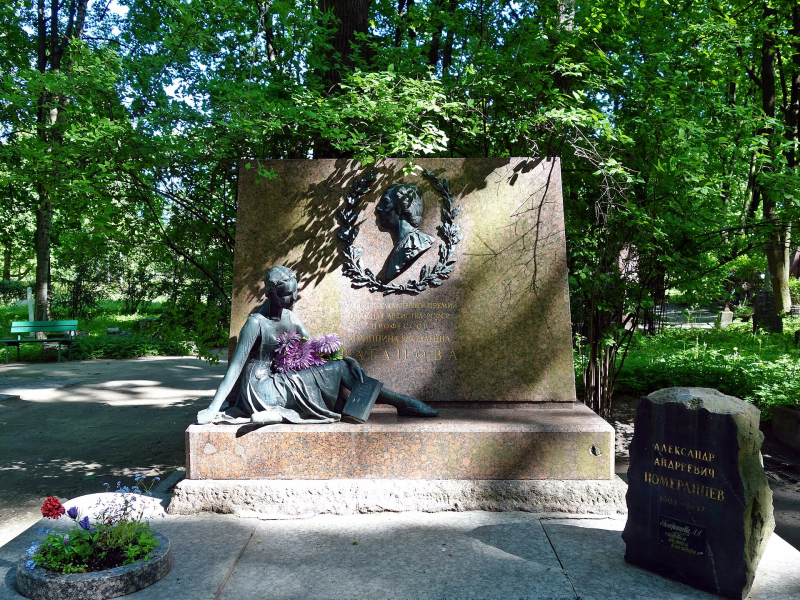
Agrippina Vaganova’s grave in St. Petersburg. Photo by Тулип / Wikimedia Commons / CC BY-SA 4.0
Her book on the foundations of classical dance, as well as the training system she developed, laid the foundation for how ballet is taught today. Having completed her training at the Imperial Ballet School that is now named after her, she spent her dancing career on the stage of the Mariinsky Theater, known for her variations. Though she was praised for her performance and offered leading roles, she became best known for her teaching innovations: she systematized everything she knew from her own experience and the decades of ballet practice before, developing a progression in which the art can be mastered and practiced to perfection. In her system, she paid particular attention to the harmony in the movements of hands, head, and torso, and the way hand movements can help perform the dance elements.
If you wish to see modern-day graduates of the academy perform on stage, you can visit their graduation concert at the Mariinsky Theater (it will be included in the theater’s official program).
Olga Berggolts, 20th century
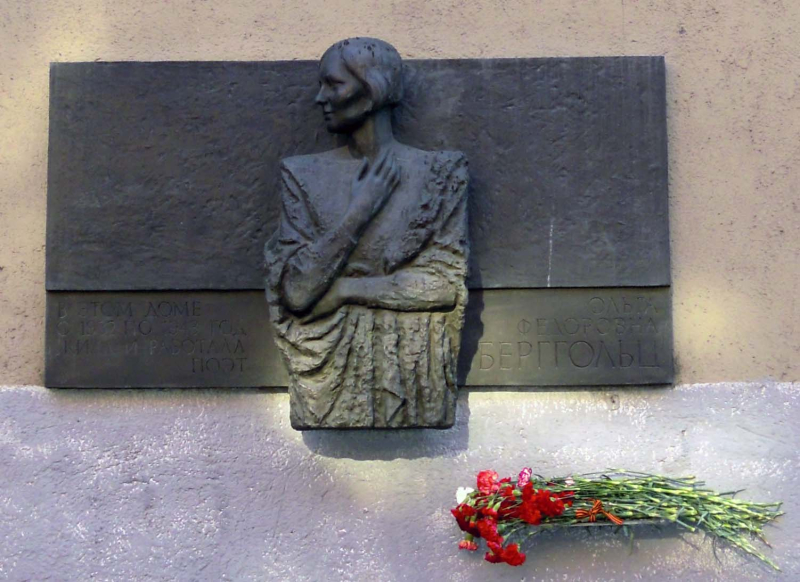
Memorial plaque to Olga Berggolts on Rubinsteina St. Photo by Золотов / Wikimedia Commons / CC BY-SA 3.0
The voice of Sieged Leningrad – that is how the poetess Olga Berggolts became known during the 900 days of the Siege of Leningrad. With the poems she read on air during that time, she aimed to support the starving, struggling people trapped inside the city. In her diaries, she wrote that knowing she made the lives of her fellow Leningraders brighter even for a moment with her poetry meant that her life had not been in vain. In 1943, she was awarded the Medal “For the Defence of Leningrad.”
In her personal life, she suffered through many tragedies and losses, and yet she continued writing, documenting her life in diaries, and reflecting on her experiences through poetry. Her autobiographical novel The Day Stars is considered one of her great works, a glimpse into her life and her reflections on the fate of the country.
Looking for more inspiring stories? Check out our interviews with ITMO’s female scientists or learn about our favorite women-led Russian brands.
Title image credit: photo by Alex 'Florstein' Fedorov / Wikimedia Commons / CC BY-SA 4.0