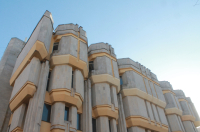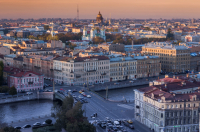
In the late 19th century, following political shifts and European trends, Russia experienced an emerging interest in traditional culture and art. The desire to explore and revive its identity manifested itself in many forms of art, including architecture. This is how Russian Revival came to life, a colorful branch of eclecticism that reinterpreted Russian traditions with modern means.
Churches and cathedrals
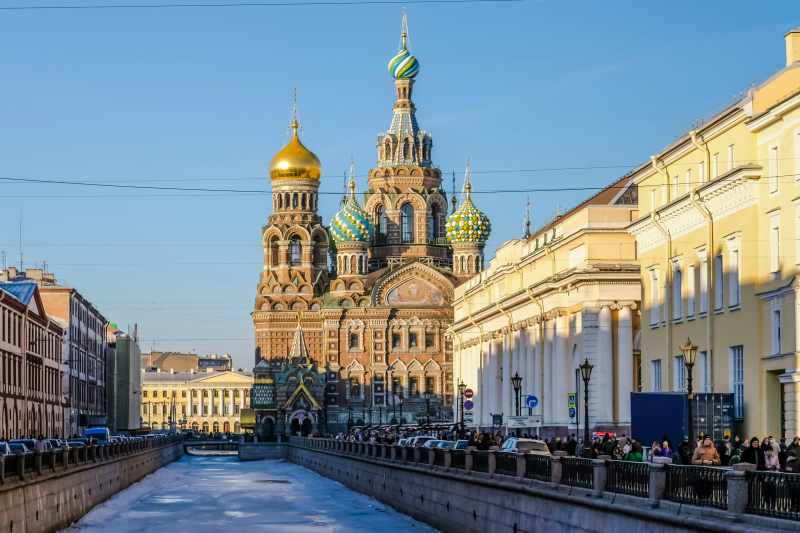
How can you tell if a cathedral is built in the Russian Revival style? Usually, it’s a big brick structure with a complex layout, topped with onion-shaped domes and exuberantly adorned with vivid details like mosaics, majolica, gold inclusions, etc. If you’ve ever seen an illustrated Russian fairy tale book, imagine it brought to life in architecture.
One of the biggest tourist attractions in the city, the Church of the Savior on Blood, checks all the boxes. Built in the late 19th century, it marks the site where Emperor Alexander II was assassinated. The project was inspired by 17th-century Russian churches, especially those from Yaroslavl, although it's Moscow's legendary St. Basil’s Cathedral that comes to mind first when you see it. Its colorful onion domes and exquisite mosaics, based on the paintings of the most celebrated Russian artists of the day, are spellbinding and worth a detailed look.
The Church of the Dormition is a gem of Vasilyevsky Island. This majestic cathedral with five gilded domes stands out among monochrome buildings without breaking the pattern of the Lieutenant Shmidt Embankment. During the Soviet era, it was used as an ice rink for professional figure skaters. Today, you can not only admire its restored interiors and facade, but also grab a bite at the adjacent cafe Monastyrskiye Pyshki, known for its delicious pastries.
Around the Obvodny Canal, there’re several examples of religious architecture in the Russian Revival style. On Gutuevsky Island, beyond the usual tourist spots, stands the Church of the Epiphany. Its location and dark-painted domes may give it a slightly somber look at first glance, but a closer look reveals all the characteristic features of the style. To the east along the canal, on Borovaya Street, shines the Intercession Cathedral. Just a decade ago, it resembled a domeless red-brick skeleton. Now, after careful restoration, it has regained its intricate ornamentation, much like a gingerbread house.
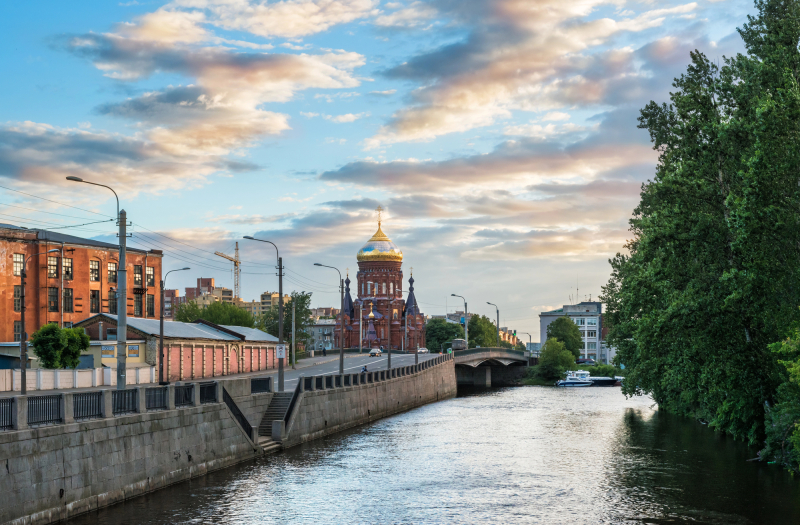
Church of the Epiphany on Gutuevsky Island. Credit: yulenochekk via photogenica
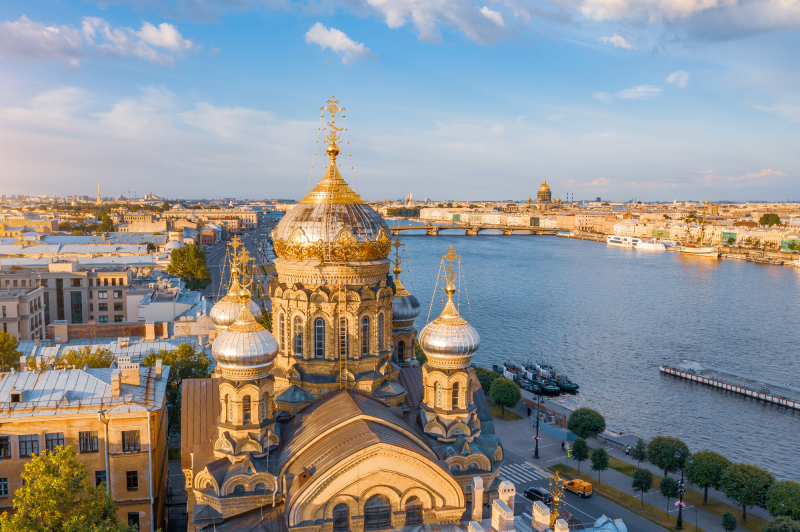
Church of the Dormition of the Mother of God. Credit: aapsky via photogenica
Sometimes, architects drew inspiration from the minimalist aesthetics of ancient Novgorod or Pskov churches. One such example, which may appear to break the stylistic rules, is the Cathedral of the Feodorovskaya Icon. Built to commemorate 300 years of the Romanov family’s reign, it’s a snow-white cathedral with its own red brick battlement, a humble version of the grand Kremlin Wall in Moscow.
Houses and mansions
The style was successfully applied to non-religious architecture as well, sometimes by the very same architects. While many cathedrals were destroyed during the Soviet era, these houses remained intact, tucked in between buildings of various other styles.
The Nikonov Revenue House on Kolokolnaya Street is often called a fairy-tale house for a reason. It’s richly decorated with glazed tiles with traditional patterns and folkloric creatures. Ornate columns and windows topped with kokoshniks complete the fantastical look.
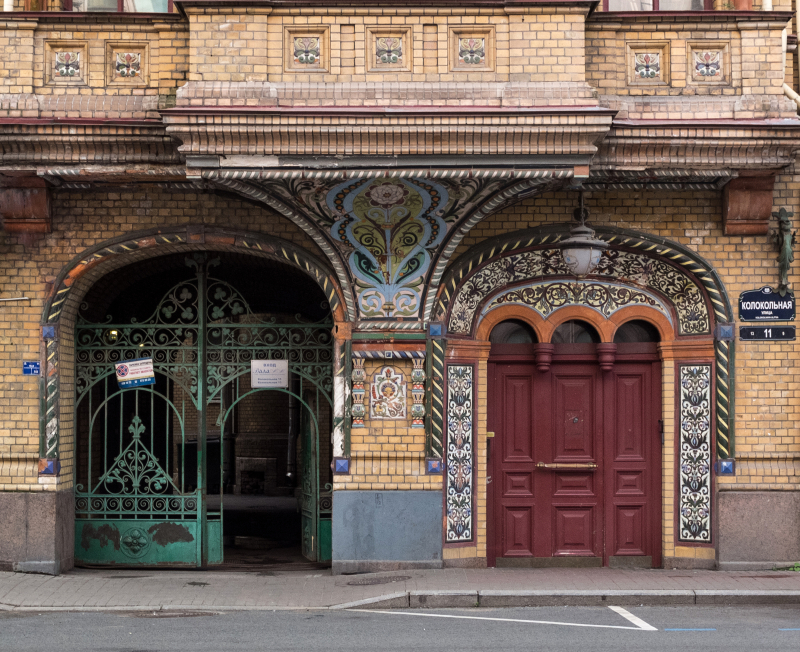
Nikonov House. Credit: Azmanova Natalia, CC BY-SA 4.0, via Wikimedia Commons
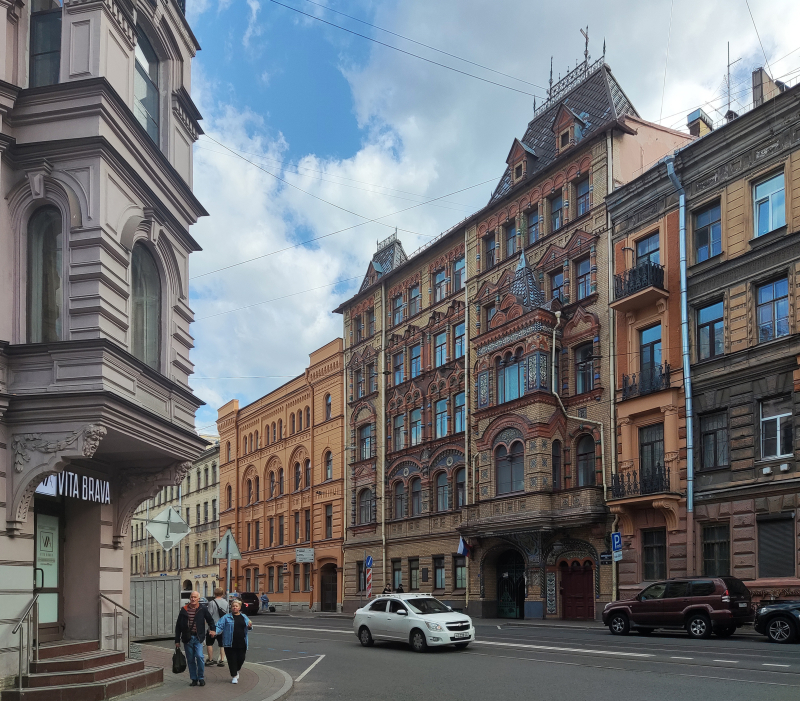
Nikonov House. Credit: Bestalex, CC BY-SA 4.0, via Wikimedia Commons
The Basin Revenue House may appear restrained in color, but its striking shapes and decorative details make it impossible to miss. Located on Ostrovsky Square, among neoclassical buildings and across from the Alexandrinsky Theatre, it once caused debate for disrupting the area’s architectural harmony.
The Officers’ House on Liteyny Prospekt follows a similar approach, choosing bold forms over bright colors. The building’s silhouette resembles a traditional Russian terem with a high hipped roof.
Perhaps the most mysterious of all is the Sosnovka Mansion. Now abandoned and hid by the forest, it looks more like a medieval castle than a humble Russian wooden home.
For more insights into the many gorgeous facades and edifices of St. Petersburg, check out the Architectural Gems tag. And for even more things to see in the city, go no further than our Unexplored St. Petersburg series.