Waltz of the Flowers (1892)
Pyotr Tchaikovsky
Uplifting, hopeful, grand, and an absolute staple of any “Best Classical Music” playlist, this piece is originally part of The Nutcracker, a ballet that keeps taking over theater stages every holiday season. First, the harp transports us to a magical world and the melody starts small, but little by little, it grows, and soon you are completely engulfed by the floral phantasmagoria. Truth be told, it’s hard not to be completely charmed as the waltz unfolds, so we totally understand why the piece became so popular on its own, even outside the world-renowned ballet.
Honorable mentions from the same ballet:
- Chinese Dance
- Dance of the Sugar Plum Fairy
- March of the Toy Soldiers
Flight of the Bumblebee (1899-1900)
Nikolai Rimsky-Korsakov
Yet another piece that on its own became more well-known than the opera it originated from – The Tale of Tsar Saltan, based on a fairy tale by Alexander Pushkin. In this piece, one of the main characters is transformed into a bumblebee so that he can fly and visit his father. To imitate a bee’s seemingly chaotic, frantic movements, Rimsky-Korsakov employs perpetuum mobile, a rapid succession of notes of equal length, which makes it one of the harder pieces to perform on a violin – and a chance for musicians to demonstrate their prowess. This, as well as frequent pop culture appearances, is what made the piece so well-known and recognizable.
Sabre Dance (1942)
Aram Khachaturian
Originally part of the ballet Gayane, this piece has been living a life of its own since pretty much its creation – it became so popular in the US in 1948, that some suggested it was Khachaturian Year in the United States. Interestingly, it was allegedly written by Khachaturian in a mere eleven hours under a deadline and immediately impressed the director, the dancers, and the musicians. Since then, this percussion-heavy, Armenian folk dance-inspired piece has been covered, sampled, featured in everything from films and series to games, ice-skating performances, and even election campaigns. And now you know its name and backstory!
Dance of the Knights (1935)
Sergei Prokofiev
Transitioning to a much darker dance with this one, heavy on the ominous strings and brass, we step into the world of Romeo and Juliet, the ballet that this piece is originally from. Coming on in the second act of the ballet, when the story hasn’t yet taken a darker life-and-death turn, the dance serves as a premonition of what’s to come later on. So evocative and suspenseful is the music, that it’s been used countless times in film and TV; you might remember it from season 2 of Wednesday: as the heroine takes to her cello to escape the world, we watch a montage that tells us something wicked is sure coming her way this season.
1812 Overture (1880)
Pyotr Tchaikovsky
Commissioned to commemorate Russia’s defense against the French invasion in 1812, this piece was written for an orchestra that includes, among others, more common instruments, a carillon and a battery of cannons (yes, really). Both of these are crucial elements to the overture’s dramatic, victorious finale. Apart from that, some performances feature a choir, so you can imagine what a giant stage it takes and how intricate the logistics of it all could be. And yet, this overture is named by some to be Tchaikovsky’s most famous piece. Curiously, in the US, it’s become popular outside its original historical context: there’s a tradition of performing it during firework displays on Independence Day.
Curious to learn more about Russian music? Go here to learn about the Mighty Handful, five notable composers of the 19th century, and visit the Russian music tag for more fun music-related tidbits.
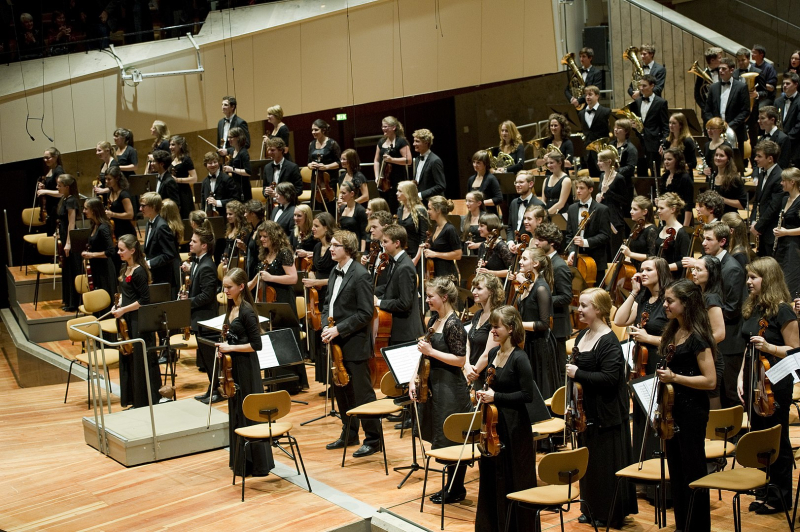
Title image credit: Steffen Kugler, Berlin / Bundesjugendorchester / Wikimedia Commons / CC BY-SA 3.0