Interestingly, the etymology of the word “skomorokh” is kind of foggy: it could’ve originated from the Greek word for “joke” or it could be connected to the Italian scaramuccia, meaning “joker.”
It is believed that they appeared around the 11th century (based on frescoes discovered in a pre-Mongol church), right after Christianity was brought to Medieval Rus. Skomorokhi are thought to have replaced pagan priests, and as such they were associated with all kinds of magic and rituals on the one hand and were called to be a part of folk celebrations – on the other. Even modern Russian culture has retained some pagan celebrations, Maslenitsa being one notable example, so it’s easy to believe that in the decades and even centuries after the transition to Christianity, earlier traditions remained in force.
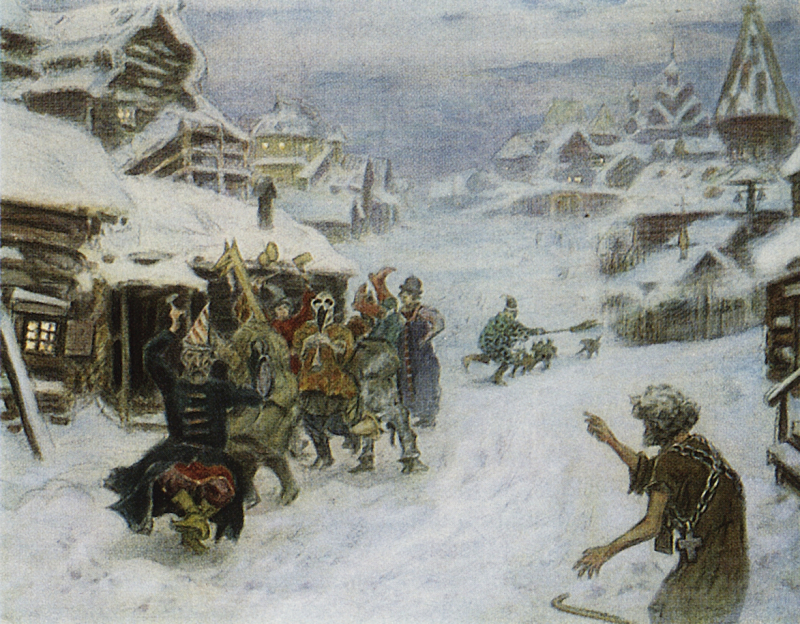
Credit: Painting by Apollinary Vasnetsov, Skomorokhs (1904) / Wikimedia Commons / Public Domain
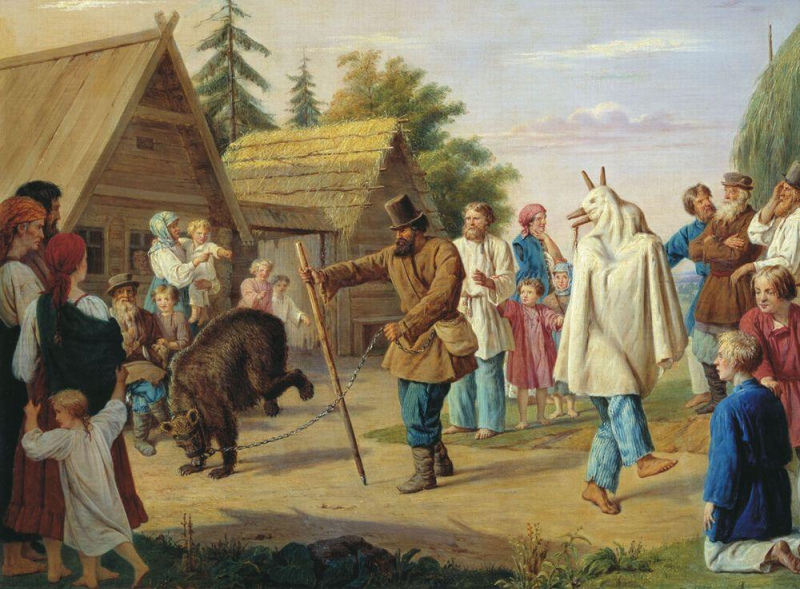
However, despite their kind of religious origins, skomorokhi were first and foremost travelling artists, performing music and dance, leading the bear – either the actual trained animal or a person dressed like one, tricks, and even dramatic performances. Among their repertoire of accessories were leather masks and colorful attire, as well as an abundance of musical instruments, including the gusli, zhaleika, domra, and tambourine – many feature in folk ensembles today.
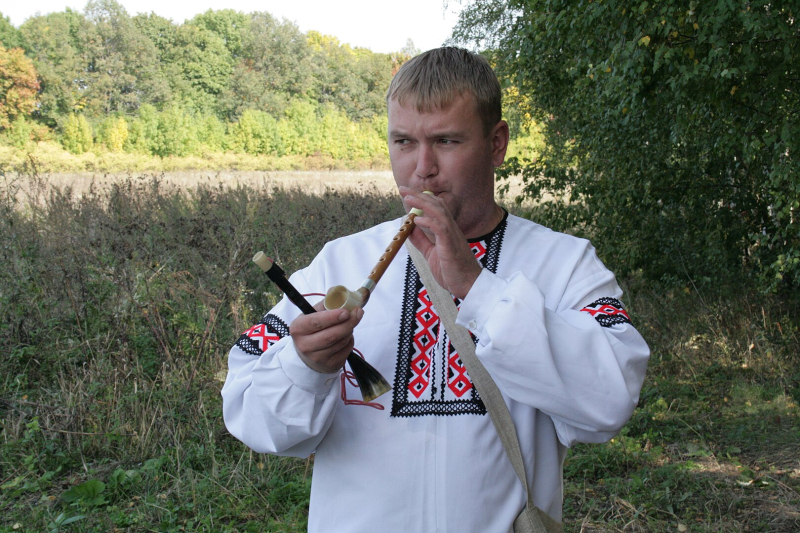
A zhaleika player. Credit: Лобачев Владимир / Wikimedia Commons / CC BY-SA 3.0
These artists were often called to be present at weddings or, counter-intuitively, funerals, as well as folk celebrations throughout the year. It was believed that they knew traditions best and thus were needed to carry them out properly. Their vague pagan connections earned them a dislike from both the church and the state, which was probably one of the pragmatic reasons for their nomad state.
According to some researchers, these often humorous performances were the Russian equivalent of theater, which was already common in the neighboring European countries. Additionally, it ties to the often satirical and politically critical literary pieces that were characteristic of the 18th century, the time after the dawn of skomorokhi culture.
To this day, the image of a skomorokh is quite a popular one to depict in period pieces, from cartoons to movies. In painting, they notably feature in the works of brothers Viktor and Apollinary Vasnetsov. On film, one famous example is the skomorokh in Tarkovsky’s Andrei Rublev (1966). The upbeat, colorful image of a skomorokh can also be seen during performances at various folk festivals, usually in some sort of engaging, acrobatics-full dance:
Yearning for more fun facts about Russian culture? Look no further than the dedicated tag, where we’ve assembled quite a collection.
Title image credit: Painting by Franz Riss, Skomorokhs in a Village (1857) / Wikimedia Commons / Public Domain