Please introduce yourself to our readers and share what first sparked your interest in digital humanities.
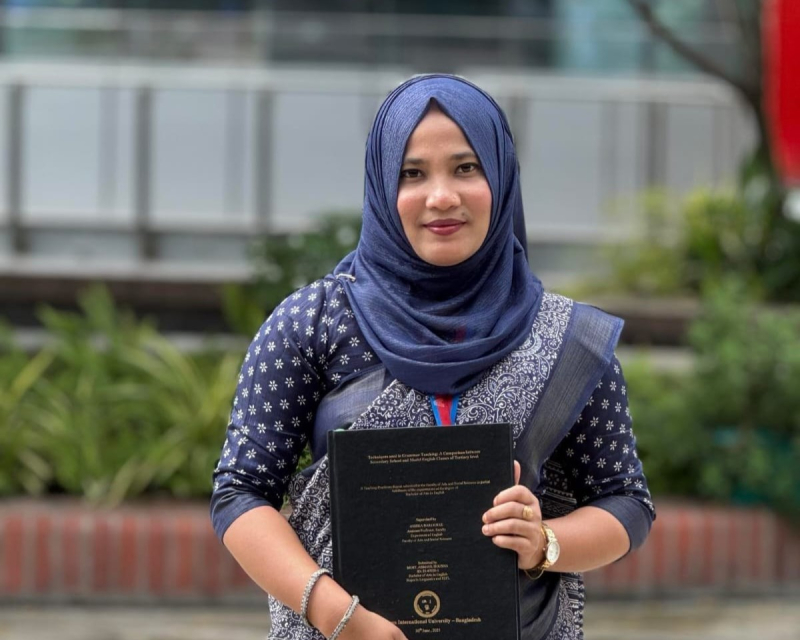
My name is Most. Asmaul Housna. My interest in digital humanities began during my final year at university in Bangladesh, where I wrote my bachelor’s thesis on teaching methods. While conducting research, I realized how significantly technology can transform the study of education and linguistics. I’ve always been drawn to the intersection of language, culture, and technology, and discovering digital humanities felt like finding the perfect field where all my interests meet. The idea of using computational tools to analyze language and cultural patterns fascinated me immediately.
Digital humanities is a relatively new and evolving field. What aspects of it excite you the most?
What excites me most is its interdisciplinary nature. Digital humanities allows me to combine my background in linguistics with digital tools to explore language, culture, and society in innovative ways. I’m particularly interested in digital archives, data visualization, and computational linguistics. These areas make it possible to work with large datasets and uncover insights that traditional methods often overlook. The potential to create more inclusive, accessible ways of studying literature, history, and language is incredibly inspiring.
What qualities do you think are most important for someone entering this interdisciplinary world?
Curiosity and adaptability are essential. Because digital humanities blends so many disciplines, from computer science and linguistics to history and digital design, it requires openness to learning new tools, methods, and perspectives. Strong critical thinking skills are also important, because it isn’t just about using technology; it’s about applying it thoughtfully and creatively to human-centered questions.
What skills or digital tools are you most interested in developing during your Master’s?
I hope to strengthen my skills in data analysis and visualization, particularly using Python and R. I’m also eager to explore tools for computational linguistics and text mining, as these are essential for language-based research. Additionally, I want to learn how to build digital archives, work with metadata, and develop interactive digital platforms for presenting research.
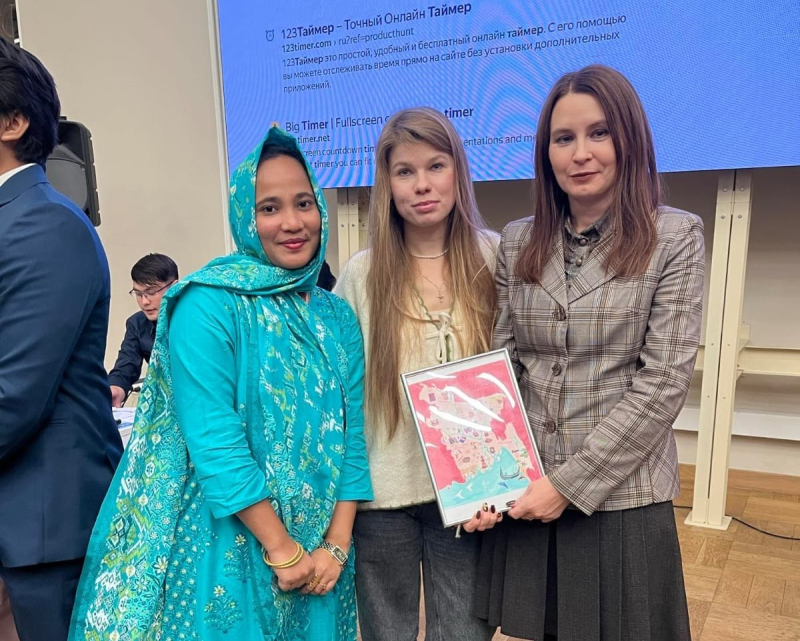
Most. Asmaul with her teachers at ITMO. Photo courtesy of the subject
You’re currently studying Russian in ITMO’s Foundation Program. What has that experience been like so far?
It has been both exciting and challenging. The language is very different from anything I’ve learned before, especially with its Cyrillic alphabet and complex case system. Still, I’ve enjoyed the immersive learning environment. Being in St. Petersburg has helped me understand the language beyond the classroom, and my professors and classmates have been incredibly supportive. Every day feels like a new step forward.
What has been the most surprising or challenging part of learning Russian?
The grammar has been the most surprising and challenging part. Russian’s case system changes noun and adjective endings depending on grammatical function, which is very different from English and Bengali. Pronunciation, especially soft sounds and certain consonants, has also taken practice. Despite these challenges, I find the language beautiful and rewarding to learn.
How has your experience in St. Petersburg been so far?
St. Petersburg has been wonderful. The city’s architecture, history, and atmosphere are truly unique. One memorable moment was my first visit to the Hermitage Museum. I was amazed by the scale of the collection and the beauty of the building itself. Walking along Nevsky Prospect in the evenings, with the lights and constant energy of the city, is another experience I’ll never forget. Studying in such a cultural city feels like a privilege.
Have you noticed any cultural similarities or contrasts between student life in Bangladesh and Russia?
Student life in Bangladesh is generally more structured and follows traditional teaching methods, with fewer digital tools used in classrooms. At ITMO, the approach is much more research-oriented and technologically advanced. Students have more freedom to explore their interests, and classes often include hands-on tasks and digital projects. Social life also differs - in Bangladesh, students tend to gather in larger groups, while in Russia, interactions are often smaller and more discussion-focused, which I really enjoy.
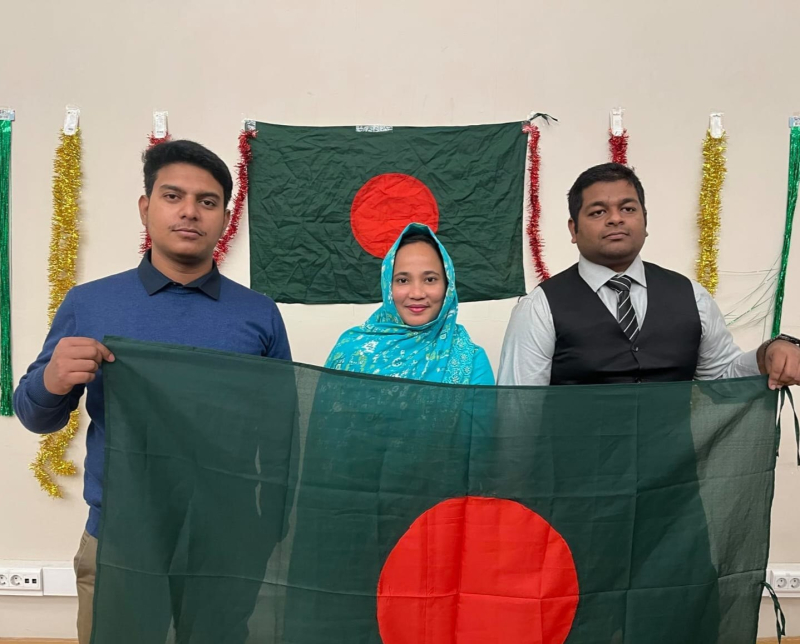
Most. Asmaul with Md. Sorowar and Md. Arafat at the Bangladesh Culture Night, organized at ITMO. Photo courtesy of the subject
What helped you adapt to a new country and academic system?
Connecting with fellow students and faculty helped me immensely. The Foundation Program gave me the language skills I needed to understand classes and participate confidently. The international student community has also been very supportive. Exploring the city, learning about Russian culture, and staying open to new experiences made the transition much easier.
What would you tell Bangladeshi students who are considering coming to Russia or ITMO for their studies?
I would say, take the opportunity with an open mind. Russia has a rich cultural and academic environment, and ITMO is a leading university in research and innovation. Prepare yourself by learning some basic Russian before arriving, as it truly helps with daily life and communication. Be ready to step out of your comfort zone, embrace new experiences, and make the most of what this incredible city and university have to offer.