What makes them special
Envisioned as the Venice of the North, St. Petersburg was destined to become a port city – and it remains an important pathway connecting the Volga River to the Baltic Sea. Dozens of transport ships pass through the city every year, with the navigation season starting in April and lasting through November. To let these ships pass comfortably, bridges along the Neva that connect the city’s districts by day, are drawn for several hours every night.
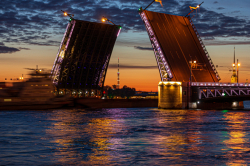
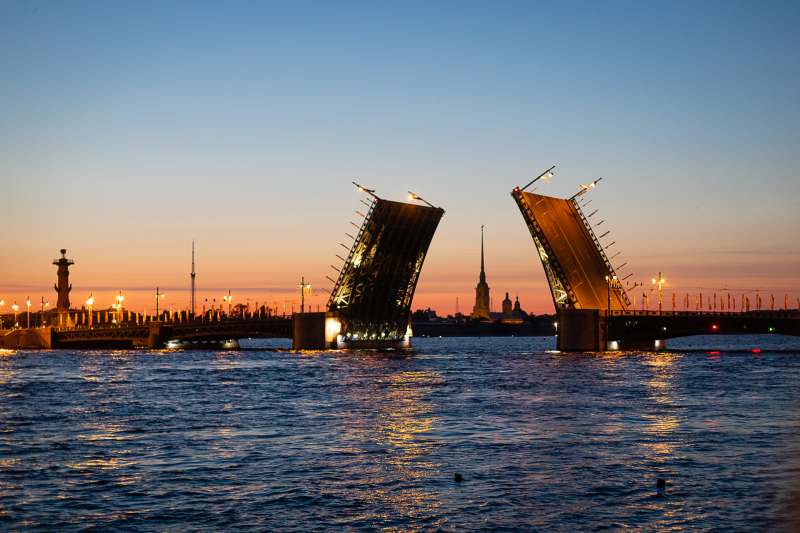
Apart from serving as examples of elegant engineering solutions, the drawbridges make for quite a spectacle, having become one of St. Petersburg’s trademarks and points of attraction – with the view of the Peter and Paul Fortress through the drawn Palace Bridge being the most famous. That’s why every night in the tourist season, the river is full of boats that arguably offer the best vantage point for the “show.” Throughout the summer, various concerts and events coincide with the opening of the bridges, such as the Scarlet Sails festival for school graduates or the Singing Bridges concert series, complete with laser projections on the Palace Bridge.
Speaking of elegant solutions, this is proven true by their age alone – the stars of the show, the Palace, Annunciation, and Troitsky bridges, are each over a hundred years old (the Annunciation Bridge will turn 180 in 2030!). And yet they continue to serve as arteries to the multimillion city day and night – of course, with proper maintenance and updated mechanisms!
If you are curious to learn about the engineering side of things, as well as the history of bridges in St. Petersburg, visit the dedicated Museum of Bridges. The four halls of the exhibit present models of the first bridges across the Neva, which lasted for only a season, as well as the more modern solutions, including four current bridges across the river.
And for more insights into the cultural significance of drawbridges in the city, check out one of our earlier articles.
Planning a bridge-watching night
First things first, you will need to know when it happens. Currently, nine bridges are drawn every night according to the schedule, with the Palace Bridge kicking off the spectacle at 1:10 am, closely followed by the Annunciation Bridge and then the Troitsky Bridge.
Next, you’ll need to decide whether you want to splurge on a boat tour to watch it all from the water or plan a route on land. In both cases, though, you’ll have to consider the side of the river you’ll be on after the bridges are drawn – because you obviously won’t be able to use a drawn bridge to get across.
These days, we are lucky to have not one but two ways to cross the Neva even with the bridges open: the Bolshoy Obukhovsky Bridge and the Western Speed Diameter (WSD). However, both of these are quite a ways off from the city center and only the former can be crossed on foot (you’ll have to order a taxi to use the WSD). So, be strategic about your chosen observation point so as to get home after you’ve seen enough – or plan a white night out and join dozens of tourists enjoying this unusual time in the city.
The final step involves packing for the adventure. As always in St. Petersburg, check the weather forecast to see if you’ll need a second (or third) layer – and definitely pack one if you are doing the boat tour, as it tends to be colder by the water. It’s also nice to pack a snack just in case your road home takes longer than expected. Other essentials can be found here.
Enjoy your bridge-watching experience!
Title image credit: Vladimir Tro on Flickr / CC BY-NC-ND 2.0