The path towards optogenetics was laid in late 1990s-early 2000s with Hegemann and Nagel’s discovery of the channelrhodopsin protein in single-celled algae Chlamydomonas. The protein helps the algae “see” light and move towards it, with its reaction 20 times faster than the human eye. What the scientists discovered is that any cell became light-sensitive if injected with Chlamydomonas’ channelrhodopsin.
Karl Deisseroth carried on with their research. As a neurosurgeon, he tried to understand how the electric signals within the brain can be controlled. Having learned of channelrhodopsin, he injected the gene responsible for its synthesis in Chlamydomonas into rat neurons. By shining a blue light on the neurons, he was able to initiate a signal. Later, in 2007, Deisseroth implanted a light-controlled switch directly within the brain of living mice.
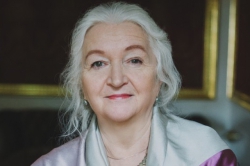
“Seeing as optogenetics is widely used in neuroscience today, the choice of this year’s Nobel laureates was quite expected. Karl Deisseroth is a long-established expert in the field with well-known contributions to its development. Achievements in optogenetics are already used in medicine: the first clinical trials in vision recovery are ongoing. The experiments in mice have shown us how to regulate memory and ‘turn on’ or suppress specific memories. Optogenetics has made it possible to map neural circuits of patients with Parkinson's disease, epilepsy, depression, and chronic pain, thus enabling the search for new treatments of these conditions,” says Vera Medvedeva, a senior researcher at ITMO’s Center for Molecular and Biological Technologies and head of the Molecular Neurobiology Laboratory.

Vera Medvedeva. Photo courtesy of the subject
According to Vera Medvedeva, before these discoveries, the brain could be studied with general methods, such as electric stimulation of several neurons, or pharmacological approaches that are slow and selective. Optogenetics, on the other hand, gave researchers a “switch” for single brain cells. This mechanism makes it possible to precisely establish cause-effect relations and directly control them. Thus, scientists have discovered the neural networks responsible for memory, emotions, pain, addiction, anxiety, depression, Parkinson’s disease, and narcolepsy. These results change our understanding of where to look for treatment targets in the future.
“Optogenetics turned neuroscience from an observation science to an evidence science. If we see neurons fire during fear, we’ve established correlation. If we activate them with light and thus cause fear – that’s proof of causation. As an endocrinologist, I particularly value that many of the important discoveries were related to the hypothalamus, where the brain links hormones, sleep, hunger, and satiation. Optogenetics helped us find neurons that trigger hunger and suppress it, which allowed us to understand why modern obesity treatments affect not only the intestines and pancreas, but also the brain itself,” adds Evgeniya Sokolova, the chief medical officer of Fomina Clinic and head of ITMO’s Public Health Sciences Master’s program.
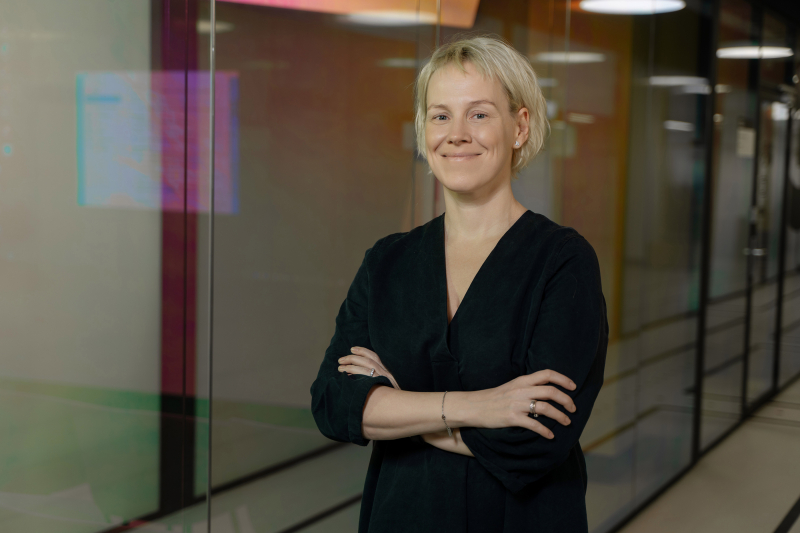
Evgeniya Sokolova. Credit: Nikita Seliverstov
In 2021, the world witnessed the most outstanding clinical example of using optogenetics – partial recovery of sight. A man blind due to a genetic disease, retinitis pigmentosa, received an injection of the light-sensitive protein gene to the retina. The patient was able to locate and identify contrasting objects on a table, while EEG (electroencephalography) demonstrated activations in his visual cortex in response to light. Recently, the results of a three-year phase of clinical trials of the MCO-010 optogenetic therapy for retinitis pigmentosa were also published. The treatment provided sustained improvements in vision, with the effect observed regardless of the type of genetic mutation, while no serious side effects were detected. The study authors are now preparing an application to license the therapy.
Russian scientists have also contributed to the method’s development, as noted by the Nobel Committee. In 1978, biophysicists from Lomonosov Moscow State University Felix Litvin and Oleg Sineshchekov were the first to register electric response to light in algae – it was their approach that was later used by Peter Hegemann. Sineshchekov continued his studies in the US, where in 2002 together with his colleagues he demonstrated the role of two rhodopsins in Chlamydomonas phototaxis. In 2015, Elena Govorunova and Oleg Sineshchekov discovered anion channelrhodopsins, which are now used to suppress neuron activity. These days, optogenetics research is carried out at various Russian research centers, such as the Kurchatov Institute and Moscow Institute of Physics and Technology.
At ITMO, the brain is studied on the molecular level. The Molecular Neurobiology Lab develops cell models that are close to actual brain physiology and thus make it possible to study neurobiological processes.
“Optogenetics is biology that needs photonics: miniature light sources, fiber-optic and wireless implants, systems to regulate cell activity, and big data analysis. These are ITMO’s strong suits. The journey from asking how algae swims toward light to a patient being able to see objects again took approximately twenty years and required collaboration among biologists, physicists, engineers, and physicians. This is precisely the process we teach students to understand in its entirety: how to evaluate new technologies, their safety and accessibility, and how to explain honestly to the public what already works and what remains merely a hope,” concludes Evgeniya Sokolova.