“The Royal Swedish Academy of Sciences has decided to award the Nobel Prize in Physics 2026 to Francis Halzen for decisive contributions to the IceCube Neutrino Observatory and the discovery of high-energy neutrinos of astrophysical origin,” states the official press release by the Nobel Committee.
Francis Halzen. Credit: nobelprize.org
Neutrinos are electrically neutral particles that have almost no interactions with matter. At every moment, billions of these particles pass through each of us without our notice. Neutrinos go through the Earth unseen, only rarely engaging in weak interaction with matter, this interaction being one of the four fundamental forces along with nuclear and electromagnetic forces and gravity.
The particles themselves are born in nuclear reactions within stars. Some neutrinos appear in supernova explosions, others – during the merging of black holes and neutron stars. Any such astronomic explosion generates a giant flow of photons, gamma rays, and neutrinos. However, unlike the photons that are absorbed by interstellar medium, neutrinos make it to the Earth. Scientists learned of their existence back in 1956. They were first implicitly registered near a nuclear reactor in North Carolina, US. Later, researchers managed to register cosmic neutrinos radiated by the Sun – these became a potential source of information about cosmic processes. This was the start of a new field of study called neutrino astronomy. Today, researchers register neutrinos and measure their energy and direction to determine what’s happening in deep space.
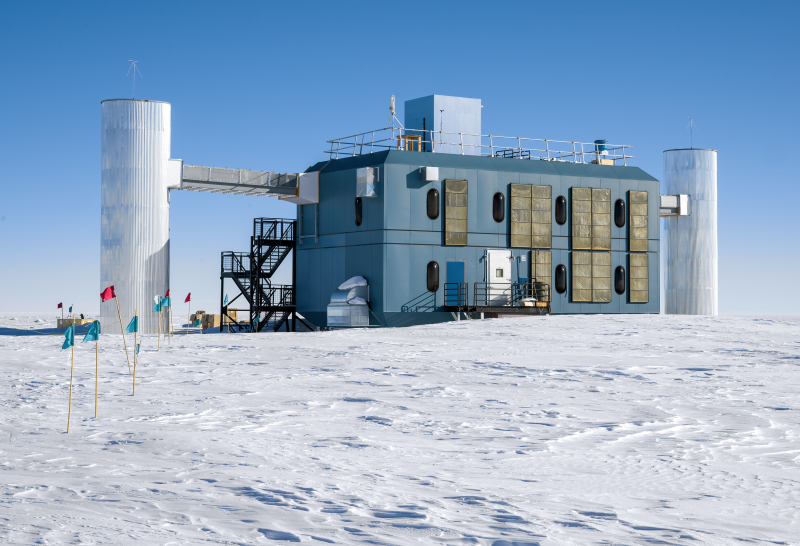
In his works, Francis Halzen, the laureate of this year’s Nobel Prize in Physics, provided proof that the universe can be studied with neutrinos. In 1988, he suggested catching neutrinos on the South Pole: when the particle collides with an atomic nucleus, it causes a flash of light that can be caught with sensors in transparent ice. The ice in this region is a great fit for research: it contains almost no background radiation, while the region itself is geologically stable. This idea was supported by other scientists and the first sensors were tested just a few years later. However, high-energy neutrinos are rare, which means studying them requires a great volume of ice: in 1988, Francis Halzen initiated the IceCube project, a polar observatory with a volume of 1 cubic kilometer; the lab fully launched in 2011. Soon after that, researchers registered the first high-energy neutrinos. Several years later they were able to prove that these particles came from beyond the Solar System. This discovery laid the foundation for neutrino astronomy.
“Cherenkov radiation is the key mechanism for registering neutrinos. The particle itself cannot be captured, but when it collides with an atomic nucleus, the ejected electron travels through ice or water and emits a faint light known as Cherenkov radiation. This is what is caught by the detectors. That’s why these experiments require a clean transparent medium and a great volume: neutrinos have weak interactions with matter and very rarely. However, this has surprising applications, such as in remote monitoring of nuclear reactors. Here is an analogy: you are in a safe zone far from the reactor, where no radiation can reach you; but neutrinos can pass even through the Earth. So, if you have a large enough detector, you can register neutrinos and just by their characteristics tell what’s happening inside the reactor. It’s a cool practical application,” shares Dmitry Karlovets, a senior researcher at ITMO’s Faculty of Physics.
Moreover, neutrinos, constantly registered by IceCube, will help researchers understand what happens in deep space; other radiation and light originating from there never reach the Earth. Along with gravitational waves, neutrinos are the only messengers from the “dark” regions of the universe, the only way we can learn about the processes happening there.
In Russia, the first experiment in this field is the Baikal-GVD, a deep-water neutrino detector in the deepest, most transparent lake on Earth. It became fully operational in 2018 and is now IceCube’s direct counterpart in the Northern hemisphere. The first experiments brought immediate success; since then, researchers at the facility catch several neutrinos every year. Baikal-GVD has an international team led by the Joint Institute for Nuclear Research in Dubna. ITMO University – namely, Dmitry Karlovets’ research group – became an associate member of Baikal-GVD in 2026. This is ITMO’s only team working in the field of neutrino physics. Every spring, optical modules are submerged under the Baikal ice. In 2026, Dmitry Karlovets became part of an expedition working with the Baikal-GVD neutrino telescope.