Many molecules exist in two forms that are mirror images of each other. Their chemical composition is identical, but their spatial organization is different. This is akin to our left and right hands: they look identical, but won’t match up if placed on top of one other. In chemistry, molecules are also divided into left- and right-handed. This property is called chirality.
Chiral asymmetry is a phenomenon that has intrigued chemists for centuries. It hides the fundamental question of the origin of life: all living organisms consist exclusively of left-handed amino acids, while the right-handed ones are rarely found in nature. Why is it that in a world with mirror forms, only one proliferates?
There is applicational value in it, too. Chirality affects not only the appearance of a molecule but also its properties. For instance, in pharmaceutics, often only one of two mirror isomers is biologically active, while the other one may be less active or have a different effect. The problem is that it’s impossible to create exclusively correctly oriented molecules – a substance will always contain 50% left- and 50% right-handed molecules.
This explains why medications with the same composition are sold at different prices: what matters is not just the composition, but the number of molecules with the effective orientation. The more target molecules selected, the more expensive the production is – and thus the higher the consumer price.
Henri Kagan and Kenso Soai’s experiments helped uncover the possible mechanism of chirality through two connected phenomena.
The first step was the discovery of non-linear effects. In 1986, Henri Kagan found that a catalyst may contain an infusion of its chiral form, but still produce the product almost exclusively in the necessary form. Earlier, it had been believed that the bigger the infusion in a catalyst, the more “wrong-handed” molecules there are in the final product. However, it turned out that the reaction can skew the distribution towards the “right” form. This effect was dubbed asymmetric amplification.
Kenso Soai expanded this notion with his discovery of asymmetric autocatalysis. He described a reaction in which the acquired molecules help produce more molecules of the same chiral form. If one form initially has even a slight prevalence, it will multiply during the reaction. This helps produce substances with very high concentrations of the target chiral form and minimal infusions of the other one.
“This discovery is greatly significant both for fundamental research and practice. First, it helps explain the origin of life: it suggests a chemical mechanism that shows how a predominant use of just one form could appear in the initially symmetrical mixture of mirror molecules. Soai’s autocatalysis is one of the functional models of spontaneous disruption of mirror symmetry. Second, the research of this year’s laureates is critically important for pharmaceutics. It gives us the tools for selective synthesis of the target form and acquisition of high-purity products,” says Ekaterina Skorb, the head of ITMO’s School of Life Sciences and the Infochemistry Scientific Center.
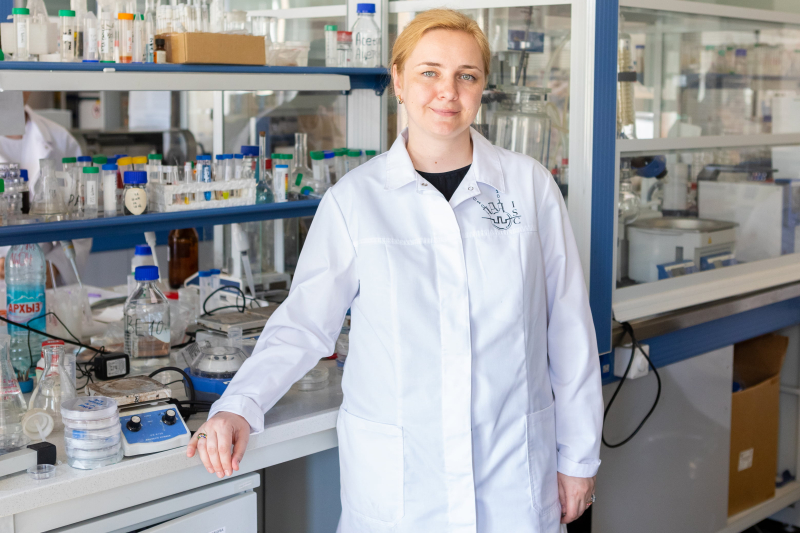
Ekaterina Skorb. Credit: Dmitry Grigoryev / ITMO NEWS
In the USSR, chirality in organic molecules was studied by biologist and biochemist Alexander Oparin, a member of the USSR Academy of Sciences. He hypothesized that life appeared gradually through chemical evolution of carbon compounds in the primordial soup. Later, the origin of homochirality became a separate field of study for Soviet and Russian scientists who looked into disruptions in mirror symmetry, chemical evolution, and the role of chiral purity in the functioning of biological molecules.
“Today, the chemical processes that could have led to the origin of life are studied at ITMO’s Infochemistry Scientific Center. For this purpose, researchers use methods of information theory that help evaluate the complexity of chemical systems and study how regularity can originate in them. This approach was already used to compare 18 amino acids. Though it doesn’t directly explain why one of the two chiral forms is more prevalent in living organisms, it gives us tools to study mixtures similar to the primordial soup where life could have originated. ITMO researchers also study reactions within coacervates – droplets with concentrations of chemical substances,” adds Dr. Skorb.
ITMO scientists also study the origins and properties of chirality in nanomaterials, as well as ways to separate chiral nanoparticles and control their optical response. These fields are interconnected but involve different mechanisms.