Physics
What’s the secret of a good sequel? Take what worked last time – and double it up. Thus, fans of the axion response will be thrilled to hear that researchers at ITMO have now described the double axion response.
All jokes aside, the phenomenon outlined in the recently published study could be a crucial one; while thus far it has been suggested to exist in metamaterials, scientists believe it to be possible in natural structures, as well. If that is the case, the discovery would open up a whole new field of study.
Read more: New Type of Axion Response Predicted by ITMO Scientists
Read also:
ITMO Researchers Solve Key Issue for Compact Particle Accelerators
***
Just like their “regular” counterparts, quantum computers are facing an issue when it comes to increasing capacities. In their case, it has to do with the speed of data transfer – or, more accurately, quantum state transfer.
Now, scientists from ITMO University and the London Institute for Mathematical Sciences have suggested a better way to transfer states from qubit to qubit. Using a classical physics concept as reference, they’ve devised a method that is both quick and resistant to performance loss.
Read more: Time-Optimal Transfer of Quantum State Achieved by ITMO Physicists
Credit: Google DeepMind (@googledeepmind) via Pexels
Artificial intelligence
From an hour-and-half to just one minute: that, according to researchers at ITMO and MSU, is how much time the new NanoMINER software will save for scientists conducting research into nanomaterials and nanozymes.
With an accuracy of 98%, the system can reliably scour scientific papers for hard data on the properties of various materials and how they’re synthesized. The algorithm is entirely open-source and has been published on GitHub to benefit other researchers working in physics, chemistry, and AI.
Read more: ITMO’s New AI Model Analyzes Papers 90 Times Faster
***
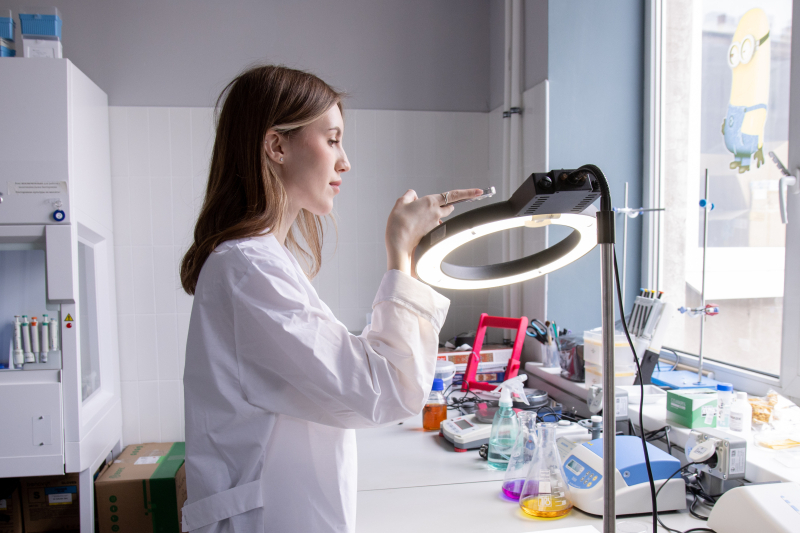
A new system designed by staff of ITMO’s Infochemistry Center uses a regular smartphone camera and a chatbot to provide real-time quality control in the production of fermented dairy products. By scanning the colors of a special indicator, the app can quickly gauge the pH levels of the sample, which is a crucial metric in production of fermented products, especially when it comes to small-batch production.
Read more: Lab in a Smartphone: ITMO Scientists Develop Mobile Bacteria Growth Monitoring System
Credit: Tara Winstead (@tara-winstead) via Pexels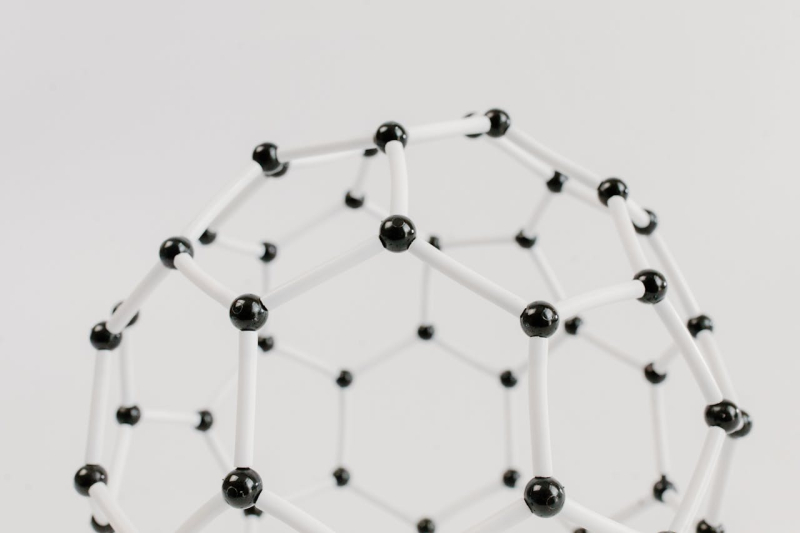
New materials
2,500 square meters of surface in just one gram of material – nearly on par with graphene, a new material developed by scientists at ITMO and Ioffe Institute is showing a lot of promise.
Why is a high surface area important? Such materials are used for purification, in drug delivery, sensorics, and much more. Being biocompatible, the new material is said to have great potential for use in biological research, environmental protection, and medicine.
Read more: Russian Scientists Create Silicon-Oxygen “Graphene” With Ultralarge Surface Area
***
The solution to most drawbacks of OLED screens may lie with semiconductors – that is, if scientists succeed in boosting their quantum efficiency. Recently, researchers from ITMO and Pohang University of Science and Technology fused a semiconductor and a metasurface to create a lighting element 1,600 times stronger than a regular semiconductor surface.
Read more: ITMO Researchers Create Next-Gen Light-Emitting Components for Displays
Credit: Beau Horyza (@solovisuals) via Unsplash
Culture
In every era, technology and art have been inherently connected. And for over a century, science has motivated filmmakers to imagine new worlds and use new methods to bring them to life. Yet sometimes, these creative pursuits have worked the other way around – prompting creatives to invent all-new tech just to put their imagination on screen. For one of our recent features, we’ve taken a look at some of the films that broke both artistic and scientific ground.