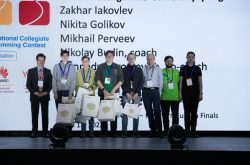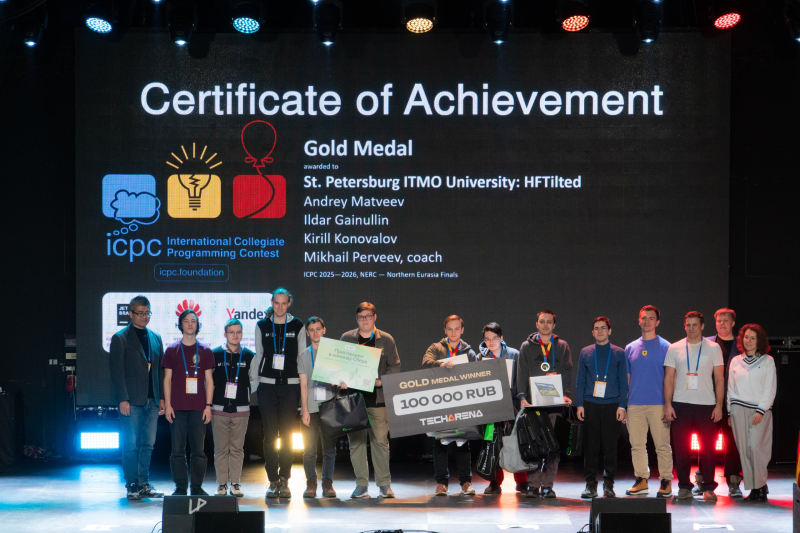
ITMO students Andrei Matveev, Ildar Gainullin, and Kirill Konovalov (team SPb ITMO: HFTilted) solved 9 out of 13 tasks. The team is coached by Mikhail Perveev – an ITMO graduate and a gold-medal champion of the ICPC Northern Eurasia Finals in 2023.
The outcome was decided in the last hour of the championship – before the leaderboard was frozen, the team from Moscow Institute of Physics and Technology aimed for the gold but, nevertheless, took home silver, solving 8 out of 13 tasks. Other silver winners are teams from Chelyabinsk State University and Novosibirsk State University (each solving 8 tasks). The champion became the team from HSE University (HSE: FFTilted) that managed to solve 12 out of 13 tasks at the contest. The championship’s results can be found in this table.
The ICPC Northern Eurasia Finals brought together the best students from several countries in the region – all of them were winners of the ICPC regional finals. In total, the contest involved 2,984 teams, 341 of which had the chance to compete for the title of champions at the Northern Eurasia Finals and a spot at the ICPC 2026 World Finals.
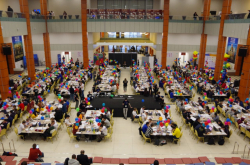
The contest took place simultaneously on several sites – in St. Petersburg, Novosibirsk, Almaty, and Tbilisi. The regional finals were organized by the official representative office of ICPC in Northern Eurasia, established under the aegis of ITMO University (ICPC NERC HQ). Among other universities that hosted this year’s finals were Novosibirsk State University, Farabi University in Almaty, and Alte University in Tbilisi.
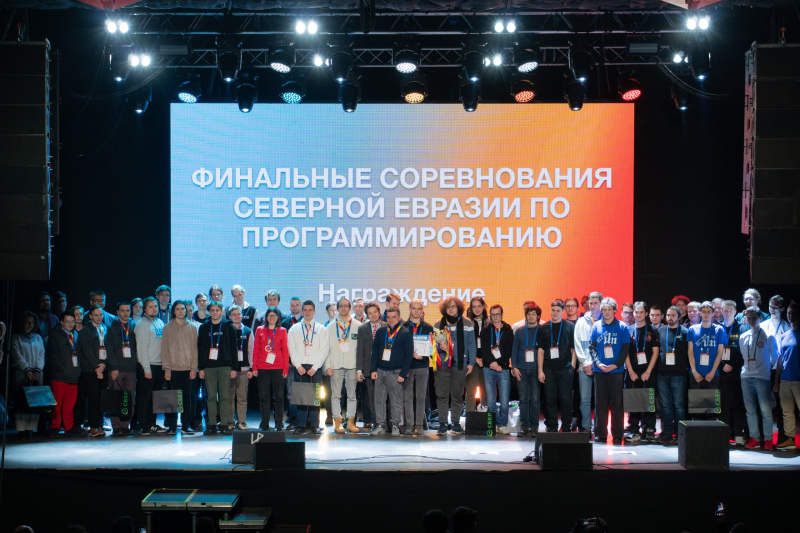
The ICPC Northern Eurasia Finals 2025 in St. Petersburg. Credit: NERCNews
According to the final results, at least 16 teams will represent Northern Eurasia and their universities in the next year’s world finals:
- HSE: FFTilted (Babin, Kudriashov, Romashov);
- SPb ITMO: HFTilted (Gainullin, Konovalov, Matveev);
- MIPT: MrZver (Belyaev, Ozhegov, Redko);
- Chelyabinsk SU: TrAkToR74 (Gorbatov, Gribakin, Karpovich);
- Novosibirsk SU: NSUtella (Boluts, Goncharov, Lylova);
- St. Petersburg SU: I See Personal Computer (Korotchenko, Moskalenko, Zaitsev);
- Nazarbayev U: clearly straight guys from *stan (Ashurov, Kenzhebayeva, Maksotov);
- Ural FU: ck feel it (Cherepanov, Kremensky, Mikhailov);
- CentralU: Central Podpivasy (Alekseev, Fedorov, Sarapkin);
- Belarusian SU: 1 (Antashkevich, Sabalenka, Vylegzhanin);
- MEPhI: Sneaky Random In The Pocket (Akhmadullin, Filonets, Petrov);
- BSUIR: Krambambulya (Areshchanka, Lozhachnik, Safonau);
- Skoltech: UnderWater (Aliev, Basharin, Shuklin);
- Free U of Tbilisi: Tbilisi FreeUni 1 (Dolaberidze, Nadareishvili, Zhorzholiani);
- Yerevan SU: 6741426 (Andreasyan, Kocharyan, Petrosyan);
- Nizhny Novgorod HSE: Muffix Sassif (Andrianov, Lepeshov, Shulyatev).
ICPC (International Collegiate Programming Contest) is the world’s largest and most prestigious championship in competitive programming. The event has been held for over 40 years and attracts thousands of students from all over the world.
The contest is open to teams of three students. Their task is to solve a certain number of challenges of varying difficulty over the course of five hours. The tasks are based on real-life cases: for example, the teams could be asked to optimize train schedules, track robot movements, design racing tracks, model luggage collection for airports, and more.
In Russia, the contest became popular in the mid-90s, when teams from ITMO, St. Petersburg State University, and Lomonosov Moscow State University were first invited to take part in regional European contests. Since then, students from ITMO University have won the title of world champions seven times.