Vasiliy Reshetkin was drafted into the army at the age of 17 in 1943 and was immediately sent to become an automatic rifleman in the ski battalion of the 68th Reserve Rifle Regiment. The training was tough: severe physical and mental hardships, poor nutrition, and low-quality uniforms.
In April 1944, Vasiliy Reshetkin was enlisted as a private in the 141st Rifle Regiment of the 85th Leningrad-Pavlovsk Red Banner Motor Rifle Division. Established in 1941 as the 2nd Leningrad Rifle Division of the Soviet People’s Militia for the defense of Leningrad, the division was later reformed and renamed. Together with his comrades, Vasiliy freed Pskov, Estonia, and Latvia, and participated in the liquidation of the Courland Pocket.
“In Riga, we forced the river and got caught in a pocket: fire on our right, fire on our left, fire in front of us… and the only way out was to go behind, over the river; we suffered heavy losses. I was a part of the crew that operated the ZiS-3 gun. In that battle near Riga, we lost our gun to a hulled-down tank and after that, I was dispatched as a messenger to communicate with the regiment command and other units of the division. I have to say this was a rather unpleasant job. As a crew member, you can hide or dig in, but messengers have a certain task and they have to go to where they’re ordered. I received a package and had to do whatever it takes to deliver it. My infantry skills helped me a lot in that: I could move by short dashes and low crawl when needed,” recalls Vasiliy Reshetkin in the book “Наши ветераны: они трудились в нашем вузе” (“Our Veterans: They Served at Our University”).
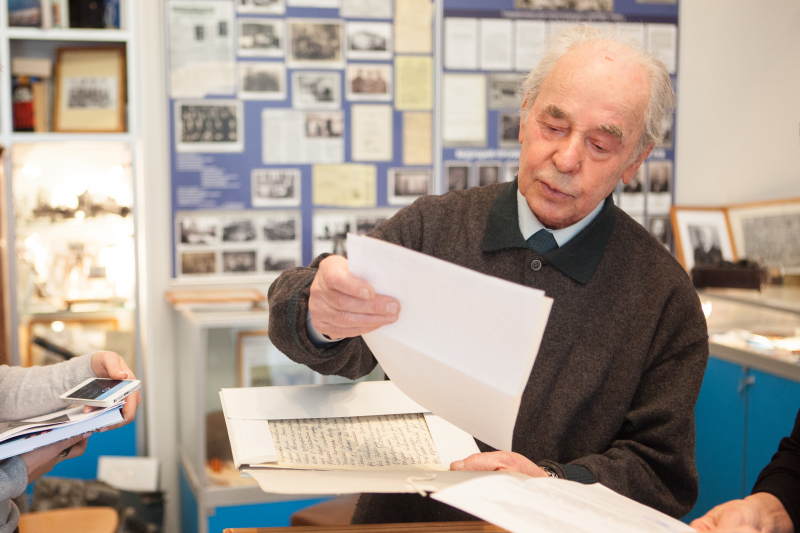
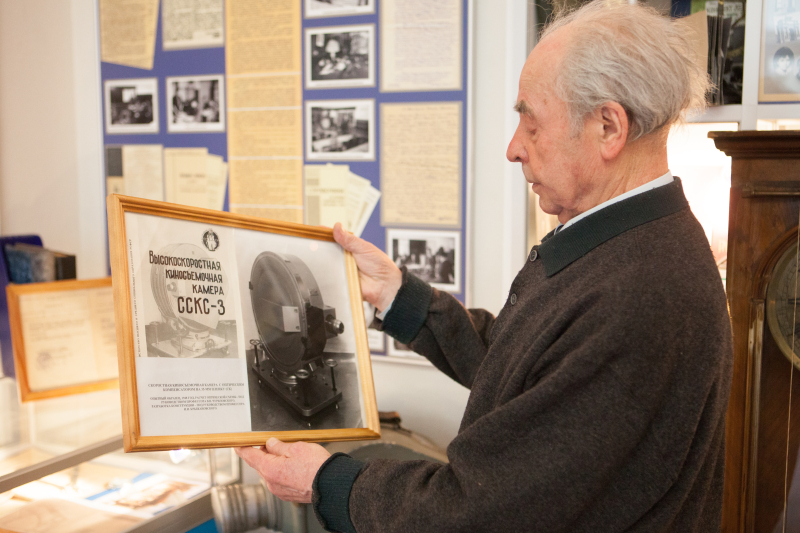
Vasiliy Reshetkin at ITMO’s Historical Museum in 2015. Photo by ITMO’s Historical Museum
In 1994, Vasiliy Reshetkin was awarded the Medal “For Courage” for the timely and accurate delivery of secret and top-secret packages to the regiment's units in a combat environment, often under enemy artillery fire, and later on – the Order of the Patriotic War, the Medal “For the Victory over Germany in the Great Patriotic War 1941-1945,” and some other state awards.
Studies and work at LITMO
After the end of the Great Patriotic War, Vasiliy Reshetkin did not leave the military – he was accepted into what is now known as Mikhailovskaya Military Artillery Academy. In five years, he obtained a qualification as an artillery technician and learned to repair guns and devices; his specialization helped him enroll at LITMO’s Optics Department and land a job as a mechanic (category 5) at LITMO.
At that time, the department was headed by Alexander Zakharievskiy, DSc in engineering, a corresponding member of the Academy of Rocket and Artillery Sciences and a professor at LITMO. Prior to the war, he had already established a name in applied optics, optical rangefinders, interferometer theory, and interference microscopy. During the wartime, Dr. Zakharievskiy developed a method and a collimator for optics equipment calibration and headed the optical workshop of a LITMO-based military hardware repair base. Alexander Zakharievskiy highly appreciated Reshetkin’s experience and skills in artillery equipment.
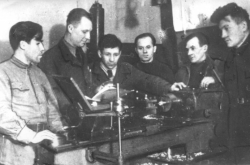
At LITMO, Vasiliy Reshetkin continued to expand his skills in setting-up, testing, and repairing devices produced by the university’s scientists. Then, he met Iosif Kryzhanovskiy – a celebrated developer of high-speed movie cameras and metal glass for optical devices. One of his developments was a technology that helped build a telescope that let astronomers capture the nucleus of Halley's Comet. At LITMO, Dr. Kryzhanovskiy founded a high-speed cinematography laboratory and invited Reshetkin to take on the role of a design engineer.
At his new position, Vasiliy Reshetkin completed an internship in East Germany, was promoted to the head of the Department of Optical Instruments, defended his DSc thesis, and became a professor at LITMO. With his fellow researchers, he created 14 types of high-speed movie cameras that were used to record on film and further study rapidly-developing processes, such as the flight of various military projectiles. Six cameras were standby; they started up and waited for the event to capture it within a wide range of response times. One of the devices was exhibited at an international exhibition in Genoa, Italy. For his devices and exhibitions, Reshetkin was awarded a Diploma of Honors, along with two silver and one bronze medals of the Exhibition of Achievements of the National Economy (VDNKh).
“A funny incident comes to mind. We needed to test one of our cameras at a customer’s polygon in Novosibirsk in spring. The weather was rather nice and warm in Leningrad so Nikolay Dyakov and I both – without even discussing it – chose summer clothes for our trip to Novosibirsk. We arrived in Siberia – and it was winter there; locals had fur and winter coats on. What were we left to do? We bought some warm clothes and hats at a store and spent all our trip money there; though, we still had a month till the trip ended. We showed up at the polygon dressed as prisoners. We had to skimp on food. A saleswoman remembered us and once, when we came to her store again looking miserably, she invited us for a soup at her house. Naturally, we didn’t go, even though we really wanted a decent meal,” says Vasiliy Reshetkin.
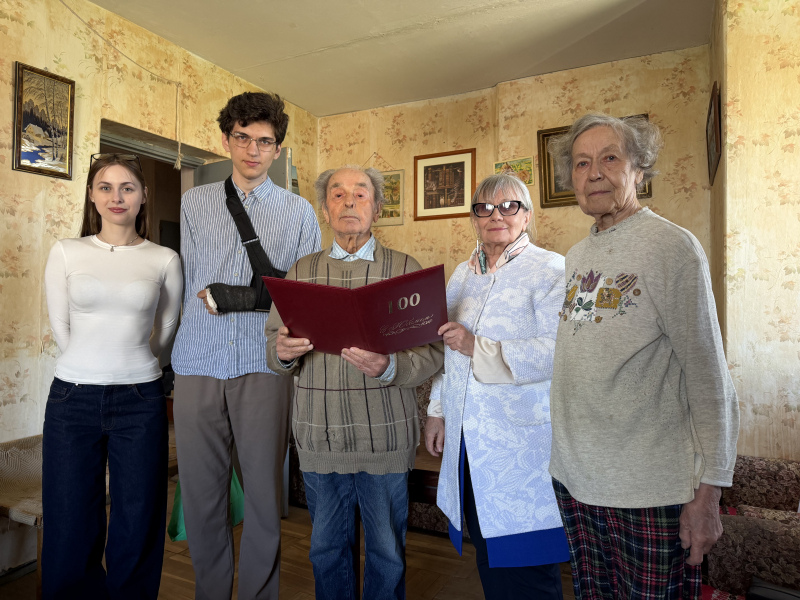
A meeting with Vasiliy Reshetkin on the eve of his 100th birthday. Photo by ITMO’s Historical Museum
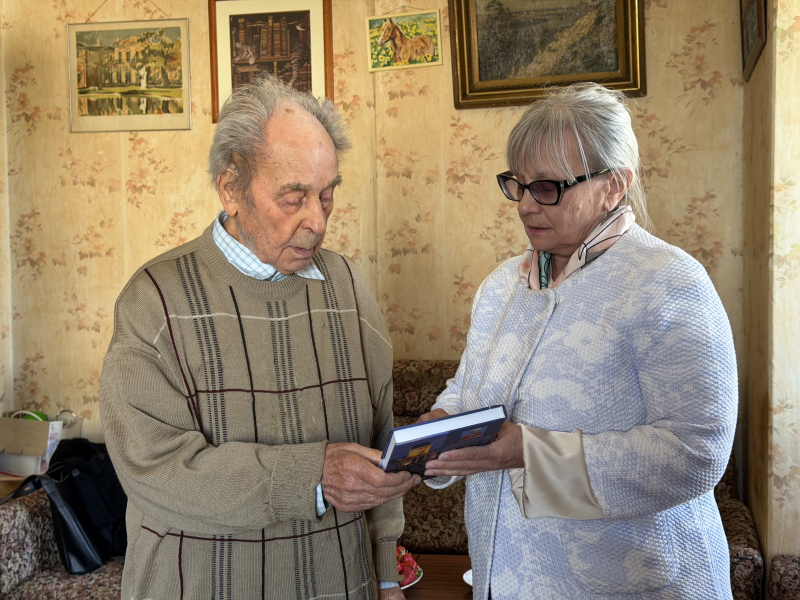
Nadezhda Maltseva, the head of the museum, and Vasiliy Reshetkin. Photo by ITMO’s Historical Museum
Vasiliy Reshetkin continued to work at ITMO up until he was almost 80. Today, he’s happily retired – but stays in touch with the university.
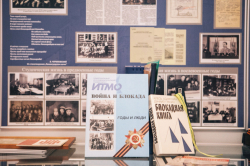
The information for this article was supplied by ITMO’s Historical Museum. The museum stores archive photographs, documents, and newspapers, as well as memories of the university’s staff, including from wartime. You can find the materials at the museum’s website. If you’d like to share the story of your family, please email its staff at museum@itmo.ru.