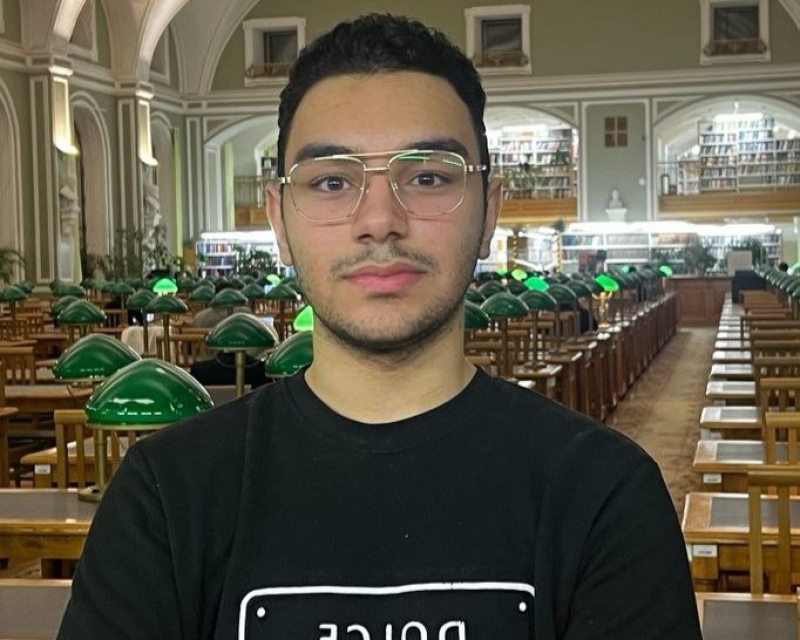
Hi Omar! Everyone knows you by the nickname Remo. Where does that moniker come from?
I’ve been called Remo by friends and relatives for a long time now. The story goes back to when I was about 12. At that time, I used to chat online with international friends on platforms like Reddit and Quora. One day, either by mistake or a display glitch, my name appeared reversed as “Ramo.” I liked the sound of it, and later I discovered “Remo” was an actual name of Latin origin, meaning “the rower.” It stuck with me ever since, and now everyone close to me calls me Remo.
What inspired you to choose computer engineering for your Bachelor’s?
Funnily enough, I didn’t always admire programmers. As a kid, I imagined them as gloomy people with no life outside their screens. What I did enjoy, though, was mathematics and logical thinking. In 10th grade, I joined the International Olympiad training program in Syria; that’s when I wrote my first line of code – print("hello world") – and suddenly, programming felt exciting.
But my path wasn’t straightforward. After school, I actually enrolled in general medicine at Damascus University. I spent one semester there, but soon realized medicine didn’t fit the life I wanted. It felt too limiting, bureaucratic, and country-specific. Technology, on the other hand, gave me freedom. With just a laptop, internet, energy, and maybe a glass of juice, I could work for a company anywhere in the world. That mix of flexibility, logic, and constant discovery is what drew me fully into computer engineering.
What drew you here to ITMO University specifically?
In high school, when my friends and I trained for competitions, we noticed ITMO’s name kept showing up at the top of the rankings. That stayed in my mind. Later, when I applied for the Russian government scholarship, I compared top universities like HSE, Bauman, MIPT, and MEPhI. ITMO stood out both for its strong academics and the vibrant community. It’s not just “go to class, then go home.” It feels like a lifestyle, with modern infrastructure, great dorms, international partnerships, and a student body buzzing with ideas. The slogan “More than a University” isn’t just marketing; it’s true.
And of course, there’s the location. I grew up in Damascus, one of the world’s oldest continuously inhabited cities, so being surrounded by history has always been natural for me. St. Petersburg carries that same depth, but with its own rhythm.
What was your first impression of St. Petersburg? Do you have a favorite memory from your early days?
Paperwork was a bit of a headache at first, but my funniest struggle was public transport. In Damascus, I rarely relied on it daily; suddenly, I had to master trams and metros packed with people. It felt strange but exciting.
One of my favorite memories was my second morning in the city. I opened the weather app and saw my location had changed automatically to St. Petersburg. At that moment, it really hit me: this was the start of a brand-new journey.
How are you adjusting to a new culture? Any challenges or joys?
It wasn’t a cultural shock so much as a cultural upgrade. Many of my relatives studied in Russia or the former Soviet Union, so I grew up with their stories. I had already started learning Russian before coming, but there’s a big difference between speaking a language and arguing with a babushka on the bus about whether you’re sitting in the wrong seat! Those little moments are what make you adapt faster.
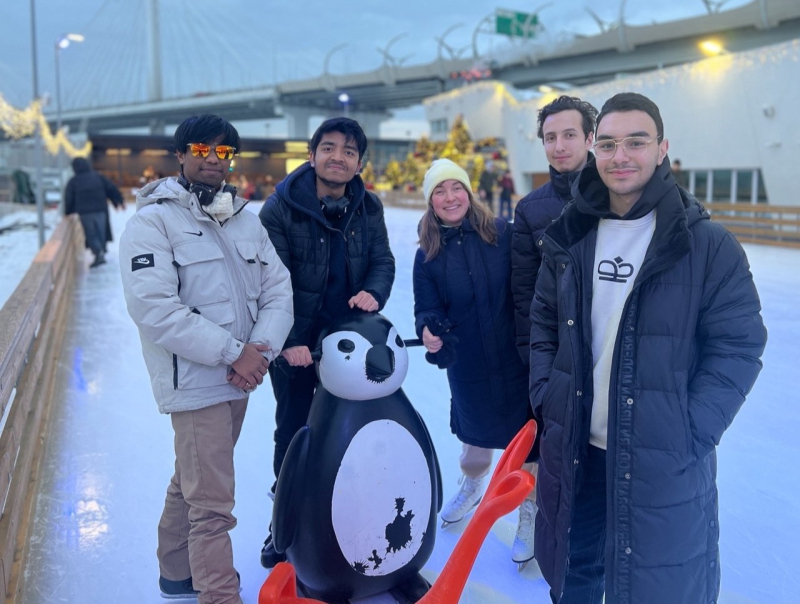
Remo with his friends and a teacher from the Foundation Program. Photo courtesy of the subject
Outside of studies, how do you relax or feel at home?
Simple routines keep me grounded. Walking through the city with music in my headphones makes me feel like the main character of a movie. I play football with friends, read, or explore new cafés. But honestly, my favorite “hobby” might be people-watching. Sitting somewhere and observing life around me is cheaper than Netflix and often funnier.
Coming back to education, which area of computer engineering excites you most right now?
Artificial intelligence fascinates me. It feels like the closest thing humans have made to actual “thinking.” I’m also drawn to cybersecurity, because what’s the point of creating smart systems if they aren’t safe? My dream is to build something that balances creativity and logic: futuristic, yet useful in everyday life. Even if my code saves someone just five minutes a day, that’s already a win, and then I’ll celebrate with ice cream.
What’s it like studying in such a diverse student community?
At ITMO, walking into the cafeteria feels like stepping into the UN, but with better food. You hear so many languages at once, share meals, stories, and memes. What I’ve realized is how similar we all are: everyone needs coffee in the morning, everyone complains about exams, and everyone laughs at memes. That common ground makes friendships grow quickly.
If you could invent one project during your studies, what would it be?
I’d design a smart platform that combines language learning with cultural survival skills. Not just teaching Russian words, but also how to handle winter, understand dark humor, or politely refuse a third serving of food from a grandmother. It would be practical, fun, and a way to connect people across cultures.
What’s one thing in Russia you’ve grown fond of already?
The white nights. Walking outside at 2 AM and still seeing sunlight feels magical. In Syria, night is really night, dark and quiet. Here, it’s like the city is taking a coffee break instead of sleeping.
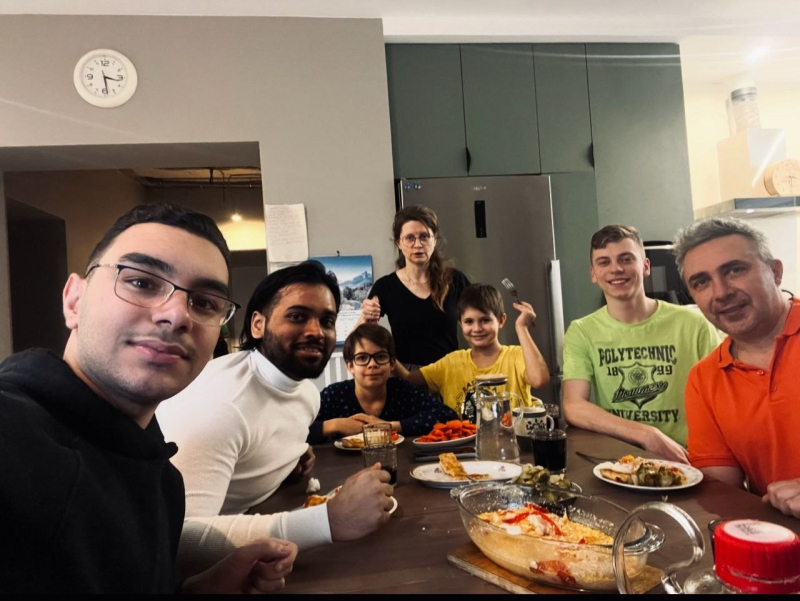
Remo at a Russian family dinner with his friends. Photo courtesy of the subject
Looking ahead, what’s your biggest dream as a student of computer engineering?
I want to build something meaningful that connects people through tech, knowledge, or shared experiences. Ideally, I’d be leading projects with teams scattered across the globe: some in St. Petersburg, others in Tokyo, New York, wherever. For me, the only borders I want are in my code, not on the map.
Finally, what advice would you give to young Syrians who dream of studying abroad?
Don’t be afraid to dream big, but don’t underestimate small steps. Learning a few Russian words, applying for one scholarship, sending one email – these little actions open doors you can’t imagine. Studying abroad isn’t just about academics; it’s about becoming someone who can adapt, grow, and inspire. Or, as I like to say: pack your courage first, your suitcase second.