Please introduce yourself to our readers.
My name is Viviana, but my friends call me Vivi. I'm 22 years old and I come from a small city called Cariamanga in Ecuador. A year and a half ago, I came to Russia to study for a Bachelor's degree in infochemistry.
How do you usually explain your program to friends or family back home?
It's like being a chemist and a programmer at the same time; you analyze substances and reactions, but you also create software, use artificial intelligence, and handle large amounts of data to solve problems in medicine, biotechnology, and the chemical industry.
What was the aha moment when you realized chemistry was your thing?
Since I was little, science has fascinated me. In my country, I learned the basics, but that was enough to awaken something in me. I loved seeing how each compound has its own reaction, how colors change, how substances transform before my eyes. Understanding how everything around us works; from the water we drink to the medicines that heal us. Laboratories were my favorite place because I experimented, mixed substances, and observed unexpected reactions. Each experiment was like solving a puzzle of the universe.
What’s the most surprising or mind-blowing concept you’ve learned so far in your program?
The most mind-blowing thing I've learned is that chemistry is no longer limited to the traditional laboratory, it goes far beyond that. What really surprises me is how technology infinitely amplifies the possibilities: you can analyze thousands of compounds in seconds, model complex molecules in 3D, or use machine learning to find patterns that would be impossible to detect with the naked eye.
Here at ITMO, I have access to cutting-edge tools and equipment that I wouldn't have in my country. It's like having scientific superpowers: chemistry gives you the knowledge of "what" and technology gives you the tools of "how." It's the perfect combination to transform ideas into real innovations.
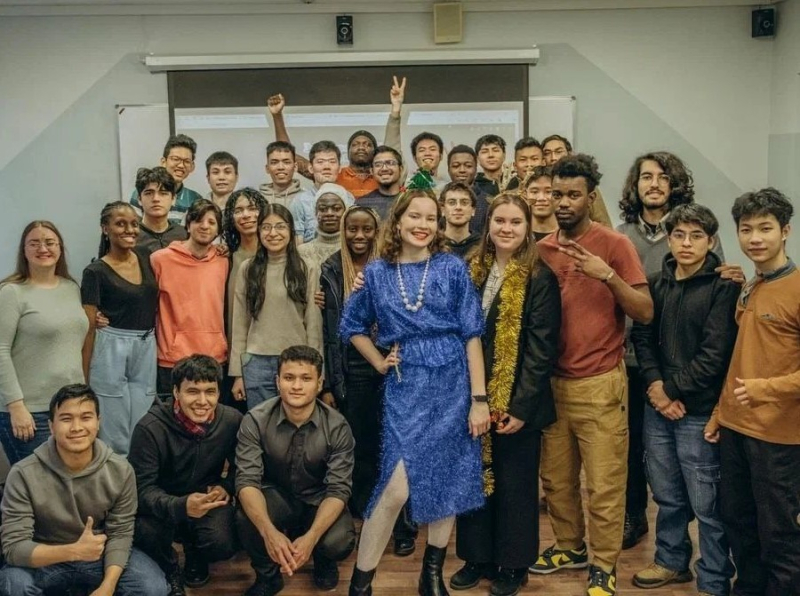
Viviana with her Russian teacher and classmates. Photo courtesy of the subject
What was your first impression of St. Petersburg, and what completely surprised you about life here?
When I first arrived, I felt a bit scared because I thought I wouldn't adapt, especially to the changing seasons. But St. Petersburg is a wonderful city; no matter the season, it remains beautiful. It's full of culture and art; every place you visit has its own history. What fascinated me most is its infrastructure. It's a city with so much movement, yet peaceful at the same time. I love its parks because they remind me of my hometown and make me feel at home.
Moving from Ecuador to Russia is a big leap. What’s been the funniest or most unexpected cultural moment so far?
Language was definitely a challenge. At first, I didn’t know any Russian, so I had to rely on gestures to express myself. It was funny at times, but also a real cultural shock. In Latin America, we’re very cheerful and expressive people, and without realizing it, we can be quite loud. When I met up with my Latin American friends, Russians would sometimes look at us with curiosity, and sometimes with a bit of annoyance, because here people tend to be more serious and reserved, especially when they don’t know you yet.
When you’re not studying molecules and data, how do you like to relax or recharge?
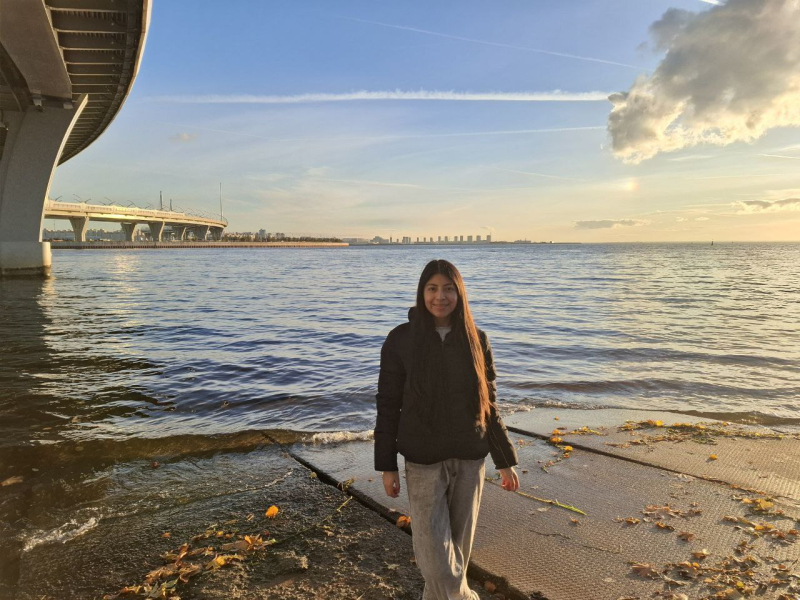
In my free time, I love watching K-dramas and horror movies while enjoying a cup of coffee. I also like going out to eat with my friends or exploring the city, visiting museums and tourist spots. My favorite place is the 300th Anniversary of St. Petersburg Park; I especially love going there in spring because the weather is mild and the flowers start to bloom, making everything beautiful.
Have you found a favorite Russian dish yet?
It would be difficult to choose just one favorite dish. But what fascinated me the most were the desserts. I had never tasted such delicious desserts before! My favorite is pyshki; I could eat them all the time. And the cakes they make here are amazing, especially the carrot cake, which is also one of my favorites.
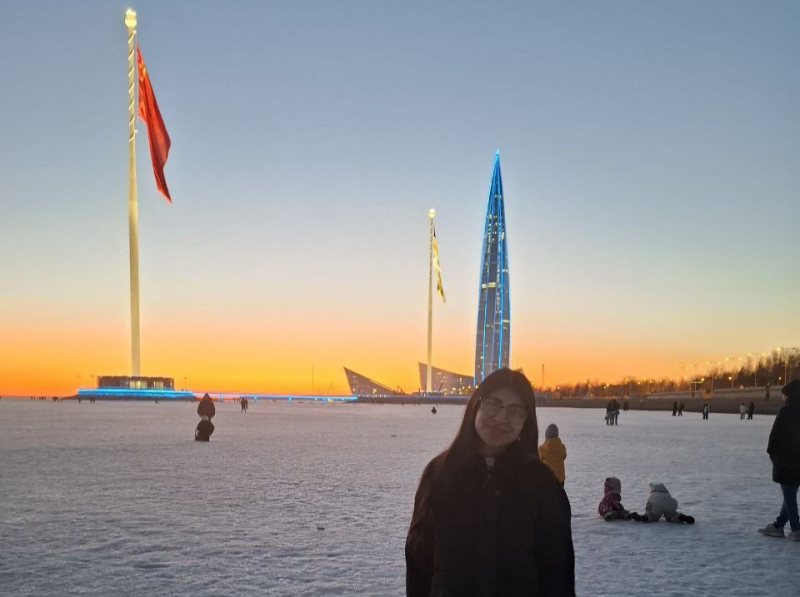
Viviana at the 300th Anniversary Park in St. Petersburg. Photo courtesy of the subject
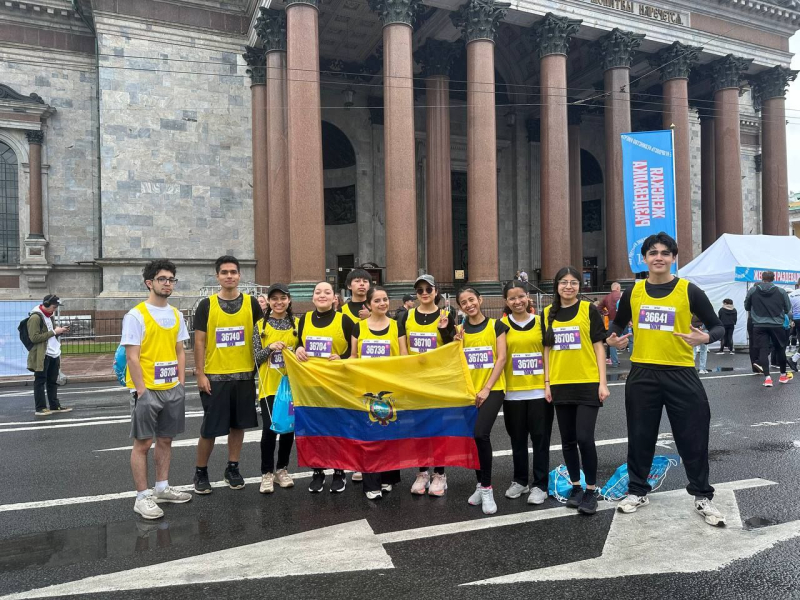
Viviana with her friends, participating in a race. Photo courtesy of the subject
How do you cope with the cold weather here?
It wasn't really a problem for me because I'm from a city with a cold climate, so I've always known how to dress warmly. But when winter arrived and it started snowing, that was something new. I had to learn to layer up even more than usual when going out. The cold is only temporary though, just on the street; because once you're inside a building or on public transport, it's completely different. But I would choose cold weather a thousand times over!
Finally, what advice would you give to students from Ecuador or Latin America who are thinking about studying a science program at ITMO?
My advice would be: don't be afraid to take the leap. Yes, it's challenging; the language barrier, adapting to a new culture, being far from home; but it's absolutely worth it. ITMO offers incredible opportunities that are hard to find elsewhere, especially in terms of technology and resources.
Start learning Russian as soon as possible, even basic phrases will help you a lot in daily life. Be open-minded and patient with yourself during the adaptation process. Connect with other Latin American students; they become your family here and help you feel less homesick.
Most importantly, embrace every challenge as a learning opportunity. Every difficulty you overcome makes you stronger and more independent. If a girl from a small city in Ecuador can do it, so can you. The experience will transform you in ways you never imagined.