During Joseph Stalin’s rule, architecture served not only a practical but also an ideological purpose: to mirror the power of the regime and the state. To achieve this, a new architectural style gradually emerged. There is still no single name for it: it was variously referred to as Soviet architecture, Stalinist architecture, and Stalinist Empire.
The newborn style was shaped by many pieces of architectural history. Columns, sculptures, and strict symmetry came from the Renaissance and Classicism. The dramatic curves and decorative excesses were borrowed from Baroque. Numerous bronze details recalled the French Empire style, while the impressive height of some buildings was inspired by American Art Deco skyscrapers. Distinctive decorative elements included Soviet symbols such as five-pointed stars, hammers and sickles, as well as sculptures depicting working-class men and women.
Particular attention was paid to urban planning. Buildings did not stand alone but formed part of larger ensembles: ultra-wide avenues and ceremonial squares for parades and demonstrations, vast parks for recreation.
The style, however, came to an abrupt end under Stalin’s successor, Nikita Khrushchev, who declared elaborate decorations unnecessary and introduced a new policy of mass construction.
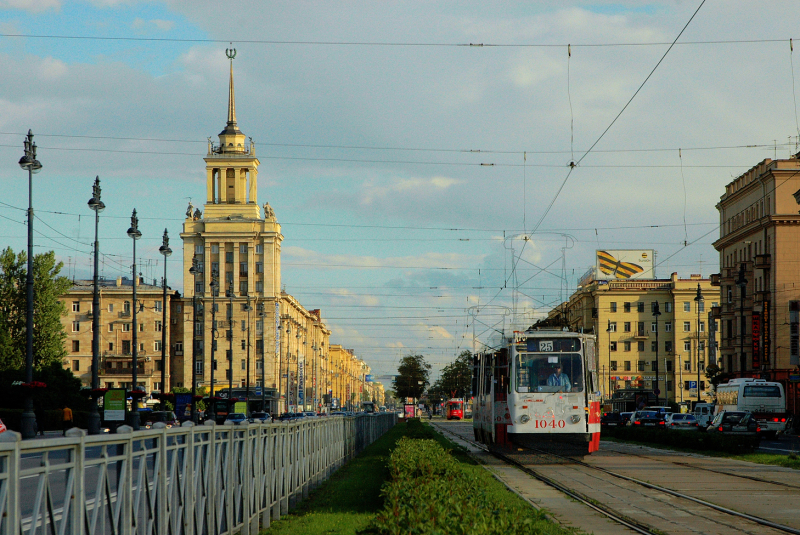
House with a spire on Moskovsky Prospect. Credit: Mikhail Medvinskiy, CC BY-SA 3.0, via Wikimedia Commons
Moskovsky Prospect
Moskovsky Prospect runs from Sennaya Square to Victory Square, but blocks of buildings in the distinctive Stalinist style start at its southern stretch (right from the Elektrosila metro station). This is classic Soviet urban planning: wide and straight streets, neat tall buildings, and a lot of greenery, both down the streets and in the parks.
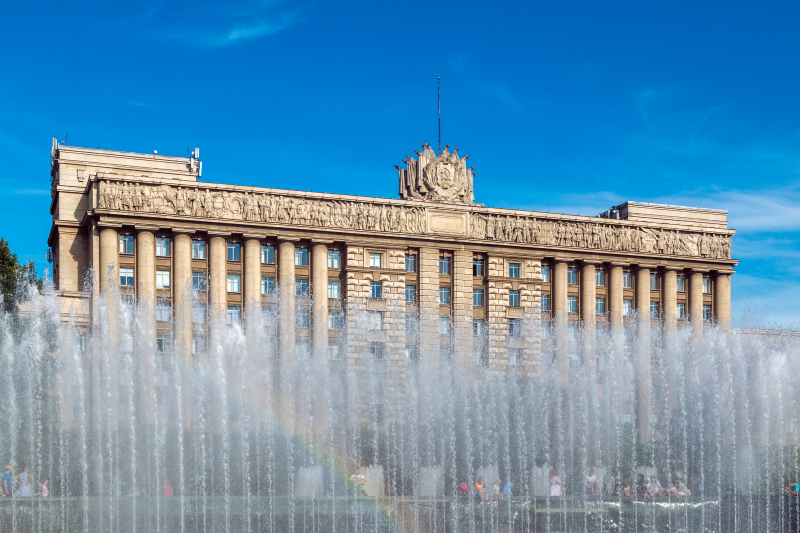
The centerpiece of the ensemble is the House of Soviets, a monolithic administrative building decorated with friezes depicting muscular Soviet workers. It stands on Moscow Square, one of the largest squares in Europe. The ensemble was designed at a time when the area was intended to become the city’s new center. Although those plans never came to fruition, the grandeur remains. In front of the building, you’ll find one of the city’s tallest monuments to Lenin.
The residential buildings are decorated with floral motifs and Soviet symbols, while arched entrances lead into their courtyards. One of the most impressive is the house with a spire near Park Pobedy, which was the tallest residential building in the city when it was constructed. The spire was made by workers at the Admiralty Shipyard, while the statues crowning the edges of the towers are dedicated to them, depicting men and women holding anchors.
More like this: Svetlanovskaya Square, Engelsa Prospect, Ivanovskaya Street
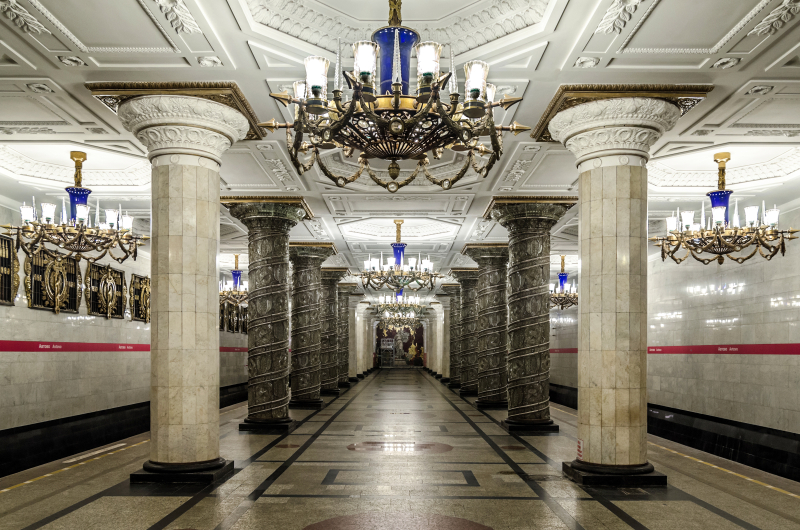
Avtovo metro station. Credit: Alex 'Florstein' Fedorov, CC BY-SA 4.0, via Wikimedia Commons
Red line of the metro
Opened in 1955, the stations from Ploshchad Vosstaniya to Avtovo formed the first line of the Leningrad Metro. Inspired by its Moscow counterpart, the line was richly decorated with columns, mosaics, and other elaborate elements. The stations were built using expensive materials such as marble and granite. The gem of the line, without any doubt, is the Avtovo metro station, often considered one of the world’s most beautiful underground stations. The Independent even noted that “Russia’s former capital has a living work of art in the shape of the Metro.”
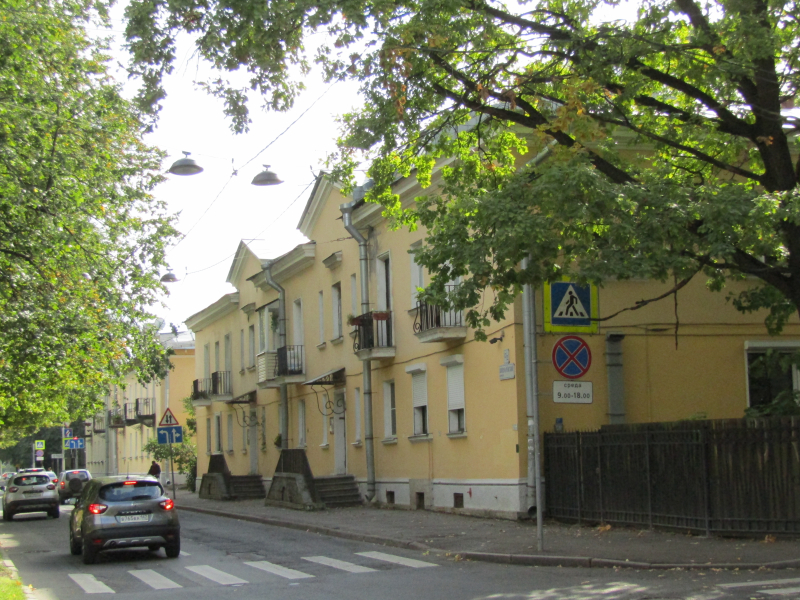
Houses around Savushkina Street. Credit: Germash19, CC BY-SA 4.0, via Wikimedia Commons
Small-rise buildings
Amid all this grandeur, you can find a very different type of architecture still falling under the category: cozy low-rise houses. These are blocks of two- and three-story buildings often known as “German cottages.” It is believed that they were built after the Great Patriotic War using the labor of German prisoners, although there is no solid evidence to support this theory. They were a quick solution to the housing shortage, but unlike Khrushchev-era apartment blocks, they kept decorative elements and distinctive shapes, creating quiet, low-density areas.
Even today, these neighborhoods are appreciated both for their peaceful atmosphere and as a quiet alternative to the bustling city center. Some of the best-known examples with colorful façades, balconies, and green courtyards can be found on Savushkina Street.
More like this: around Udelnaya metro station, Narvskaya Zastava, Volkovskaya metro station, Bolshaya Okhta
Title image credit: Mike1979 Russia, CC BY-SA 4.0, via Wikimedia Commons