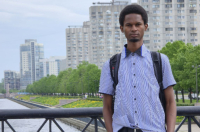
Hi, Habeebulah! Could you introduce yourself to our readers?
Hi! My name is Habeebulah Abdullahi, and I'm from Kwara State, Nigeria. I have a Bachelor's degree in statistics, and I'm currently pursuing a Master's degree in public health sciences at ITMO University.
I've been in Russia for about a year now, having completed my Foundation Program earlier this year.
What made you choose ITMO University?
What attracted me was ITMO’s focus on innovation in science and technology. I've always been interested in how technology can be used to solve real-world problems, and I wanted to study in an environment that encourages innovation.
Studying abroad was also an opportunity to experience a different culture, learn about new traditions, and become familiar with another educational system. I wanted to broaden my perspective, both academically and personally.
You studied statistics before moving into public health sciences. What inspired this change?
Since childhood, I've been passionate about improving the healthcare system in my country and across Africa. I'm particularly interested in how advanced technologies and innovation can contribute to better healthcare.
Although my Bachelor's degree was in statistics, I don't see public health as a completely different field. It brings together different scientific disciplines, and I believe my background in statistics can be valuable in this area.
How have you found your studies at ITMO so far?
Everything has been going smoothly so far. We've recently submitted our research project proposals and selected our preferred supervisors. My proposed supervisor specializes in biostatistics and works on cancer-related research, which I think aligns well with my academic background and research interests.
Your Master's program is taught in English. Has learning Russian still been useful?
Absolutely! Even though my academic program is in English, knowing some Russian makes a big difference when I need to speak Russian at work and in everyday situations.
Completing the Foundation Program was very helpful in this regard. It gave me the language skills I needed to navigate daily life here more comfortably.
How have you been settling into life in St. Petersburg? Have you had the chance to explore the city?
Yes, I've had a few opportunities to explore St. Petersburg. During my preparatory year, we went on a boat trip with our teacher, and I've also visited the Russian Museum of Ethnography and several other places.
I particularly enjoy spending time in the city center. It's probably my favorite part of St. Petersburg so far.
Have you participated in any university events or cultural activities?
Yes! Earlier this year, I attended Nigerian Cultural Night, which was a wonderful opportunity to celebrate and share our culture.
We showcased traditional Nigerian clothing, played Nigerian music, and introduced people to our cuisine. It was a great experience because we got to share different aspects of our traditions with others.
Nigerian food is something I would definitely recommend trying. One traditional dish is pounded yam, which is made from cooked and pounded yam and usually served with soup. And, of course, there's Nigerian jollof rice! That's another dish I think everyone should try at least once.
Did you receive any support when you first arrived in Russia?
Yes, ITMO's Buddy System was a great help to me.
When I first arrived in Russia, my Buddy, Irina, came to meet me at the train station and helped me get settled. Having someone there to welcome you and help you navigate a new environment makes a big difference, especially when you're arriving in a foreign country.
How do you usually spend your free time outside your studies?
I enjoy spending time in conversations with my friends. I also play basketball and tennis whenever I have the opportunity.
Apart from that, I like reading about and exploring research topics related to health. It's an area I'm genuinely interested in, so even during my free time, I sometimes find myself looking into new ideas and developments.
What are your plans for the future? Where would you like your career to take you?
I think a lot depends on what opportunities the future brings, but one thing I would really love to do is become involved in healthcare policy and public health policy in Nigeria.
My interest isn't necessarily in practicing medicine directly. I'm more interested in the systems and policies that shape healthcare and how they can be improved. Ultimately, I'd like to contribute to making healthcare better in my country and, hopefully, across Africa.
What motivates you to keep working toward that goal?
I believe in my own capabilities and in the possibility of achieving something meaningful in life. I know that I have the potential to accomplish great things, and that belief motivates me to keep moving forward with my studies and my ambitions.
Of course, I don't know exactly what the future holds, but I'm optimistic about the opportunities ahead.
Finally, what advice would you give to students from Nigeria or other countries who are considering studying at ITMO?
My first piece of advice would be to choose your study program carefully.
If you're applying for a Master's degree, think about your academic background, what you studied during your Bachelor's degree, and how that connects to the program you want to pursue.
It's important to find a connection between your previous studies and your future academic goals. Otherwise, you might find yourself struggling with a program that doesn't suit your background or interests.
Another very important factor is the language of instruction.
I've seen international students struggle with studying in Russian. Of course, there are students who have successfully completed Russian-taught programs and even graduated with honors, but it requires a great deal of effort. You might be perfectly capable of understanding complex concepts, but the language barrier makes it difficult to follow lectures, or express your knowledge.
That's why I would strongly recommend considering an English-taught program if you aren't confident enough in your Russian language skills.
Studying abroad is a valuable opportunity, but it's important to make decisions that support your academic success rather than simply choosing a program because it allows you to move to another country.