In early 2026, Russian LLMs took over the top six positions in the SLAVA benchmark (a 14,000-question test that covers Russian history, social studies, and geography), which marked a sharp shift from November 2023, when the US and China held the ranking’s top three. The experts claim these shifts reflect not only increased investment in domestic AI models – but also a larger share of Russian training datasets.
In the meantime, Russian-language data still remain a relatively scarce resource, with the local available web being 10-20 times smaller than the global one. According to the researchers, these volumes are good enough to build a part of the multilingual corpus yet not for a competitive general-use model that works exclusively in Russian. Additionally, they note that Russian-language data should ideally make up 5-30% of the training datasets.
The experts believe that Russian AI models should be multilingual. Although Russian data is vital, isolation from global corpora will leave domestic models further behind their foreign competitors and weaken their performance on tasks that go beyond the local language context. Multilingual models show a broader “worldview”: different languages carry unique information, and English remains the language of science. Cutting off access to these resources would artificially isolate the models from the richest, most current data available in the market.
“Russian-language data makes the model not only sound more natural but also more proficient when it comes to Russian realities, history, law, and culture. At the same time, general-purpose models can’t do without the global body of knowledge. That’s why Russian developers should not choose between local and international data – but instead focus on building the most diverse and high-quality corpus,” note the authors of the study.
As the experts point out, data restrictions hamper model capabilities. Pretraining requires datasets with trillions of tokens: web pages, books, scientific papers, open-source code, and encyclopedic materials. In contrast to their counterparts, Russian developers rely more heavily on open-source sources because their resources are limited as for collecting, purchasing, and digitizing data on their own.
Russian LLMs could also gain a competitive edge through access to offline resources from libraries and archives, as well as educational, scientific, cultural, and professional collections. Digitizing these sources will help developers improve model performance across specialized fields – for example, medicine, law, construction, geology, and other fields that require Russian expertise and standards.
Furthermore, the study emphasizes that the future success of Russian LLMs relies on cooperation among the industry, the state, the open-source community, as well as different cultural and educational organizations. In this case, a distributed development model looks very promising – the state creates the conditions, the industry deals with deployment, the scientific community provides methodological depth, the education sector trains relevant specialists, and the open-source community speeds up the exchange of developed tools and solutions.
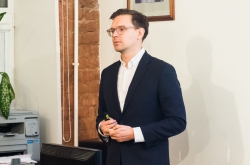
“Right now, each big company builds models for its own needs, but there are tasks that require a collective effort to solve. Rather than everyone training their own models on the same professional literature, we could share our solutions – or sell them. We need to encourage sharing accumulated knowledge as public smart agents, which others can use to build systems for their tasks,” says Alexander Boukhanovsky, DSc in engineering and the head of ITMO’s Institute for Artificial Intelligence.

Alexander Boukhanovsky. Credit: Dmitry Grigoryev / ITMO NEWS
The Russian LLM market will grow given that developers implement the global tech framework, enhance and adapt it for local tasks, and release products quickly. Should all players join efforts during the early stage, domestically produced models will stand a chance of becoming a full-scale tech infrastructure layer for Russia. Another factor that affects the field’s success is copyright regulations for AI training. The researchers argue that these laws need to safeguard creators' interests without limiting the models’ access to training data.
“So far, Russian models hold a distinct advantage over global counterparts – they understand Russia better: the language, history, law, and culture. But this advantage doesn’t come on its own. To develop competitive models, we need an extensive body of data, including international resources and quality Russian materials for understanding the Russian specifics. If there is less data, models will depend more heavily on foreign datasets and fail to recognize the Russian context. Therefore, access to diverse resources isn’t only a matter of AI quality – but also a vital condition for developing in-demand Russian models,” note the authors of the study.
Info
The survey was conducted by ITMO’s Institute for Artificial Intelligence and included experts from the AIRI Institute, Lomonosov Moscow State University, ITMO University, the Russian Presidential Academy of National Economy and Public Administration, HSE University, Yandex, Sberbank, T-Bank, AI VK, independent teams, and other players in the Russian LLM market.