Electrons are typically depicted as very small particles. However, at the quantum scale, this is a simplification: electrons also possess wave properties. If an electron is free, unaffected by any force, it behaves like a flat wave and doesn’t radiate. However, a wave’s properties can be changed. For instance, magnetic coils can guide electrons similarly to the way lenses guide light.
The physics of electrons in a uniform magnetic field has been established for quite a while. Such a field is arranged so that its strength and direction are identical at all points in the region of space under consideration. The Soviet physicist Lev Landau had shown that the motion of an electron in such a field is quantized: it permits only discrete states. This means that the electron does not move arbitrarily, but transitions from one level to another, as if climbing a set of steps. These states are called Landau levels. However, this theory describes electron motion under the conditions of an ideally uniform magnetic field, which in reality requires special conditions. In real experiments involving particle accelerators or electron microscopes, the field is always significantly non-uniform, meaning the simplified Landau model is not suitable for describing them.
In their new study, researchers from ITMO’s Faculty of Physics demonstrate a way to accurately describe twisted electrons – not in an ideal uniform field, but in conditions close to those in real microscopes and accelerators, generalizing Landau’s theory. In these devices, the field is formed by separate magnetic coils. This means that it inevitably changes along the trajectory of electron movement: the field’s effect is stronger inside the coils and is absent between them.
The team has conducted calculations based on a scenario wherein an electron passes through multiple magnetic lenses. They focus the beam and change the shape of the electron wave, leaving it with a complicated structure. Next, the electron lands in the area between the magnets, where the field’s force is locally equal to zero. In the absence of a magnetic field, the electron mustn’t emit photons – this would violate the law of conservation of energy. A particle “radiates” only when it is accelerated by the centripetal force exerted by magnets. A free electron does not have enough energy to “radiate.” However, the physicists’ calculations showed that if the non-uniformity of the magnetic field is taken into account, the electron will emit a microwave radiation photon in regions where the field is locally absent.
It turned out that after leaving the magnetic field, the electron wave retains the previously formed transverse structure and wavefront curvature, which then continue to evolve during free propagation.
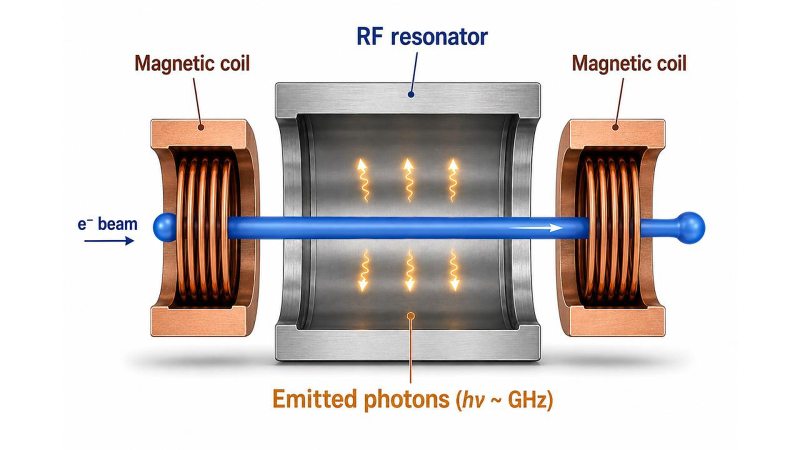
A twisted electron beam passes through two magnetic coils and radiates a photon in the detector area with no magnetic field. Credit: the paper’s authors
“An interesting aspect of our work is that it considers several geometric effects. We were able to connect the radiation produced by the electron to the geometry of its quantum state and its evolution as it passes through the magnetic system. This means that we were able to demonstrate that it’s a geometric effect and its parameters are determined, among other things, by the location and setup of magnetic lenses,” says Igor Shenderovich, a member of the team and a researcher at ITMO’s Faculty of Physics.

Igor Shenderovich. Credit: Dmitry Grigoryev / ITMO NEWS
According to the authors, the suggested framework can be tested in a transmission electron microscope, where the electron beam can be formed, passed through the magnetic system, and directed into a region with a microwave detector.
“This work is important primarily for fundamental physics. It helps understand how stable and controllable structured electron states are under conditions close to those of real laboratory setups. We were able to describe how a nonuniform field affects the life of an electron, which brings us one step closer to realism. Our work is an attempt to understand what quantum processes with twisted particles actually look like inside a real-world machine, such as an electron microscope or an accelerator,” adds Stanislav Baturin, the head of the study and a senior researcher at ITMO’s Faculty of Physics.

Stanislav Baturin. Credit: Dmitry Grigoryev / ITMO NEWS
In the future, the proposed theory will help clarify how the location and setup of magnetic coils affect the electron’s state: whether they will destroy the necessary beam structure or, conversely, help control it. In the future, this can be used for diagnostics: based on the frequency, direction, and intensity of microwaves, it would be possible to hypothesise on the quantum state’s initial conditions, its focus, and the orbital angular moment of electrons and other charged particles.