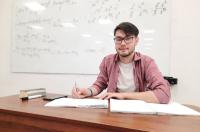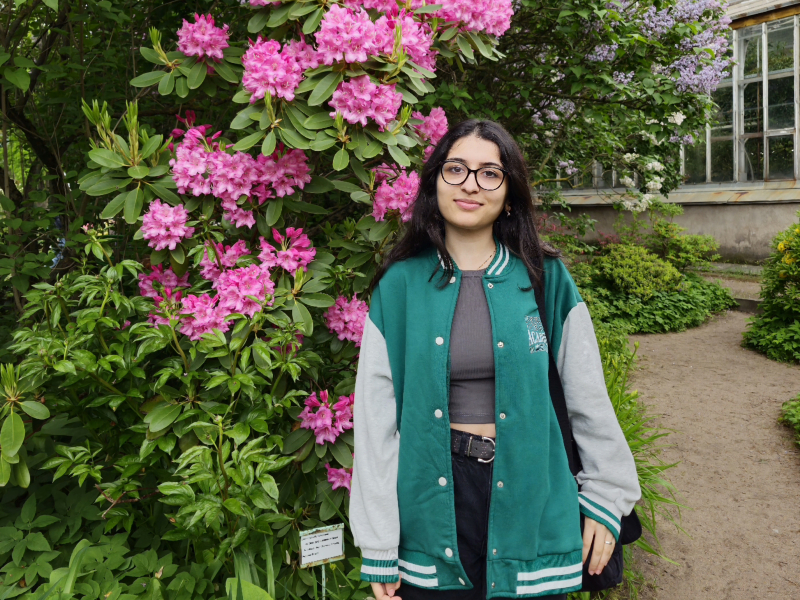
Hi Sinem! Please introduce yourself and tell us a little about your journey to ITMO.
Hi! I'm Sinem Aygün, a Turkish student currently living in St. Petersburg and preparing to start my Bachelor's in software engineering at ITMO University. My journey to ITMO began thanks to a friend’s recommendation. After hearing great things about the programs and opportunities here, I decided to take the leap of faith and apply. I’m so glad I did!
What made you decide to study abroad, and why did you choose Russia?
Studying abroad had always been a dream of mine. At the end of high school, I applied for scholarships in different countries, and out of all the options, Russia stood out – the culture, language, and geographical proximity to Türkiye were all major factors.
You’re currently learning Russian. How has the experience been so far?
I can describe it in just one word: rollercoaster. There have been so many ups and downs. I expected it to be hard, but not this challenging! Still, every day brings a new word or phrase that suddenly makes things click. I definitely mess up sometimes, but I’ve started to enjoy the process.
Do you have any funny or memorable stories from your Russian language learning journey?
Oh, definitely! When you're a beginner, funny moments are inevitable. One of my favorites is when my Russian friend was teaching me words to use at the bakery – rogalik, bulochka, pechenye, etc. Then he jokingly told me I could call pirozhki by a certain… inappropriate nickname, just for fun.
As a beginner, I didn’t realize he was joking, and that word stuck in my head the most. So every time I went to a bakery, I confidently asked, “Can you give me two [!@#$*%]?” People would laugh, and I thought it was just my accent. One day, a lady behind me in line kindly explained that it was actually a swear word. I was so embarrassed! But even now, every time I visit a bakery, I can’t help but laugh at the memory. At least I’ll never forget the correct name!
What strategies or habits have helped you improve your Russian outside the classroom?
Definitely listening to music and talking with native speakers. But you have to be careful – your native-speaking friend’s vocabulary will become your vocabulary, including their slang! Also, listening to music alone isn’t enough. I recommend writing lyrics in a notebook and translating them as much as you can. It really helps with memorization and comprehension.
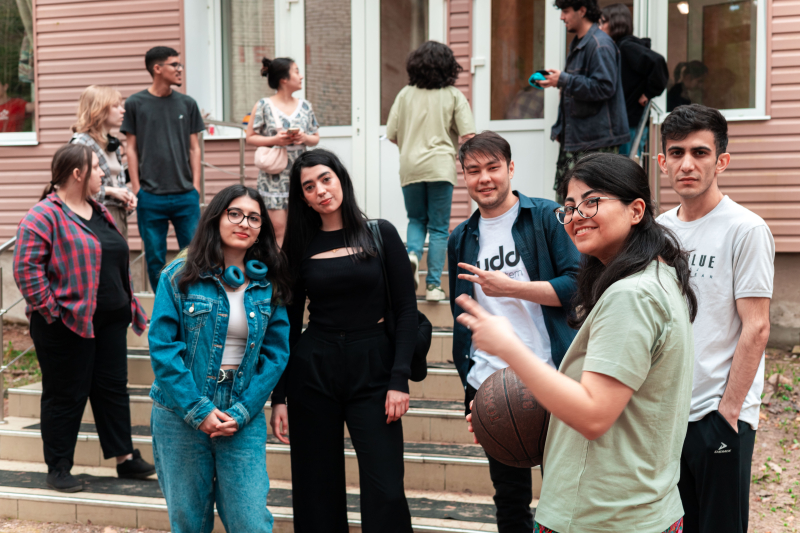
Sinem with her friends. Photo courtesy of the subject
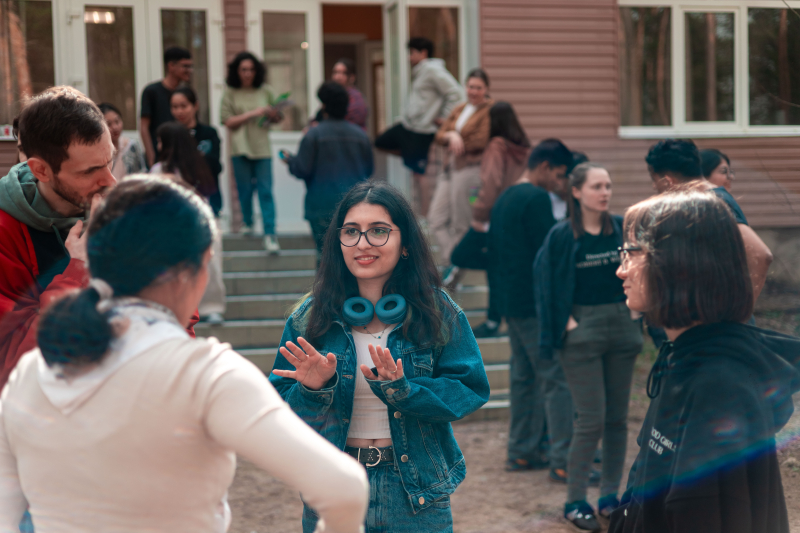
Sinem with her ITMO friends. Photo courtesy of the subject
You’ll be starting your Bachelor's in software engineering soon. What are you most excited about?
I’m really excited to dive into coding, build actual projects, and learn the skills I’ll need to work in tech. I’m especially looking forward to the creative side of front-end development, and eventually understanding how everything works together on the back end, too.
What inspired you to pursue software engineering?
Honestly, it all started with my high school informatics teacher. She noticed my curiosity and creative thinking, even though I wasn’t a huge fan of math at the time. Instead of pushing formulas, she encouraged me to explore how technology works and showed me how coding can be used to create real, useful things. That spark grew into a genuine interest. I realized software engineering was a field where I could keep learning, solve real problems, and build things that matter.
What’s been your impression of ITMO’s academic environment so far?
It’s very friendly, especially for international students. Most Russian students speak English; even if they don’t, they still try to help. The atmosphere doesn’t feel overly formal, which makes it easier for me to ask questions and engage with what I’m learning.
Have you connected with other international students at ITMO?
Yes! ITMO has a big and welcoming international community. I’ve met people from all over Asia, Europe, Latin America, and Africa. It’s been incredibly eye-opening to see different perspectives and learn about other cultures. We plan trips together, cook our traditional foods, and it feels like a second family.
As a Turkish student in St. Petersburg, how has it been adapting to Russian life and culture?
The biggest shock was how different the social life is. In Türkiye, people basically adopt you five minutes after meeting you. You walk into someone’s home, and suddenly you’re their “canım” (“my dear,” a Turkish term of affection – Ed.), your plate is overflowing with food, and their aunt is checking if you’re eating enough!
In Russia, people are more reserved at first. Random smiling or small talk isn’t really a thing. But once you break through that initial wall, the connections are deep and real. It’s not instant, but it’s sincere, and I really admire that. It’s helped me find a balance between the warm chaos of Turkish culture and the quiet authenticity of Russian life.
What’s your favorite place in St. Petersburg to relax, explore, or feel inspired?
Honestly, I want to say “anywhere in the city” because St. Petersburg is incredibly beautiful and full of character. Every street has something, whether it’s a cozy cafe, a quiet canal, or stunning architecture.
But if I had to choose one specific place, I’d say Kirov Central Park on Yelagin Island. It’s peaceful, green, and just far enough from the city buzz. It’s perfect for long walks, deep thoughts, or just doing nothing. Don’t forget to bring your tea and snacks – it makes everything better!
If you could introduce one Turkish dish or tradition to your classmates, what would it be?
Easy – çiğ köfte! It’s a spicy, meat-free dish made from bulgur, tomato paste, and a mix of flavorful spices. We eat it with greens, lemon, and pomegranate sauce, either wrapped in lettuce or lavash. But it’s more than just food – it’s a ritual. In Türkiye, eating çiğ köfte is a social event where everyone gathers, shares stories, and laughs. I’d love to bring that vibe here – it connects people, no matter where they’re from. And once you try it, you’re hooked!
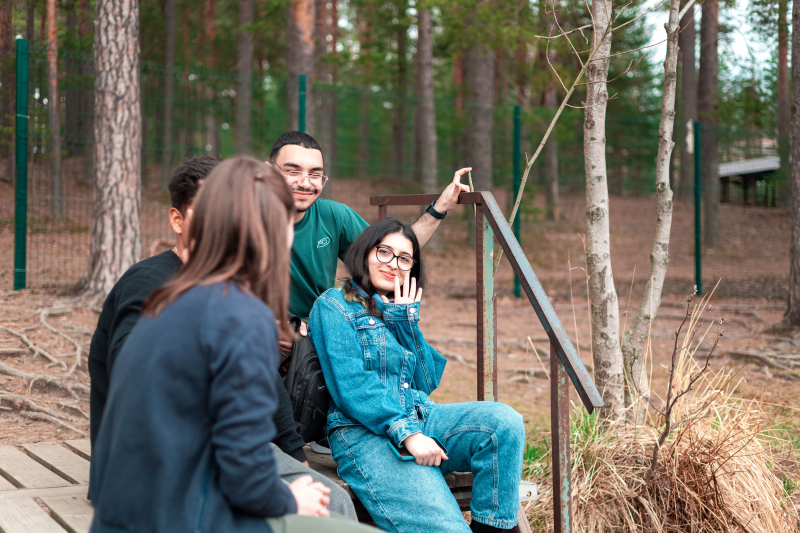
Sinem with fellow ITMO students at the university’s Yagodnoe outdoor camp. Photo courtesy of the subject
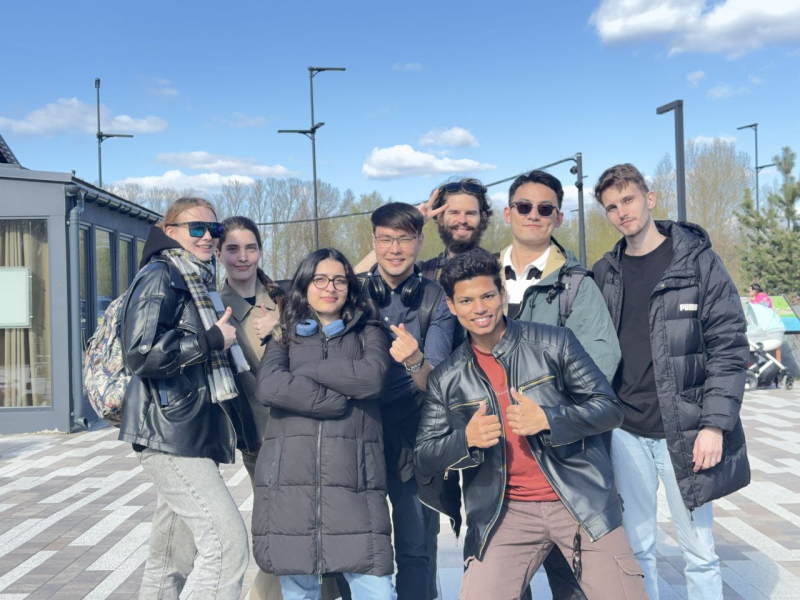
Sinem with her ITMO friends. Photo courtesy of the subject
What do you hope to achieve during your studies at ITMO?
I want to become a skilled developer who can build meaningful, user-friendly applications. Beyond that, I hope to grow as a person, become more independent, confident, and open-minded. I’d also love to work on international projects and maybe even build a career abroad one day.
Finally, what advice would you give to other students in Türkiye who are thinking about studying in Russia?
Go for it! Be ready to step out of your comfort zone. Start learning the language early – it makes a huge difference. And don’t be afraid to ask for help – people are often more understanding than you expect. Russia has so much to offer if you’re open to the experience.