
Please introduce yourself to our readers. What motivated you to pursue data science as your field of study?
Hello, I’m Pranay Shreshth from Motihari, a town in the East Champaran district of Bihar, India. Motihari is historically significant as the center of Mahatma Gandhi’s Champaran Satyagraha in 1917, his first movement of non-violent resistance in India. Growing up in a place so connected to India’s history of truth, courage, and resilience has always inspired me to pursue meaningful work.
I’m currently pursuing a B.Tech. in computer science and engineering with a specialization in data science and machine learning at Lovely Professional University (LPU), India. My motivation for choosing data science comes from my long-standing love for mathematics and my habit of analyzing patterns. I’ve always been fascinated by how numbers reveal human behavior and how data can help solve real-world problems. Over time, this curiosity grew into a passion for working in a field where logic, data, and impact come together.
What made you choose ITMO for your exchange semester? How did you first learn about the program?
I first learned about the exchange opportunity through LPU’s international program team. Around that time, my friend Manish Mishra also mentioned that he planned to apply for the same exchange at ITMO. Since our academic interests aligned, I felt encouraged to join him. ITMO stood out because of its strong reputation in AI, machine learning, and research-oriented education. I saw it as the perfect chance to experience a new academic system, learn in a different cultural environment, and challenge myself. Looking back, I’m very grateful that I made this decision.
You’re studying big data and machine learning at ITMO. What courses or topics have stood out the most so far?
Three courses in particular have made a big impact:
-
Machine Learning: it strengthened my foundations and boosted my confidence in applying algorithms practically.
-
Methods and Models for Multivariate Data Analysis: this course taught me how to work with complex datasets and understand relationships between multiple variables.
-
Emotional Intelligence (soft skills): this was completely new for me, since we don’t have such courses in India. It helped me understand emotions, develop self-awareness, and improve how I communicate and handle challenges.
Together, these courses not only enhanced my technical skills but also changed the way I approach problem-solving and decision-making.
How does the academic environment at ITMO compare to your experience at LPU?
The academic environment at ITMO is quite different from what I’m used to at LPU. The class sizes here are much smaller, which makes discussions with professors easier and creates a more interactive learning atmosphere. The evaluation system is also different. Instead of a fixed 100-mark format, ITMO uses a flexible points-based system that varies depending on the course. Another interesting difference is that not all subjects run for the entire semester. Some are short, intense courses that finish in a few weeks, allowing students to focus deeply on each topic.
The teaching approach here is highly practical and application-driven. Students are encouraged to implement concepts, work on real tasks, and engage with lab work rather than rely only on theory. The labs and facilities are excellent, which supports hands-on learning. Overall, ITMO feels more flexible, focused, and skill-oriented.
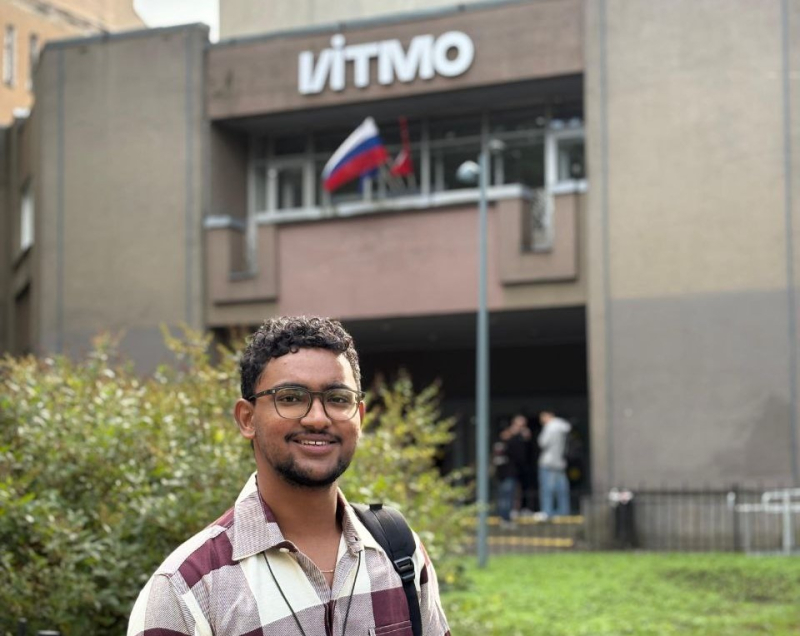
Pranay at ITMO’s Lomonosova campus. Photo courtesy of the subject
What was your first impression of the city and life at ITMO?
I arrived in St. Petersburg at the end of August, straight from the Indian summer, and the sudden drop in temperature surprised me immediately. Even before winter, the air felt cooler and lighter than anything I had experienced. The city itself was breathtaking. The architecture, wide streets, bridges, and canals made it feel like an open-air museum. Every corner seemed to hold a part of the city’s long history. By November, temperatures dropped below zero and it began to snow – something I had never experienced before. It was both exciting and challenging, and simple tasks like stepping outside suddenly required more preparation.
In contrast to the cold weather outdoors, campus life at ITMO felt warm and welcoming. From the first week, I felt supported. The friendly environment and calm pace helped me adjust much faster than I expected.
Have you noticed any cultural similarities or differences between student life in India and Russia?
There are definitely some similarities – students in both countries respect their professors, take notes attentively, and treat education seriously, which felt familiar to me. But there are differences too. Students in Russia are more confident about asking questions during lectures, and punctuality is taken very seriously. Daily life also feels more independent. Everyone manages their own schedule, meals, and responsibilities. The ITMO Buddy System played a huge role during my first weeks. They helped with documentation, campus processes, and basic adjustments. This support made the transition much easier. Food habits have also changed. Back home, I ate at the hostel mess; here, I cook for myself. Thanks to the spices I brought from India, my cooking skills have improved more than I expected!
I do miss festivals like Diwali and Durga Puja, especially the atmosphere and family time. I celebrated Diwali at the office of the Indian Consulate in St. Petersburg, which was comforting, but nothing can replace the feeling of home. Now, I’m excited to experience Christmas and New Year here for the first time.
What challenges have you faced while adapting to a new academic system and a new culture?
The biggest challenge has been adapting to the weather. Temperatures dropping below zero and snowfall were completely new to me. I’m slowly adjusting by dressing in layers and planning outdoor activities more thoughtfully. The language barrier was another challenge. Most people prefer speaking Russian, while I speak English and Hindi. Translation apps, basic phrases, and support from friends and buddies helped me navigate this. Patience and open-mindedness were key.
If you had to describe one moment that confirmed “Yes, choosing ITMO was the right decision,” what would it be?
The moment I received points for my final Python project was very meaningful to me. Since my classes started a bit late and the first weeks were filled with documentation work, I didn’t immediately feel like I was progressing. Seeing those points made me realize that I was finally contributing, learning, and achieving something here and it reassured me that I made the right choice.
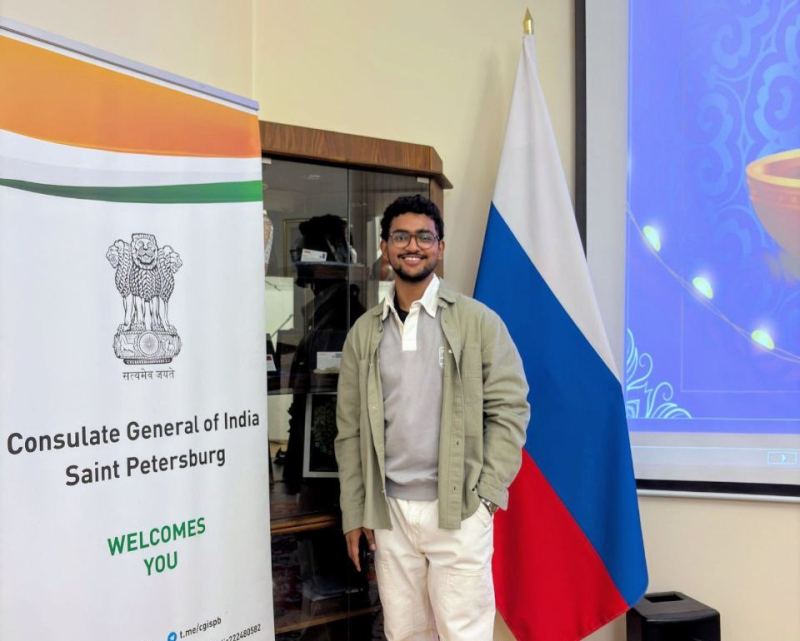
Pranay at the office of the Consulate General of India in St. Petersburg. Photo courtesy of the subject
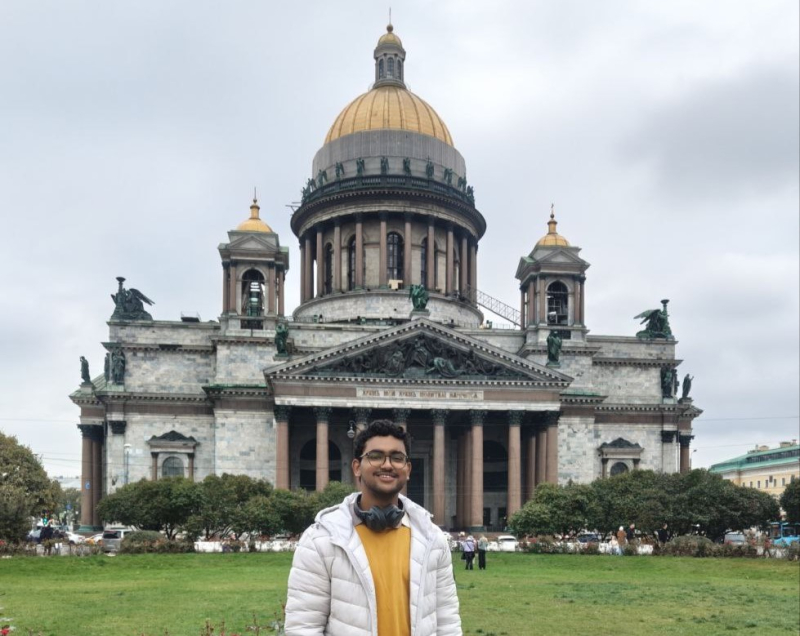
Pranay at St. Issac’s Cathedral in St. Petersburg. Photo courtesy of the subject
What are your career goals after completing your B.Tech.? Would you consider returning to ITMO for a Master’s degree?
After completing my B. Tech., I want to start my career in data science, machine learning, or artificial intelligence to gain industry experience and understand how large-scale data-driven projects work. This will help me refine my focus before pursuing my next degree. I definitely plan to pursue a Master’s in the future because I believe in continuous learning. A strong foundation in both industry and academics will give me more confidence and clarity. Getting a good job is not just about career growth for me, it’s also about making the people who believe in me proud: my family, mentors, and close friends. Their support motivates me to stay focused and put in my best effort every day.
Finally, what advice would you give to Indian students who are considering an exchange or full-time degree at ITMO?
My advice is simple: go for it without hesitation. Opportunities like this can transform your perspective. Living and studying in a new environment teaches independence, adaptability, and confidence. You learn not only from classes, but from people, challenges, and everyday experiences. If you get the chance – take it. It is absolutely worth it.