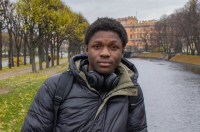
Please introduce yourself to our readers.
My name is Oludotun Fawole, and I’m a second-year Bachelor's student studying mechatronics and robotics at ITMO University. I’m originally from Oyo State in southwestern Nigeria.
What first sparked your interest in robotics?
Growing up, I’ve always been curious about how things work. I loved mathematics and spent a lot of time working on small projects at home, trying to build things. My early experiments were in programming and electronics, especially with Arduino. Over time, that curiosity developed into a strong interest in robotics and intelligent systems. I love how robotics brings together engineering, mathematics, and computer science.
If you could build any robot without limitations, what would it do?
I would build a robot that captures my thoughts and turns them into something clear and structured. For me, thoughts are shaped by experiences, conversations, and interactions, so I’d want a system that quietly documents those moments and connects them. It would help me understand how my ideas form and evolve over time.
I’m also fascinated by the idea of “uploaded intelligence,” where knowledge can be preserved, expanded, and accessed seamlessly. So, this robot would not just store information, but also organize it into something meaningful, almost like an extension of my thinking. The goal wouldn’t be to replace my mind, but to understand and use it more effectively.
What’s been the most exciting project you’ve worked on so far?
It’d be the project on the concept of an intelligent study assistant for international students. It’s designed to simplify complex academic materials, especially in Russian, into clearer, more understandable formats without losing their core meaning.
The idea came from my own experience as a foreign student, where the challenge isn’t just in understanding concepts, but also dealing with scattered information across lectures, chats, and materials. I expanded this into a system that can connect to platforms like Telegram group chats, extract important information, and organize it into structured summaries, such as deadlines, announcements, and key study points. It also uses AI to process lectures, notes, and conversations, offering features like summarization, translation, and adaptive explanations. What excites me most is that it solves a real problem I face daily. I see it evolving into a powerful tool that can genuinely help international students study more effectively.
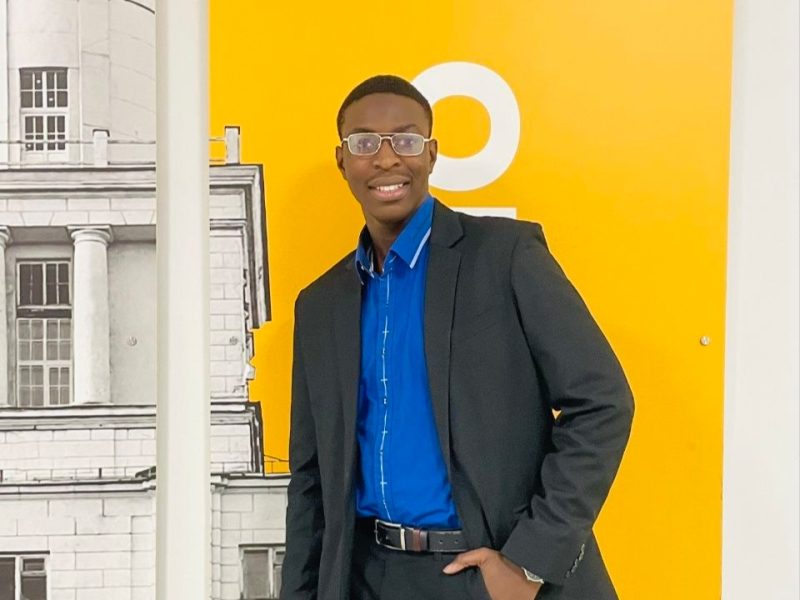
Oludotun at ITMO. Photo courtesy of the subject
How would you describe the learning environment at ITMO?
It is engaging, immersive, and combines lectures with practical classes, which helps connect theory to real-world applications, especially in engineering and robotics. I also appreciate the flexibility – at the beginning of the semester, students can choose schedules that suit them. This makes it easier to manage time and learn at your own pace.
Has anything about studying robotics here surprised you?
I am pleasantly surprised by how mathematically intensive my program is. I’ve always enjoyed math, but the depth here is greater than I expected. We still do a lot of programming, but it feels more like an extension of mathematics, focused on problem-solving.
What does a typical day look like for you as a robotics student?
It includes lectures, programming tasks, and solving mathematical problems. I spend a lot of time watching technical tutorials, preparing lab work, and writing reports. It’s a good balance between theory and hands-on work.
How do you usually relax and recharge outside your studies?
I enjoy playing chess. I could spend an entire day on it! I also like reading about psychology, communication, and human behavior. It’s a great way to relax while exploring ideas beyond my technical field.
What has been the most interesting cultural difference you’ve experienced since moving from Nigeria?
At first, not understanding the language made everyday life and studying quite challenging. As I became more comfortable with Russian, I started noticing differences in communication and social dynamics. In Russia, interactions tend to be more direct and structured, compared to the expressive and socially warm style in Nigeria. It felt unusual at first, but over time I came to appreciate it as a different way of expressing ideas.
Have you discovered any favorite Russian foods?
Yes, I’ve grown to enjoy several Russian dishes, especially the soups. Trying new food has been a fun part of adapting to life here.
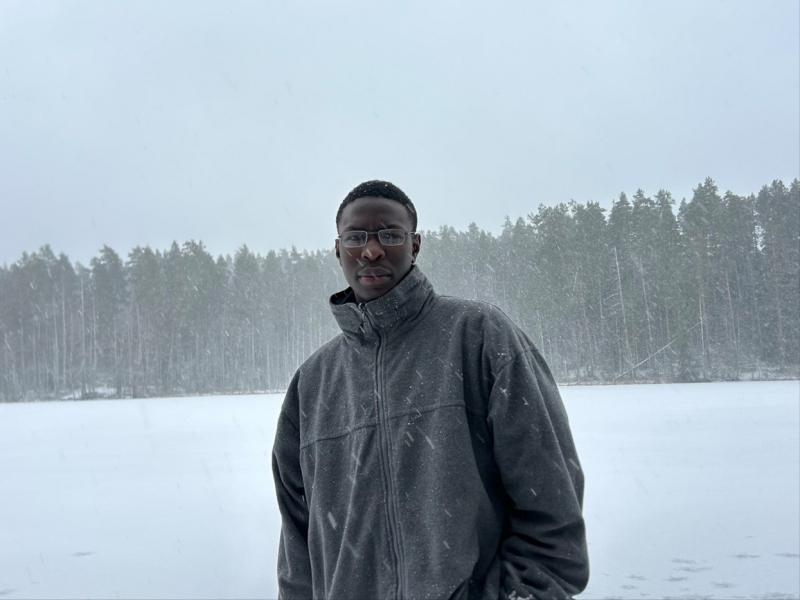
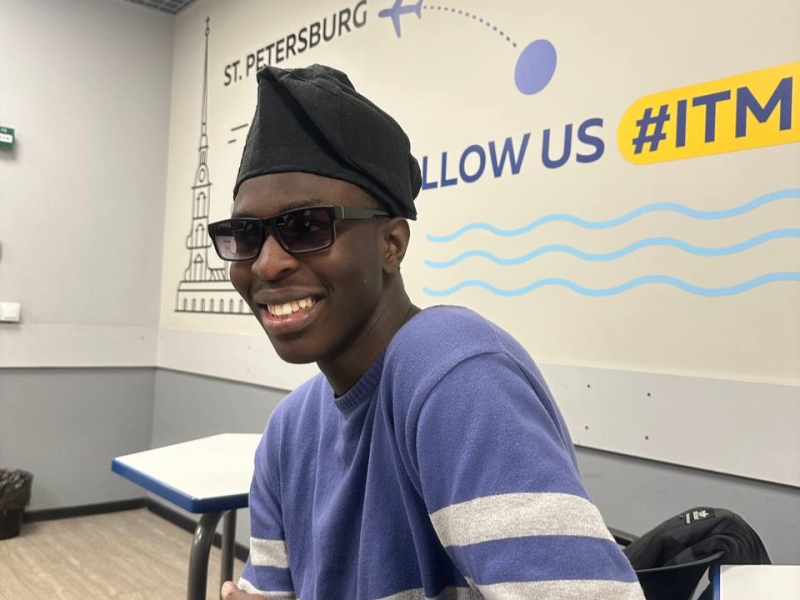
Oludotun during the winter at Yagodnoe. Photo courtesy of the subject
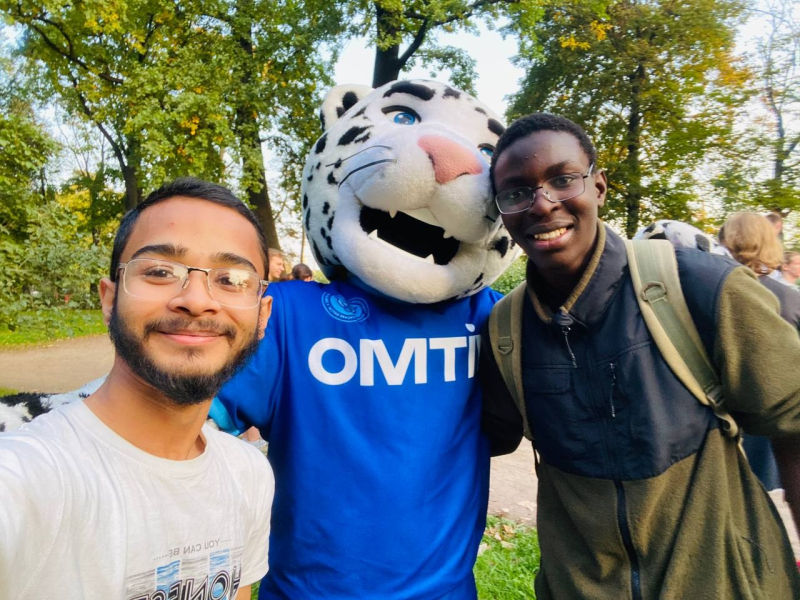
Oludotun with his friend and ITMO KronBars mascot Tim the snow leopard. Photo courtesy of the subject
If your personality were a robot, what would it be like?
It would be an explorer robot, curious, logical, and highly efficient. It would approach everything with precision, constantly learning and improving over time. It would analyze systems carefully, solve problems effectively, and enjoy experimenting with new ideas and challenges.
Is there any sci-fi idea or film that inspires your work?
I’m not much of a movie person, but Iron Man is definitely inspiring to me. The idea of a wearable suit that enhances human abilities using AI, robotics, and real-time problem-solving really resonates with my interest in building tools that help people think and act more effectively.
What advice would you give to students who want to study robotics at ITMO?
Start small and start now. Learn the basics, especially programming, like Python, and experiment with Arduino or simple electronics projects. Use free online resources, join communities, and participate in hackathons. Robotics is a broad field, so explore different areas and find what excites you most. Most importantly, be patient and persistent. The learning curve can be steep, but it’s absolutely worth it.