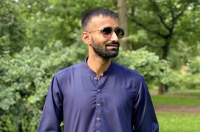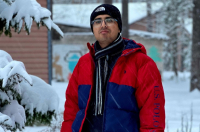
Please tell us a bit about yourself
My name is Umer Ahmed Baig Mughal, and I’m pursuing a Master’s in robotics and AI at ITMO’s Faculty of Control Systems and Robotics.
I come from Hyderabad, in southern Pakistan. It’s known for its rooftop wind-catchers that channel cool river breezes into homes. Those ancient “air conditioners” taught me something early: engineering is about solving real human problems with what you have. Summers there often exceed 45°C, so St. Petersburg’s climate has been quite a change!
What sparked your interest in robotics and AI?
Robots weren’t my first attraction, electronics were. I loved how sensors could measure the world and controllers could influence physical systems. But eventually I became fascinated by one question: between sensing and acting, what actually decides? How does a machine decide what data means, choose its next action, or adapt when conditions change?
Those questions led me to AI. Robotics excites me because it sits at the intersection of the physical and digital worlds.
Before coming to ITMO, you already had some experience in the industry. What led you to resume your studies?
After years in industry managing R&D and quality control, I had experience but lacked perspective. Industry solves immediate problems; research asks whether you’re solving the right ones. I wanted both.
What excites you most about the direction of robotics and AI?
For decades, industrial robots thrived in predictable, structured factories. Now, advances in perception and machine learning let machines operate in the real world. My research is in autonomous inspection systems: robots that are continuously monitoring bridges, tunnels, and power facilities to identify risks before failures happen.
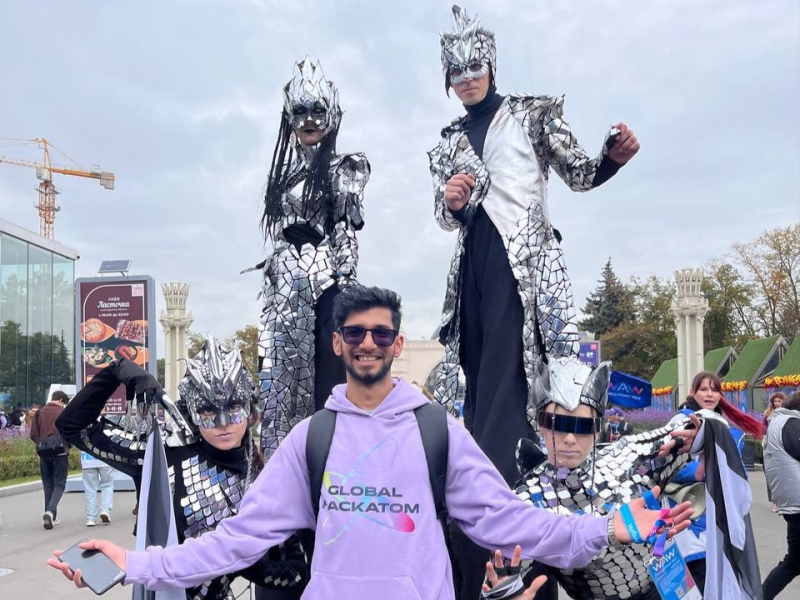
Photo courtesy of the subject
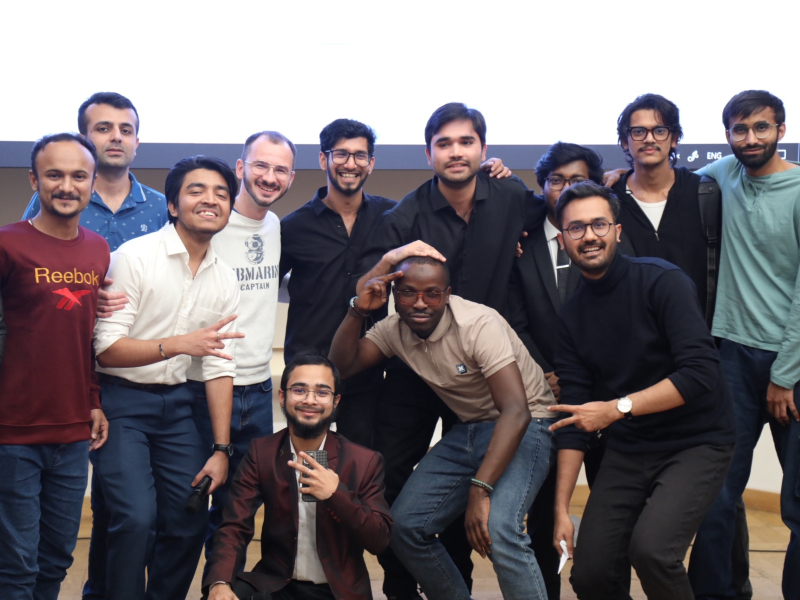
Umer with his friends at ITMO. Photo courtesy of the subject
What’s the most valuable lesson you’ve learned thus far?
That engineering is about trade-offs. We often search for the “best” algorithm, but every choice involves compromises – accuracy vs. speed, performance in one environment vs. another. Working on autonomous navigation taught me that success comes from integrating imperfect components into a reliable system.
What’s a common misconception about AI or robots?
That AI is on a direct path to human-like intelligence. AI isn’t becoming more human; it’s becoming more useful at specific tasks. Machines excel at pattern recognition; humans are better at reasoning under uncertainty and understanding context. The future is about combining them effectively, not replacing one with the other.
How would you describe the academic atmosphere at ITMO?
Intellectually demanding but highly supportive. Curiosity is treated as a professional obligation, not a personality trait. You’re expected to ask questions, and discussions regularly move beyond the syllabus into open research problems. Coming from industry, this was exactly the environment I needed to grow as both an engineer and a researcher.
What was the biggest cultural adjustment moving from Pakistan to St. Petersburg?
Learning to be comfortable with uncertainty. Starting from scratch in a new country means that even simple tasks require learning something new. At first, it felt like solving dozens of small problems daily. But those challenges became invaluable: they taught me adaptability and independence.
What surprised you most about student life in Russia?
That the most valuable learning often happens outside the classroom. Through ITMO, I participated in the ObninskTech Winter School and Summer University (with Rosatom and MEPhI), World Atomic Week in Moscow, and the Global HackAtom championship. My team won first place in the Engineering Hackathon and third in the Winter School edition.
What struck me was the subject matter: nuclear technology, energy systems, fields entirely outside my research. But that was the point. Modern engineering challenges don’t respect disciplinary boundaries. Collaborating across them may be the most important skill a researcher can develop.
Congratulations on those achievements! Have you found any favorite places in St. Petersburg?
My favorite routine is walking along the canals and bridges at dusk, when the light turns golden on the water. To escape the urban density, I discovered the Gulf of Finland coastline, Komarovo, Kotlin Island, Solnechnoye, quiet and wide. Additionally, Igora Drive, a world-class motorsport complex, was a fascinating surprise!
How do you relax or recharge when not studying?
By shifting into a completely different type of thinking, like reading outside my research area or traveling. Some of my clearest insights have come while walking in unfamiliar places, not while working. My brain needs novelty like a compass needs open space! I also spend time with friends, explore the city, and occasionally join innovation competitions.
What do you miss most from Pakistan?
The texture of daily life. In Pakistan, human connection is part of everyday life – unscheduled visits, spontaneous conversations, evening chai with friends. Relationships are maintained through presence, not scheduling. And the food. There are flavors inseparable from specific memories and people. No restaurant abroad has replicated them.
What keeps you motivated in such a fast-moving field?
Watching how quickly the world is changing. In two years, I’ve seen extraordinary advances in AI and robotics. Technologies that seemed futuristic are now practical tools. Meeting researchers and students from many countries reminds me that innovation is driven by curious people who refuse to accept that any current version is the final version.
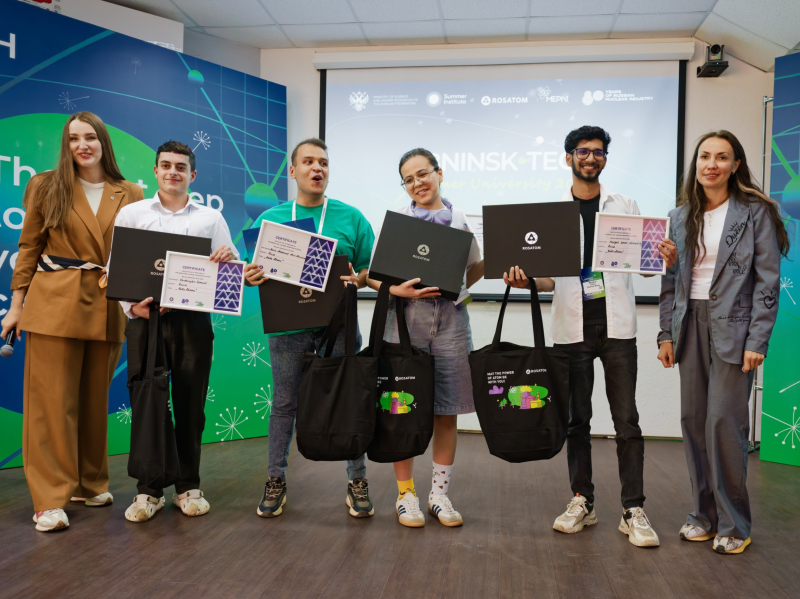
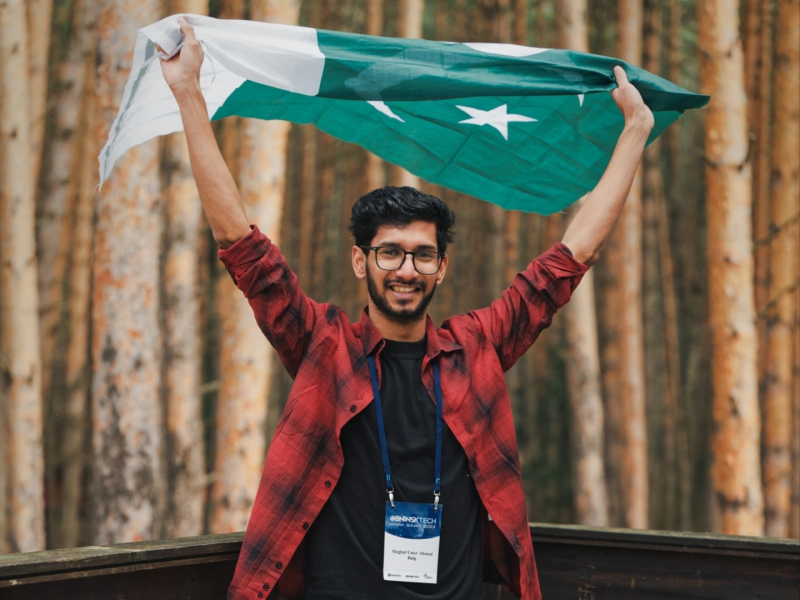
Omar at the ObninskTech Winter School. Photo courtesy of the subject
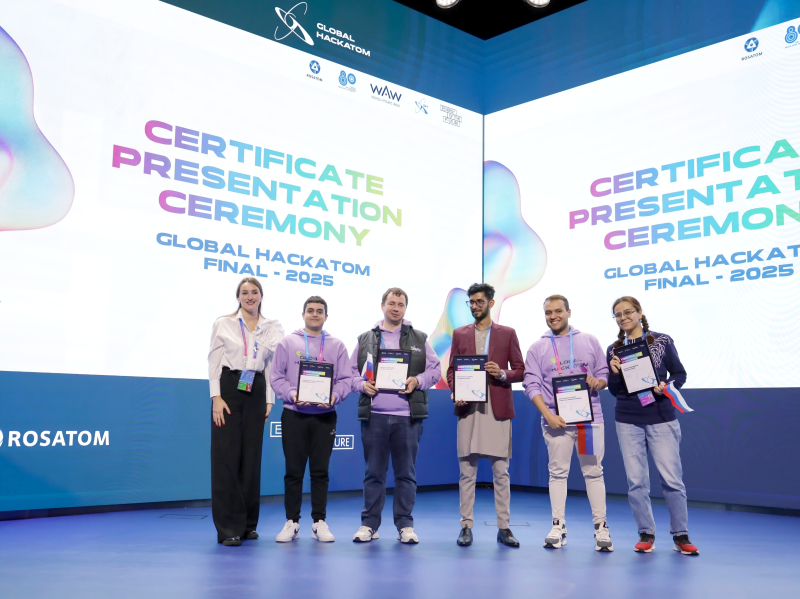
Omar at the Global Hackatom Final 2025, organized by Rosatom. Photo courtesy of the subject
What advice would you give to Pakistani students considering robotics and AI at ITMO?
There are three things I wish I’d known before. I’d like to share them with the readers.
First, be honest about why you want this. This field demands genuine curiosity, tolerance for failure, and patience. If you’re here because it’s trending, you’ll struggle. If you care about these problems, you’ll thrive.
Second, bring solid technical foundations. ITMO will challenge you at the research level. It won’t rebuild your math or programming from scratch. Come prepared.
Third, treat the whole experience as education. The city, the people from 40+ countries, the seminars on unfamiliar topics, the discomfort of a new life in a foreign language, all are a part of the process. Students who get the most from ITMO are as intentional about learning from the environment as from the curriculum. If you’re curious, disciplined, and willing to embrace uncertainty, ITMO can help you grow as an engineer, researcher, and global professional.